




11 Best Product Design Agencies for Startups in 2026


Key takeaways:
- "Product design" means two incompatible things. For software startups it is interface and experience work; for hardware startups it is industrial design, enclosures and design for manufacture.
- The hardware side is a far smaller market. Federal labor data counts just 2,874 industrial design establishments in the entire United States, against 20,052 graphic design firms.
- Stage decides the hire more than budget does. Pre-seed teams need someone who can ship weekly; Series A teams need someone who can build a system that survives new hires.
- Ask a hardware firm who owns the CAD files and whether it takes a cut of tooling. Ask a software firm who implements the design.
Startups get product design wrong in a specific and expensive way: they hire for the artifact instead of the stage.
A pre-seed team commissions a polished design system it will throw away after two pivots. A Series A team hires a scrappy generalist and then discovers nobody documented anything, so the three designers hired afterward each invent their own patterns.
The eleven firms below cover both software and hardware, and the two groups have almost nothing in common commercially. We're first, and we say plainly which of these situations we are wrong for.
Software product design and hardware product design are different purchases
If you are searching for product design agencies as a hardware startup, most of what you find will be irrelevant, because the category is dominated by software.
Software product design covers user research, information architecture, interface design, prototyping and design systems. The deliverable is a Figma file plus documentation, the feedback loop is days, and a mistake costs a sprint.
Hardware and industrial design covers form, ergonomics, materials, mechanical layout, design for manufacture and assembly, tooling, and regulatory or certification constraints. The deliverable is CAD, prototypes and a manufacturing package, the feedback loop is weeks, and a mistake caught after tooling costs tens of thousands of dollars and months.
The market sizes tell the story. Federal data counts 2,874 industrial design establishments in the United States, employing about 19,700 people at an average annual wage of $127,038, with California holding 512 of them and Texas, Florida, New York and Michigan following. Against 20,052 graphic design firms, industrial design is a specialist trade with roughly one seventh the supply.
That scarcity has practical consequences for a hardware startup. The good firms are booked, they cluster in a handful of metros, and they will ask about your manufacturing plan on the first call, because form decisions and factory decisions are the same decision.
Some firms genuinely do both, but treat that claim skeptically. A studio that builds beautiful interfaces is not automatically equipped to specify a snap-fit enclosure for injection molding.
What stage you are at decides who to hire
Budget is the obvious filter and usually the wrong one. Stage predicts fit better.
Pre-seed and pre-product needs speed and range over process. What matters is someone who will produce a working prototype this month, not a research program. Heavy discovery here is often a way of avoiding the fact that nobody knows who the user is yet.
Seed and early product-market fit needs iteration capacity. The product changes weekly, and the constraint is throughput plus the judgment to keep it coherent while it moves.
Series A and beyond needs systematization. This is when a design system stops being over-engineering and starts being the thing that lets you hire three designers without producing three products. It is also when hardware startups face design for manufacture in earnest.
Matching the firm to the stage is the whole game. A strategy-led studio running an eight-week discovery for a pre-seed team is burning runway on certainty it cannot yet have. Our take on hiring a product design agency works through when the answer is genuinely no.
The 11 best product design agencies for startups
The table separates software from hardware, since that is the first fork in the decision. Each location was taken from the firm's own website rather than a directory.
| Firm | Type | Best for | Based in | Pricing |
|---|---|---|---|---|
| Awesomic | Software | Continuous design without a hiring cycle | San Francisco, CA | From $1,490 monthly |
| thoughtbot | Software | Design and engineering in one team | Distributed, US-founded | Quote only |
| VAULT | Software | Design and build in one team, US timezone | Chicago, Illinois | Quote only |
| Significa | Software | Design plus development for products | No public address | Quote only |
| Krootl | Software | Web and mobile app builds | No public address | Quote only |
| Whipsaw | Hardware | Award-level industrial design | San Francisco, CA | Quote only |
| Astro Studios | Hardware | Consumer hardware with strong brand | San Francisco, CA | Quote only |
| Bould Design | Hardware | Restrained, product-led industrial design | San Francisco, CA | Quote only |
| Synapse | Hardware | Engineering-heavy products to production | Seattle, WA | Quote only |
| Simplexity | Hardware | Complex electromechanical development | Berkeley and San Diego, CA | Quote only |
| Nectar Product Development | Hardware | User-centered hardware design | Long Beach, CA | Quote only |
Three of the software firms publish no address at all, and one identifies a Polish operating entity. The table says exactly that rather than implying a US presence none of them claims.
1. Awesomic
Best for: software startups whose design needs change faster than a hiring process can.
Startups rarely fail at design because the design was bad. They fail because design became a bottleneck: one contractor with a queue, or a hire who took four months to land and left after nine.
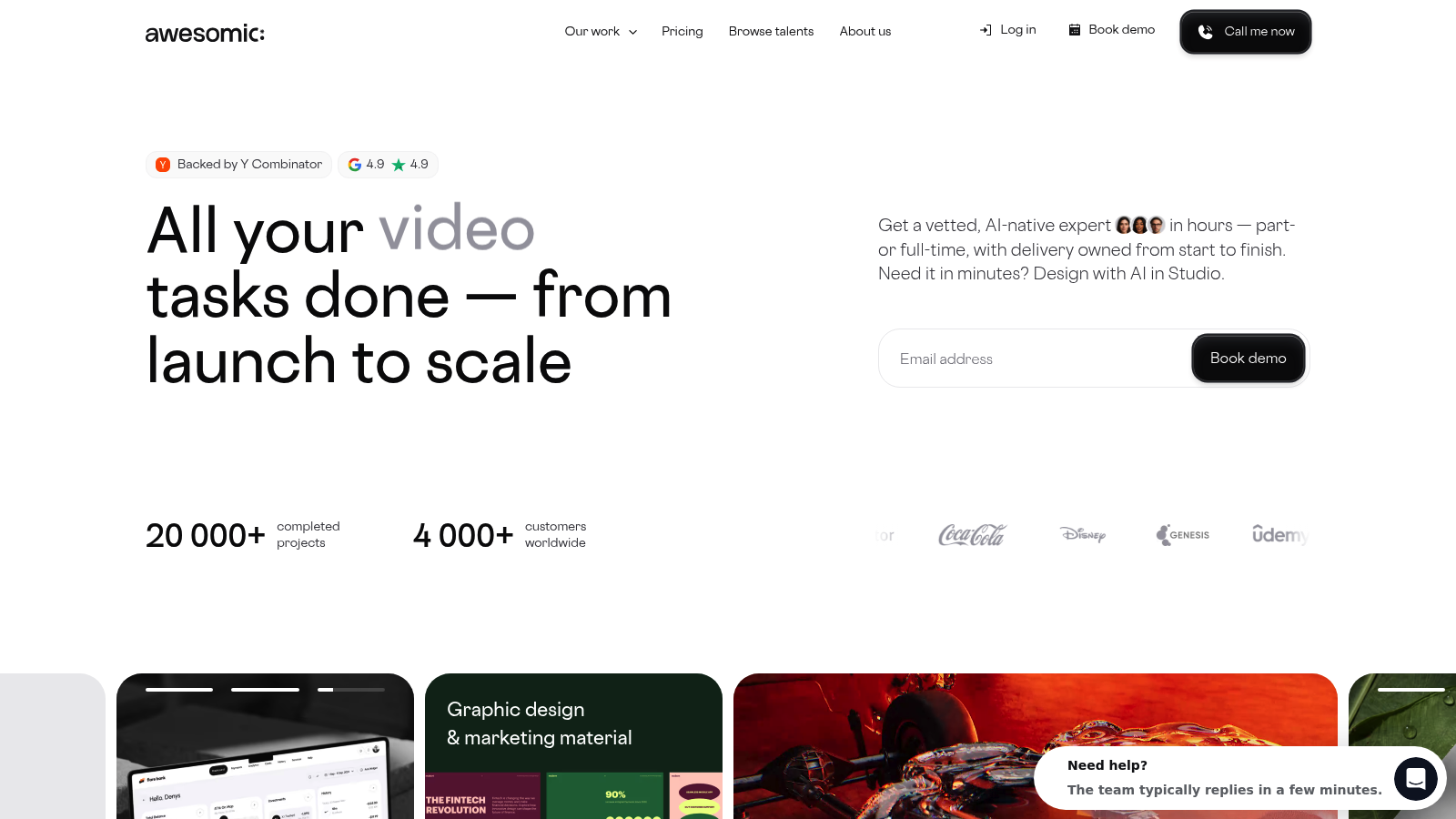
Awesomic replaces that with a subscription. Post a task, get matched with a vetted specialist within hours, iterate with revisions that are not capped, and scale active tasks up or down each month. Product design sits with brand, web, motion and copy on the same plan, which suits a startup where the same week needs an onboarding flow, a pricing page and an investor deck.
MemoryOS is the case we point to. The US ed-tech startup, co-founded by two-time World Memory Champion Jonas von Essen, built a gamified memory-training app. We took their screen drafts and rebuilt the UX and UI, improving navigation, decluttering the interface, giving the important elements a more distinctive and playful treatment, and replacing the original Red Hat Text typeface with something more readable.
We also made the visuals for the Kickstarter campaign page, the App Store listing and social. That campaign went on to become the most funded app in Kickstarter's history as of July 2021, with backers pledging $642,014 in roughly a month.
Worth being precise about: the product and the campaign earned that result. Our part was making the thing legible and appealing enough to carry it.
Services: UX and UI design, product and app design, design systems, prototyping, web design and no-code build, brand identity, pitch decks, illustration and motion.
Pricing: Graphic Pack is $1,490 monthly and All-in-One $2,995, the latter adding no-code development, copywriting and QA. Committing quarterly across three months reduces those to $1,190 and $2,396. Dedicated Talent, a full-time designer plus a PM, is priced on request.
Proof: upwards of 20,000 delivered projects, more than 4,000 client companies, a 4.9 score on Trustpilot and the same on Google Play, one applicant in roughly 120 accepted onto the talent roster, and Y Combinator backing.
Where we are wrong: we do not do hardware. No CAD, no enclosures, no design for manufacture, no tooling. If you are building a physical product, hire one of the seven industrial design firms below. We can do the brand, the app and the campaign around it, but not the object itself. Our case studies show the range honestly.

2. thoughtbot

Type: software.
thoughtbot has worked with startups for a long time, combining product design with engineering in the same team rather than handing designs across an organizational wall. It operates as a distributed consultancy with deep roots in the Ruby and web development communities.
For a founding team without engineering leadership, that pairing removes the most common failure point, which is a design nobody can build as drawn.
Services: product design, web and mobile development, product strategy, team training.
Why buyers shortlist it: design and implementation under one contract, so the handoff is internal rather than yours to manage.
3. VAULT

Type: software.
VAULT, which trades as Vault Innovation Group, is a Chicago software company founded in 2012 that runs discovery, product design and engineering as a single practice rather than a sequence of handoffs.
Its case studies are the startup kind rather than the enterprise kind: a breathing-coaching product taken from idea to 10,000 sign-ups, and a cannabis supply platform it credits with helping raise $4.5M. Its founder is active in the Chicago startup scene through TechNexus, 1871 and LongJump, which matters if introductions are worth as much to you as the build.
Services: product discovery, UI/UX design, prototyping, custom software and mobile development, AI and machine learning implementation.
Where it fits: founders who want the people drawing the screens to be the people shipping them, in a US timezone, and who do not need a hundred-person bench.
4. Significa
Type: software.
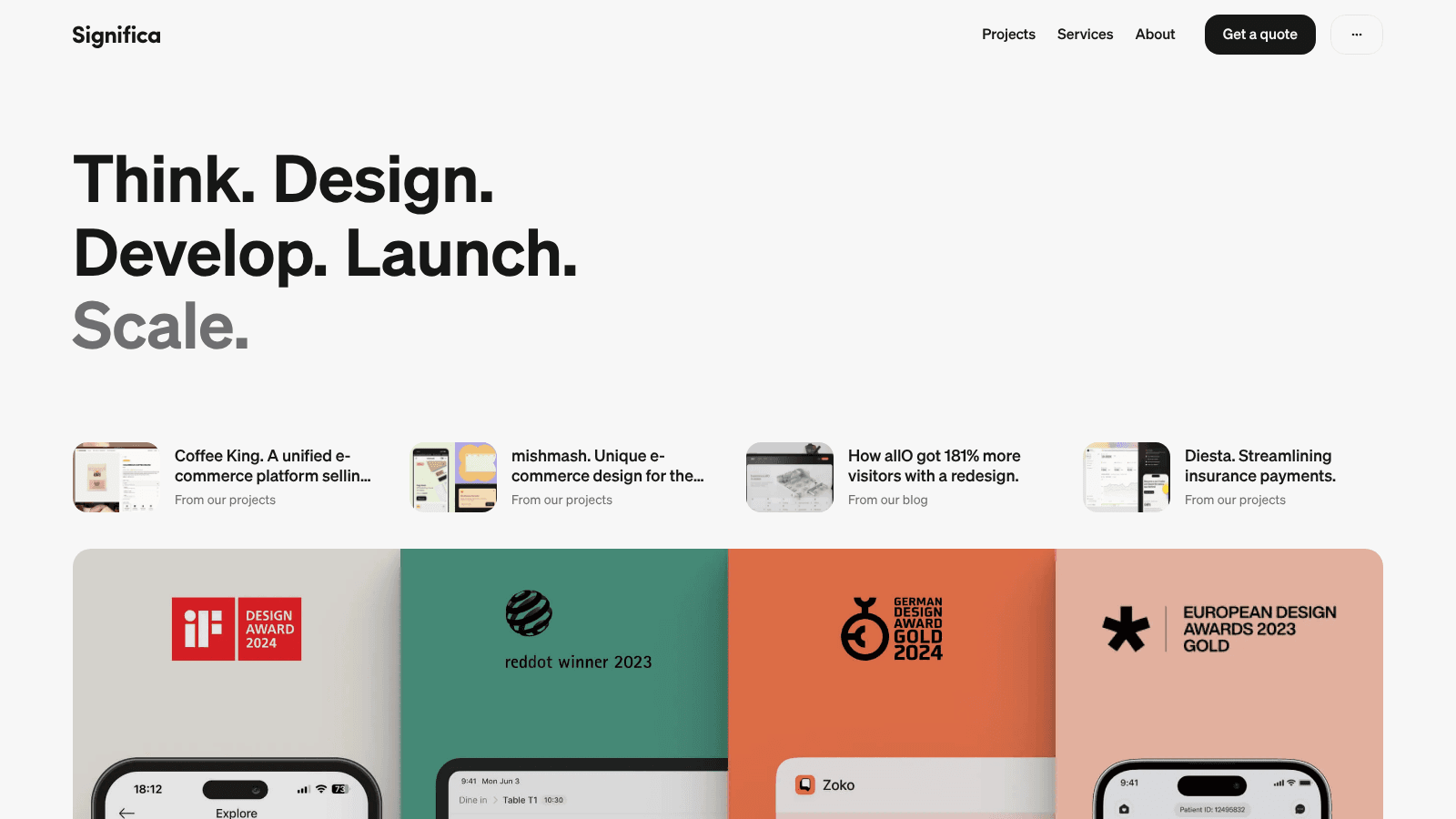
Significa positions as a digital product design and development agency, covering the range from interface design through to shipped software. Its site refers to an office but publishes no address for it, so we make no claim about where the team sits.
Its work leans toward well-crafted product interfaces rather than marketing sites, which is the right emphasis for a startup whose product is the marketing.
Services: product design, UX and UI, web and mobile development, branding.
Its real strength: design and build together at a scale where senior people remain on the project.
5. Krootl

Type: software.
Krootl works across web and mobile app design and development for startups and growing companies. It publishes no office address.
It sits at the more accessible end of this list, which suits early teams that need competent execution rather than a name.
Services: web and mobile app design, development, MVP builds, UI and UX.
Where it fits: early-stage teams needing an MVP designed and built without a studio's minimum engagement.
6. Whipsaw

Type: hardware.
Whipsaw works from Mississippi Street in San Francisco and is among the most recognized industrial design firms in the country, covering product design, brand and digital experience across consumer and medical categories.
It is a premium hire, and the right one when the object itself has to carry the brand.
Services: industrial design, mechanical engineering, brand, user interface, design research.
Why buyers shortlist it: a track record across consumer hardware categories that very few firms can match.
7. Astro Studios

Type: hardware.
Astro Studios operates from 6th Street in San Francisco's SoMa district, with a portfolio spanning consumer electronics, gaming hardware and sports products.
Its strength is products where industrial design and brand identity are the same conversation, which describes most consumer hardware launches.
Services: industrial design, brand strategy, packaging, product graphics.
Where it beats the alternatives: consumer hardware that has to look like something on a shelf and in an unboxing video.
8. Bould Design

Type: hardware.
Bould Design is a San Francisco industrial design studio known for restrained, product-led work, and for having shaped several well-known connected consumer devices.
It is deliberately small, which means senior attention throughout and limited concurrent capacity. Approach early if the timeline matters.
Services: industrial design, product development support, design research.
Its real strength: restraint. Its work tends to age well rather than photograph well once.
9. Synapse

Type: hardware.
Synapse works from 6th Avenue in downtown Seattle and is an engineering-led product development firm, taking complex hardware from concept through to production rather than stopping at industrial design.
For a startup whose risk sits in whether the thing can be built at all, that emphasis is the correct one.
Services: product development, mechanical and electrical engineering, industrial design, manufacturing transfer.
Where it fits: technically demanding hardware where engineering feasibility is the real question.
10. Simplexity Product Development
Type: hardware.
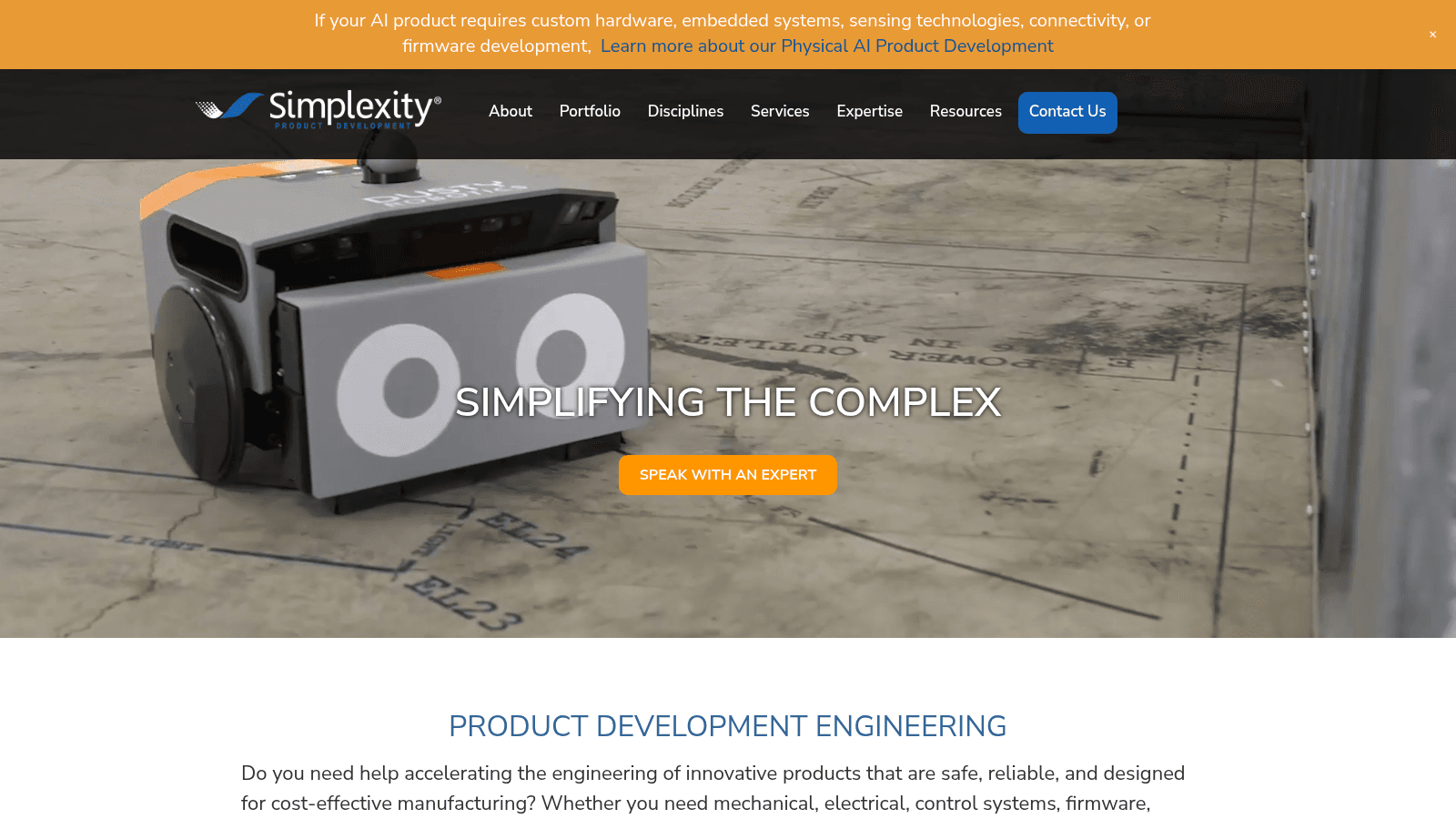
Simplexity is an engineering-first product development firm operating from Berkeley and San Diego, with additional presence in the Pacific Northwest, specializing in complex electromechanical systems.
The name is the philosophy: reducing mechanism count and complexity, which is what makes a product manufacturable at a price that works.
Services: mechanical and electrical engineering, embedded software, industrial design, design for manufacture.
Where it fits: products with motors, sensors and moving parts, where the engineering is the hard part.
11. Nectar Product Development

Type: hardware.
Nectar Product Development works from Gladys Avenue in Long Beach, California, combining industrial design with usability and user interface work under a user-centered design practice.
Its emphasis on usability testing for physical products is less common than it should be, since hardware mistakes are considerably harder to patch than software ones.
Services: industrial design, usability and human factors, user interface design, engineering support.
Why buyers shortlist it: it tests physical products with users before tooling, which is exactly when finding problems is still cheap.
What product design costs a startup
Software and hardware price on different logic, so the table splits them.
| Engagement | Typical cost | What you're buying |
|---|---|---|
| Software: MVP design project | $15,000 to $60,000 | Research, flows, screens, prototype |
| Software: design plus build | $60,000 to $250,000 | Designed and shipped product |
| Software: design subscription | From $1,490 a month | Continuous capacity, no per-project scoping |
| Hardware: industrial design phase | $30,000 to $150,000 | Concepts, CMF, CAD surfaces, prototypes |
| Hardware: design through production | $150,000 to $1,000,000+ | Engineering, DFM, tooling support, testing |
Hardware's range is wider because tooling is a separate capital cost that dwarfs the design fee. Injection mold tooling alone routinely runs into six figures, and it is committed after design is frozen, which is precisely why hardware firms front-load engineering rigor that software teams find excessive.
For a sense of the labor market underneath these numbers, federal figures put the 2024 median wage for industrial designers at $79,450, against an average annual wage of $127,038 across industrial design services establishments, which reflects how senior and specialized agency-side staffing tends to be. Budgeting for design at an early stage is covered in more depth in our guide to design budgets for startups.
Questions to ask before you sign
Six questions separate a good fit from an expensive one:
- Who exactly works on this, and are they the people in this meeting?
- What happens if we pivot in month two, and how is that priced?
- Who owns the source files, the CAD and the design system when we finish?
- For hardware: do you take any margin on tooling or manufacturing?
- For software: who implements the design, and what does the handoff look like?
- What is the smallest useful engagement you offer?
Question four matters more than it appears. Some hardware firms make part of their revenue on the manufacturing relationship, which is not improper but is a conflict of interest you should know about before you agree a factory. Question three is the one founders most often skip and most often regret, particularly with CAD, which is worthless to you if you cannot open or transfer it.
Question six is the practical one for early teams. Many strong firms have minimums well above a pre-seed budget, and finding that out in week three wastes runway. The different shapes these engagements take are set out in our overview of types of product design.
Choosing at your stage
If you are pre-seed and building software, buy capacity rather than process. A subscription or a small studio that ships weekly will serve you better than a discovery engagement, and our comparison of product design subscriptions covers where that model stops working.
If you are at Series A, buy systematization. This is the moment a design system pays for itself, because the alternative is three designers producing three visual languages.
If you are building hardware at any stage, buy engineering judgment early. The cost curve is unforgiving: a change in week four is a conversation, the same change after tooling is a quarter and a six-figure write-off. Start with a firm that will argue with your mechanical assumptions before it shows you renders. Founders weighing that first serious spend may find our account of an early startup's journey a useful reference point.
For software teams that would rather add a designer than run a hiring process, our product designer hiring page sets out how the matching works.
FAQs
How much does a product design agency cost for a startup?
For software, an MVP design project typically runs $15,000 to $60,000, and design plus development $60,000 to $250,000. A design subscription is $1,490 to $2,995 a month, which suits teams whose requirements change faster than a scope document survives. For hardware, an industrial design phase runs $30,000 to $150,000, and a full path through to production commonly exceeds $150,000 and can pass $1,000,000, with tooling as a separate capital cost on top that often reaches six figures by itself.
What are the top product design agencies for hardware startups?
Hardware startups need industrial design firms rather than the digital studios that dominate product design searches. Whipsaw, Astro Studios and Bould Design in San Francisco cover consumer hardware and industrial design at a high level. Synapse in Seattle is engineering-led and takes complex hardware through to production. Simplexity in Berkeley and San Diego handles complex electromechanical systems, and Nectar Product Development in Long Beach pairs industrial design with usability testing. The supply is genuinely thin: only 2,874 industrial design establishments exist nationally.
When should a startup hire a product design agency instead of a designer?
Hire an agency when the work is varied, the volume is uneven, or you need a capability you cannot yet justify full-time, which describes most companies before Series A. Hire in-house when design is continuous, deeply tied to product decisions, and you have someone senior enough to direct it. The trap is hiring one generalist designer early and expecting them to cover research, interface, brand and marketing design, which is three jobs and usually ends in the designer leaving.
What is the difference between product design for software and for hardware?
Software product design covers research, information architecture, interface design and design systems, delivered as design files and documentation, with a feedback loop measured in days. Hardware product design covers form, ergonomics, materials, mechanical layout and design for manufacture, delivered as CAD and a manufacturing package, with a feedback loop measured in weeks. The decisive difference is reversibility: a software mistake costs a sprint, while a hardware mistake found after tooling costs months and a large write-off.
Who owns the design files after the project ends?
Only what your contract says, and the default frequently favors the agency. Ask for written assignment of the design files, including editable source rather than exports, and for hardware insist specifically on native CAD in a transferable format. A manufacturing package you cannot open or move to another vendor leaves you dependent on that relationship indefinitely. Settle it before work starts, since it is a routine request beforehand and an awkward negotiation afterward.
One subscription and your hiring problems solved

FAQ


Awesomic is a revolutionary app that matches companies with vetted professionals across 30+ skill sets, from design and development to marketing and product. Based in San Francisco with a global core team, we offer a faster and more flexible alternative to traditional hiring through a subscription-based model. Awesomic delivers high-quality talent on demand, without the delays of recruiting.
We function as a subscription-based service that matches you to top-tier, vetted talent. Submit a project in just a few clicks and start receiving deliverables in as little as 24 hours. Scale your Awesomic plan up or down as your business needs change.
Every Awesomic subscription comes with unlimited revisions. You receive daily progress updates via the app, and you can provide feedback or request iterations as needed. If your project requires a different approach, you can request a talent rematch at any time, at no extra cost. You can also add teammates to collaborate and streamline feedback
A talent marketplace is a platform that utilizes data and intelligent matching algorithms to connect professionals with projects based on their skills, experience, and availability. While often used internally by large companies, Awesomic applies this model at scale, matching vetted global talent to your most critical business needs.
Hiring is time-consuming, expensive, and risky. Awesomic eliminates that problem. We rigorously vet all talent for technical ability, communication, and soft skills, ensuring only senior-level professionals work on your projects. You skip the job posts, interviews, and delays, and get straight to results.
No, Awesomic goes beyond design. While many clients utilize us for branding, UI/UX design, or motion graphics, we also provide vetted talent in no-code web development, product design, marketing, and more. Think of us as an extension of your team. A flexible, high-performing creative partner from planning to execution, whether you're building awesome products or scaling your team.
You can talk directly with your matched talent via the Awesomic app, connect via Slack, email, or schedule video calls. No matter the plan, you’ll receive daily updates in the app for every active task. You can also tag us in for any issues through our in-app customer chat.


