




The Founder’s Guide to Hiring Designers (Who, When, How)

.png)
The startup design hiring dilemma: when, how, who?
“You have 1,001 tasks as a founder – do you really need a designer right now?” If you’ve asked yourself this, you’re not alone. Many startup founders struggle with when to make their first design hire, what kind of designer they need, and where to find that talent.
Perhaps your product’s UI looks a bit homemade, your branding is inconsistent, or your marketing ads just aren’t converting, but you’re unsure who to hire to fix it. The paradox is clear: design is critical to your startup’s success, yet hiring designers can feel confusing and daunting for non-design founders.
Here’s the reality: great design can be a startup’s secret weapon. Companies that prioritize design outpace their peers. One study found that top design-focused firms achieved twice the revenue growth of their industry average. And it’s not just big firms; across the board, 87% of hiring managers say bringing on more UX/UI designers is a top priority to improve product and customer experience. In other words, if you get the design right, you gain a serious competitive edge. If you ignore it, you risk falling behind.
We’ll help you decide if it’s time to hire a designer, which type of designer fits your needs, and the best way to hire them, whether that’s a full-time employee, a freelancer, an agency, or a new subscription-based service that didn’t exist a few years ago. Think of it as a step-by-step framework to avoid common pitfalls, like hiring the wrong skill set or overspending on the wrong solution.
Along the way, we’ll share data-backed insights and real examples (including how one YC startup saved over 70%, and got their entire brand and product design done in 8 weeks using an on-demand design service).
Why great design makes or breaks for startups
For a startup, the product is king, and design is a huge part of the product. How your app looks and feels, how easy your website is to use, and the impression your brand gives off can determine whether users stick around or flee. Here’s the evidence:
- Design impacts growth metrics. User experience (UX) and visual design directly affect your conversion rates and customer retention. For instance, studies show that over 85% of online consumers won’t return to a site after a bad user experience. On the flip side, investing in good design can yield tremendous ROI as one analysis found that every $1 invested in UX can return $100 in value (a staggering 9,900% ROI). No wonder LinkedIn’s data ranks UX design among the top 5 in-demand skills globally, with job postings for UX roles up 25% year-over-year. Users today expect smooth, beautiful digital experiences; it’s almost becoming a barrier to entry if your startup provides that, you’ll outshine competitors who don’t.
- Customers judge by design. It’s often said that “good design is good business,” and the stats back it up. In fact, the design director at Slack observed that hiring skilled designers has a clear line to business success. Great design builds trust: a polished app or website signals to customers that your startup is professional and here to stay. Conversely, design missteps (ugly UI, confusing navigation, off-key branding) can erode credibility fast.
- Design gives a competitive edge... if you act on it. Here’s a mindset shift: many startups still underestimate design. If you, as a founder, prioritize it early, you’re seizing an advantage. Gusto’s co-founder put it bluntly: treating design as a priority puts you ahead of 90% of other startups that neglect it. There’s even a term, “design debt” – the accumulation of design problems that become harder (and more expensive) to fix later. Joshua Goldenberg of Amplify Partners warns that delaying a design hire piles up design debt that can bite you later when your product’s usability or your brand’s image needs a costly overhaul. The takeaway: the longer you wait to bring in design expertise, the more you pay in lost users or a chaotic product that needs reworking down the line.
In short, hiring the right designer at the right time can propel your startup forward. It’s not just about making things “pretty” – it’s about optimizing the user journey, building a brand users love, and outclassing competitors. Next, we’ll figure out what “the right designer” means for your situation, and when to pull the trigger on that hire.
What kind of designer do you need?
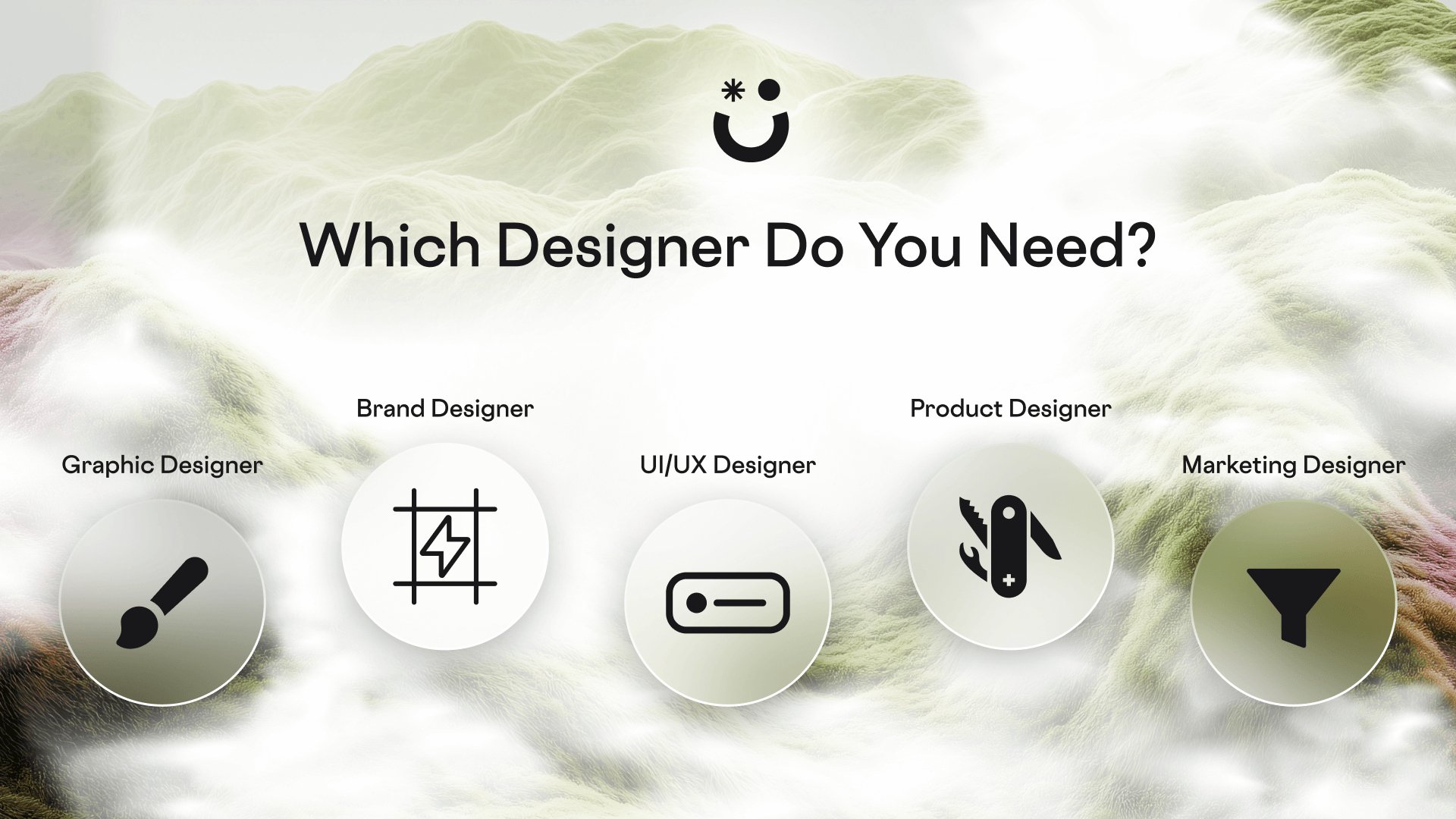
One reason hiring designers is confusing is that “designer” can mean a lot of different things. It’s an umbrella term covering roles from graphic designers to UX designers to product designers and more. So, step one: define what type of design help you need. Here are the key designer roles relevant to startups, and how to know which one fits your needs:
- Graphic designer: Focuses on visual assets for marketing and brand communications. This is the go-to role for graphics, illustrations, social media images, slide decks, flyers, etc. If your startup needs a bit of everything, a visual graphic designer is a versatile choice. Cost note: Graphic designers are often more affordable than specialized UX designers. In the U.S., a full-time graphic designer earns around $60,000/year on average, and many freelancers charge roughly $25–$50/hour for basic design tasks (rates vary by experience).
- Brand designer: Focuses on crafting a cohesive brand identity – the visual and stylistic DNA of your company. This includes your logo, color palette, typography, and brand guidelines to ensure everything your company produces looks and feels consistent. Brand designers work more strategically, thinking about the story and values behind your visuals. If you’re launching a product and need to establish a professional look from day one (name, logo, website theme, etc.), or your current branding is all over the place, a brand designer is ideal. In practice, early-stage startups often combine this role with graphic design; you might find someone who brands your company and then creates the collateral too.
- Marketing designer: Sometimes called a “visual marketing designer” or similar. This role focuses on conversion-oriented graphics, including digital ads, email templates, landing page designs, infographics, and event materials. A marketing designer’s job is to make assets that drive growth: eye-catching ads, high-converting landing pages, etc. If your pain point is “our ads and social posts aren’t engaging or on-brand,” a marketing designer can help level up those materials. Note that not every company formally separates this role, but some designers specialize in working closely with marketing teams, running A/B tests on creatives, and iterating designs to boost metrics. If you have a heavy load of performance marketing or content graphics, look for this skill set.
- UI/UX designer: If you have an app, SaaS product, or website that is central to your business, you’ll need a UI/UX designer. They design the screens and interactions, ensuring the product is both usable (UX) and visually appealing (UI). Often one person wears both hats as a “UI/UX designer,” but to clarify: a UX designer conducts user research, defines the information architecture, and makes wireframes and prototypes to optimize how a user flows through your product; a UI designer then designs the detailed visual elements (layouts, buttons, icons) to make the interface attractive and on-brand. If you’re building a product and find that users get confused or the interface looks dated, this is the role to hire.
- Product designer: A somewhat broader term often used in tech. Product designers usually encompass UX/UI skills but also think about the product holistically – user needs, business goals, and how design aligns with product strategy. In practice, many startups use the title “Product Designer” for their first design hire. It implies someone who can do it all: research user needs, sketch wireframes, create polished UI, maybe even assist with branding or marketing graphics in a pinch. If you can only afford one designer early on, a product designer is often the best investment because they can flex across different design tasks. Many VCs and experienced founders advise that your first design hire be a product design generalist who can evolve with your needs.
Now, how do you decide among these roles?
If you have multiple design needs but can’t hire several people, one strategy is to start with a generalist designer who’s competent in various areas. For example, a designer who can handle your app UI and also whip up a landing page or logo as needed. On the other hand, if you have one very specific, high-impact need (e.g. your UI is fine but your brand visuals are awful), you might engage a specialist short-term for that project (like a brand expert for a rebrand) and bring on a generalist later.
If you’re still not sure what you need, start by outlining the design tasks you foresee in the next 3–6 months. Categorize them: are they mostly marketing collateral? Mostly product UI work? A mix? This task list often makes it obvious whether you need:
- (A) a visual marketing-focused designer
- (B) a UX/UI product-focused designer, or
- (C) someone who can do a bit of both.
Also remember, modern solutions like Awesomic’s design subscription give you access to multiple design specialties on one plan – one week you could get a branding project done, the next week UI screens, using different vetted specialists on their service. That kind of flexibility can be a lifesaver.
Now that you know who you might need, let’s tackle when to hire and how to decide the hiring model.

When and whom to hire first: founder’s checklist
Timing a design hire can be tricky. Hire too late, and you suffer from “design debt” – your product or marketing suffers and may need expensive fixes. Hire too early or in the wrong capacity, and you might burn cash without enough work for them. Here’s a quick checklist (and some tough questions) to help founders decide if it’s time to bring in design help, and in what form:
Ask yourself:
- Is lack of design quality holding us back?
- Are our design needs ongoing?
- Do we consider design a key differentiator for our business?
- What’s our funding and stage?
- Am I (the founder) or someone on the team currently doing design grudgingly?
If you’ve gone through these questions and conclude “Yes, it’s time to get design help”, the next question is whom to hire first, immeditely followed by for how long, and how to hire them. For many founders, that first move is to hire an AI logo designer through Awesomic and get the brand foundation right before scaling anything else. After that comes how long, and how to hire them.
Full-time vs. part-time vs. contract for the first hire
You don’t always have to start with a full-timer. Here’s where the hiring model comes in: you could start with a contract freelancer or agency for an initial project – say a 2-month engagement to revamp your website or design MVP screens – and then decide on a full-time role.
If design needs are ongoing and core to your business (e.g. a SaaS app that will continuously evolve), a full-time hire or a stable long-term solution (like a subscription design service that functions like an on-demand designer) makes sense.
Remember, you can also mix approaches: maybe you’re not ready for a full-timer this quarter, so you use an on-demand design service to handle projects. One YC startup, Perseus Defense, did exactly that: in the rush to their Demo Day, they needed tons of design (brand, website, video) in 2 months but didn’t hire multiple people immediately – they used Awesomic’s subscription to get it done, then post-launch they could evaluate long-term needs.
Hire a designer as soon as you identify design is affecting your product or growth trajectory. If it’s a crucial gap, earlier is better. And if you’re still on the fence, the next section will lay out concrete options (and costs) to help you make the call in a way that fits your startup’s situation.
Exploring your hiring options: what’s the best way to get design work done?
Once you’ve decided you need design help, the next big question is how to bring that talent on board. Startups today have several routes to consider, each with pros and cons. The four main options are:
1. Hire in-house (full-time employee)
2. Hire freelance designer(s)
3. Hire a design agency/studio
4. Use a subscription-based service (on-demand design talent for a flat fee)
Let’s break down each model:
Option 1: In-House full-time designer
Pros: This is the traditional route – adding a designer to your team. The big advantage is dedication and deep context. A full-time designer will develop a deep familiarity with your product, brand, and customers. They’re available whenever needed, embedded in your workflow, and can shape your internal design culture. You can eventually build a design team around them as you grow.
Cons: It’s typically the most expensive option. You’re not only paying a salary, but also benefits, taxes, equipment, etc. For perspective, hiring even a mid-level designer might cost you $70k–$100k/year in salary (plus 20-30% extra in benefits/overhead) depending on role and location. Senior product designers can be well into six figures. Lastly, onboarding any full-time employee has ramp-up time; some studies suggest it takes months before a new hire is fully up to speed.
Founder tip: If you go full-time, spend the effort to craft a compelling job description and vet candidates thoroughly. Don’t just hire the first decent portfolio you see. Look for someone who is excited about your mission and can handle the ambiguity of a startup. Consider giving a practical exercise (a small paid design task or a presentation of their past work) to see how they think. Also, because startups can’t always match big-company salaries, consider offering equity or a path to leadership to attract talent. One stat to keep in mind: fully onboarding a new full-time hire to full productivity can take months. Plan accordingly and be patient as they integrate.
Option 2: Freelance designer
Pros: Hiring a freelancer (or several) is a popular flexible approach. You can contract independent designers on a project basis or hourly. The advantages are cost flexibility and no long-term commitment. Freelancers are great for short-term needs or testing the waters – for example, getting a couple of sample designs to see what style suits you.Essentially, it’s pay-as-you-go design talent. No HR overhead, no long contracts.
Cons: Quality and reliability can vary widely. Anyone can label themselves a “designer” on freelance platforms, so you might have to sift through many candidates and portfolios to find someone truly skilled and reliable. There’s also the matter of availability: a good freelancer might juggle multiple clients, meaning they aren’t always free exactly when you need them. Managing freelancers also requires time since you act as the project manager, defining tasks, reviewing work, consolidating feedback, etc. If you hire multiple freelancers for different tasks (say one for UX, one for graphics), you become the coordinator between them. Posting a job on Upwork can yield 50+ proposals overnight – sorting through them and interviewing can be a significant effort. Consistency can be an issue too – each freelancer has their style, so if you use many, your design output might lack a cohesive look.
Cost: Freelance rates are all over the map. Broadly, you might see designers on the low end at $20–$30/hour (often less experienced or international contractors) and on the high end $100–$150/hour for seasoned specialists. According to one service’s data, typical freelance graphic design rates span from ~$25/hour at the low end up to $75/hour or more for experienced designers. Let’s say a startup needs ~50 hours of design work in a month – at $50/hour that’s $2,500 for that month. Not bad compared to a full-time salary, but remember the trade-off is you’re managing those hours closely. Also, freelancers often limit how many revisions they’ll do on a flat-fee project, so beyond that you pay extra. There can also be platform fees, too. In short, freelancers can be cost-effective for discrete tasks, but if you find yourself needing continuous design, the costs and coordination effort can start creeping up to what you’d invest in an in-house role or a retainer with an agency/service.
Tips for success: If you choose freelancers, vet their portfolios and reviews carefully. Look for work examples similar to what you need. For specialized industries, like if you need to find a defense tech designer, platforms like Awesomic make that search faster by matching you with vetted specialists who already have relevant experience. Don’t hesitate to do a small paid trial task to gauge reliability before giving a big project. Use a contract or clear agreement, by specifying deliverables, timelines, and ownership of intellectual property (always ensure you own the final designs). And factor in your time as a cost: you’ll need to provide clear creative direction and feedback. Also, build a roster — if you find a great freelancer, treat them well so you can re-engage them; but have a backup or two in case they get busy.
Option 3: Design agency or studio
Pros: Agencies bring a suite of services. When you hire a design agency (ranging from a small studio to a big creative firm), you’re essentially getting a team of experts. They often have multiple designers plus account or project managers who organize the work. Agencies can tackle larger, complex projects that might overwhelm a single freelancer or in-house designer. If you need a complete brand identity + website + marketing campaign all within two months, an agency can deploy a team to handle all aspects in parallel. They also usually have established processes, so you’ll get things like research, moodboards, iterative reviews, and polish. Agencies are a common choice for high-stakes projects like major rebrands, product overhauls, or big launch campaigns where you want top-tier quality and are willing to pay for it.
Cons: Agencies charge rates to cover their team’s salaries, overhead, and profit margin. Agencies may have a long turnaround time as they juggle multiple clients and have structured workflows. If you need rapid daily iteration, an agency might feel too slow or formal.
Founder consideration: If you decide on an agency, invest time in picking the right one. Look for an agency that has worked with startups or your industry. Big flashy agencies might impress, but smaller boutique studios might give you more attention. Always check their portfolio and client testimonials. Clarify the scope and deliverables in writing, so you won’t have to worry about scope creep. For legal safety, ensure any contract covers IP transfer to you upon project completion.
Option 4: Subscription-based talent and design services (on-demand)
This is a relatively newer model that has gained popularity in the last few years: companies like Awesomic, Superside, ManyPixels, etc., offer unlimited design requests for a flat monthly fee. Think of it as having a designer (or design team) on call, without hiring them full-time.
Pros of a design subscription service
You pay a monthly subscription and can send in as many design tasks as you want, one after the other. Typically, subscriptions range from a few hundred to a couple thousand dollars per month depending on how fast or senior you want your designer. For example, some services start around $400–$500/mo for basic graphic design and go up to $1,500+/mo for more complex or faster-turnaround work. Still, even $1k/month is significantly cheaper than a full-time salary (~$8k/mo for a $100k/yr designer).
Many promise 24-48 hour turnaround on each request. Essentially, you get daily progress – submit a request today, see a draft or completed design by tomorrow or the next business day. Good services will pair you with a vetted designer or team. Awesomic, for instance, accepts only ~0.8% of designer applicants (top 1%) onto its platform, meaning you get skilled people without sorting through resumes. If your assigned designer is sick or on leave, the service manages a replacement or you can opt to wait. You don’t worry about HR, payroll, or someone quitting suddenly; the service handles the workforce.
Many subscription services have a network of designers with different specialties. This means if you need a logo one week and a mobile app UI the next, they might internally route those to designers who specialize in each. Your subscription covers a range of design types, which is like having a multi-skill design team at your disposal. Need to bring on a military tech designer for a specialized project? Awesomic handles that routing within 24 hours. Many Awesomic clients get branding, web design, and video animation done all under one plan.
Cons of a design subscription service
Most of these services operate on a queue model: the designer works on your current task, and only when that’s done do they move to the next. So if you have multiple big projects concurrently, one subscription might not cover it; you’d need multiple subscriptions or still use other resources. If you need extremely specialized work (e.g. 3D CAD modeling or high-end video production), a general subscription likely doesn’t cover that. So, some services, like Awesomic, offer custom plans at other price ranges for these types of requests.
Cost and common concerns
Typical plans range roughly from $400 up to $2,000 per month. For example, Awesomic has tiers based on what you need. If you compare this to other options: a freelancer could cost more than that if you accumulate hours, and an agency would most likely charge higher fees. Even compared to an in-house junior designer (let’s say $5k/month cost), a ~$1k subscription is very cost-effective if the output meets your needs.
A common concern is “Will the quality be good enough? Are these just random offshore designers?”
Top subscription services address this by showcasing their vetting. Also, most services offer unlimited revisions, meaning if a design isn’t right initially, you can request tweaks until you’re satisfied. This mitigates risk as you’re not paying extra for redos, unlike with some freelancers or agencies where change requests can incur additional fees. In effect, the incentives are aligned for them to get it right and make you happy to retain you as a subscriber.
To summarize this option: it’s a subscription to a design team, giving you speed, predictable costs, and flexibility. It’s a modern solution tailor-made for startups that need quality design but want to stay lean and agile.
How to hire right: Tips for screening and onboarding your designer
No matter which hiring model you choose, full-time employee, freelancer, agency, or subscription, success will depend on how clearly you define the work and how effectively you collaborate. Here is a quick checklist to ensure you're on the right track.
- Write a clear role brief or project scope
- Know where to look for candidates
- Assess for fit, not just skill
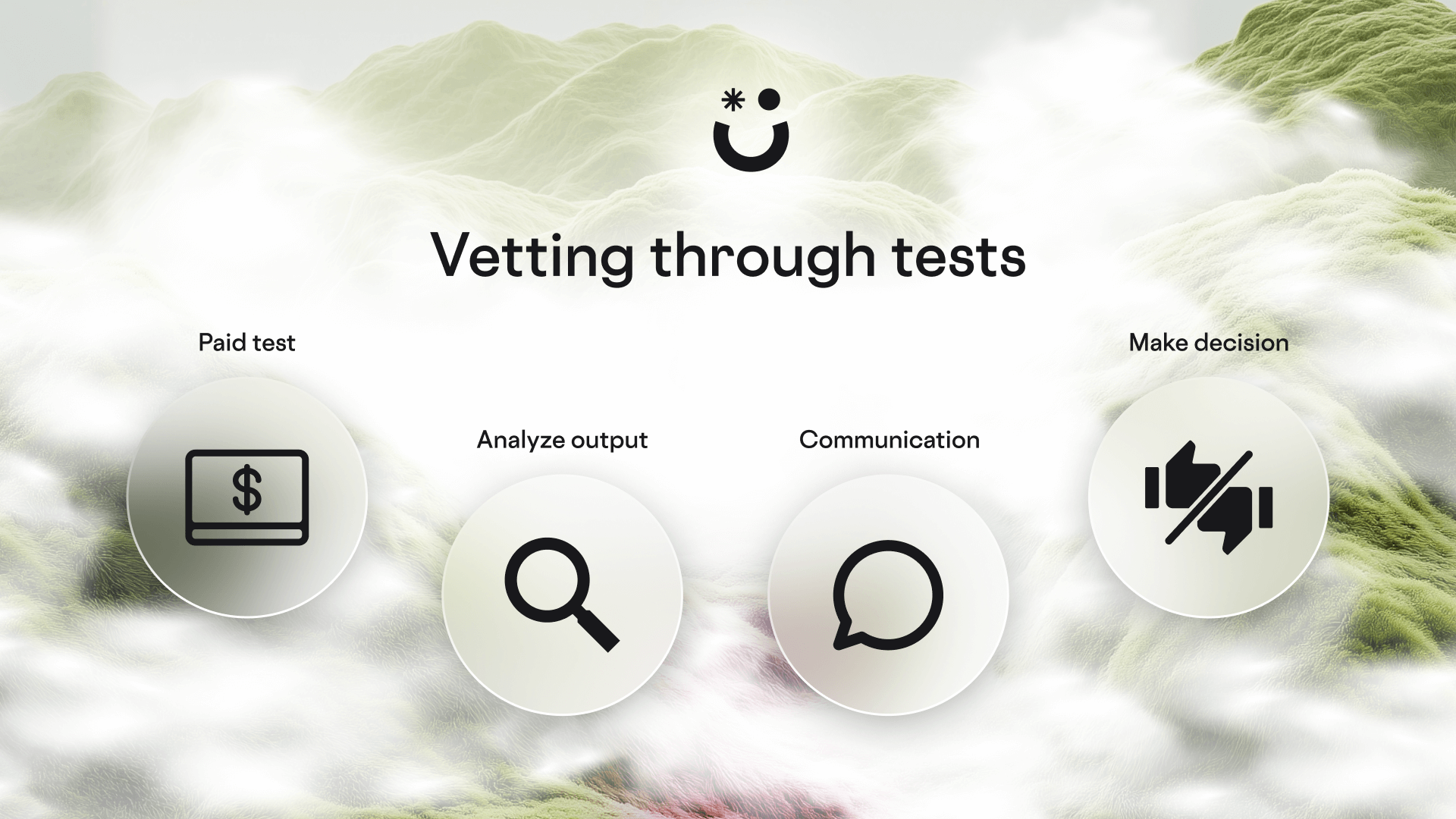
- Consider a small paid test project
- Set clear communication channels and feedback loops
- Avoid common pitfalls such as falling for a pretty portfolio instead of one that outlines business wins
- Set clear onboarding goals
- Plan for the long term (and the what-ifs)
These are general practices which greatly increase the chance that your design hire or partnership will yield awesome results and not headaches. For a more detailed guide, look at our graphic design hiring guide.
How one startup simplified design hiring (Perseus Defense)
Let’s illustrate the journey with a real example. Perseus Defense is a Y Combinator-backed startup from the Summer ’25 batch. They’re in a complex space (defense tech) but faced a common startup challenge: they needed high-quality design work done quickly for their launch. Specifically, they needed a full brand identity with merch design, a marketing website, and a product demo video leading up to Demo Day – essentially, everything to present a polished company to investors and customers.
Let’s think on their options:
- Hiring a full-time designer was impractical given the time crunch .
- Agencies would have long timelines or hefty price quotes that didn’t fit their lean approach.
- Freelancers for each piece was a possibility, but coordinating a logo designer, a web designer, and a video animator separately sounded like a management nightmare in a tight timeframe for founders that are not experts on design.
Their solution: They turned to a talent subscription service (Awesomic) to handle it all. With one subscription (at the “Pro” tier) and a clear list of tasks, they essentially had a design SWAT team on call.
Over the next two months, here’s what happened:
- They then moved to the website. In just 11 days, Perseus had a fully designed marketing website, complete with custom graphics and mobile-responsive layouts. (For context, 11 days is lightning-fast compared to many agencies that might take 4–6 weeks for a website design of similar complexity.) The Awesomic designer worked day-by-day, incorporating feedback rapidly via the platform.
- Meanwhile, for the launch video, Awesomic brought in a motion design specialist. Within about 5 days, they produced an animated explainer and launch video showcasing Perseus’s product, complete with on-brand visuals and snappy storytelling. This video ended up being a highlight at Demo Day.
- Awesomic’s team also streamlined the branding: they delivered a full brand identity guide and adjustments to the logo.
- Throughout, the founders provided input and feedback, but they didn’t have to coordinate multiple parties. Essentially, Perseus got a multi-talented design team for the price of a couple months’ subscription.
The results: Perseus Defense showed up at YC Demo Day with a level of polish that impressed investors. Their brand and site looked like a mature company’s, not a scrappy startup, which helped instill confidence. The launch video garnered 700+ interactions across platforms in its first week. According to calculations using public data on salaries, agencies, and time to fill the respective roles, they spent about 78% less than they would have if they’d tried to contract out all those projects individually.
They were so happy with the outcome that one co-founder, Jason, said “Awesomic was truly awesome… one of the best decisions we’ve made. I only wish we’d started sooner”. That quote, underscores that even a skeptical founder can become a convert when the model works as advertised.
Not every startup will have the same needs or scenario as Perseus. But their case shows how thinking beyond the traditional hiring box can yield huge benefits. They identified what they needed, and chose the model that could deliver it. They then executed it by clearly queueing up tasks and giving quick feedback, which is why it succeeded.
Assess your situation and don’t assume you must hire a full-timer from day one if that doesn’t fit, and there may be creative solutions like this that are a better fit for now.
The key is to get the quality design work done, one way or another, so your startup can shine.
Design your hiring success
Hiring a designer doesn’t have to be intimidating or overwhelming. Let’s recap the key takeaways:
- Don’t underestimate the power of design.
- Match the designer to the problem.
- Choose the hiring model that fits your stage.
- Set your designer (or service) up for success.
- It’s okay to start small and iterate.
Above all, treat design as a priority, not an afterthought. The startups that win hearts are often those that sweat the details in design: the intuitive app, the stunning landing page, the consistent brand that users trust. By making informed hiring decisions using this guide, you’ll avoid common pitfalls and get the design help you need in a smart, cost-effective way.
If you’re ready to level up your startup’s design without the hassle of traditional hiring, you might consider trying a design subscription service like Awesomic. It’s month-to-month, so there’s little risk – and it could just be the shortcut to the design quality you need, right when you need it. Book a demo with us or check out some our client’s testimonials.
At the very least, armed with this guide, you can confidently decide what kind of design help to pursue and how to integrate it to fuel your startup’s success.
One subscription and your hiring problems solved

FAQ


Awesomic is a revolutionary app that matches companies with vetted professionals across 30+ skill sets, from design and development to marketing and product. Based in San Francisco with a global core team, we offer a faster and more flexible alternative to traditional hiring through a subscription-based model. Awesomic delivers high-quality talent on demand, without the delays of recruiting.
We function as a subscription-based service that matches you to top-tier, vetted talent. Submit a project in just a few clicks and start receiving deliverables in as little as 24 hours. Scale your Awesomic plan up or down as your business needs change.
Every Awesomic subscription comes with unlimited revisions. You receive daily progress updates via the app, and you can provide feedback or request iterations as needed. If your project requires a different approach, you can request a talent rematch at any time, at no extra cost. You can also add teammates to collaborate and streamline feedback
A talent marketplace is a platform that utilizes data and intelligent matching algorithms to connect professionals with projects based on their skills, experience, and availability. While often used internally by large companies, Awesomic applies this model at scale, matching vetted global talent to your most critical business needs.
Hiring is time-consuming, expensive, and risky. Awesomic eliminates that problem. We rigorously vet all talent for technical ability, communication, and soft skills, ensuring only senior-level professionals work on your projects. You skip the job posts, interviews, and delays, and get straight to results.
No, Awesomic goes beyond design. While many clients utilize us for branding, UI/UX design, or motion graphics, we also provide vetted talent in no-code web development, product design, marketing, and more. Think of us as an extension of your team. A flexible, high-performing creative partner from planning to execution, whether you're building awesome products or scaling your team.
You can talk directly with your matched talent via the Awesomic app, connect via Slack, email, or schedule video calls. No matter the plan, you’ll receive daily updates in the app for every active task. You can also tag us in for any issues through our in-app customer chat.


