Awesomic Team

Key takeaways:
- At 3 builders and 40 internal users, Retool Team costs $230 a month billed annually ($316 monthly) and Business costs $750 ($915), and the 40 internal-user seats make up most of either bill.
- UI Bakery ($60 a month billed annually), DronaHQ ($100, while usage stays under 25,000 tasks) and Superblocks ($140 with five apps) undercut Retool Team at that size. ToolJet Pro costs $7 more on annual billing and $19 less on monthly.
- Budibase and Appsmith cost more than Retool Team on their cloud plans, but both offer free self-hosted editions with no license fee, and someone on your team still has to run the servers.
- All six app builders here undercut Retool Business, but their cheapest fitting plans often leave out the audit logs or role-based permissions that Business includes.
Retool is a strong choice for building internal tools: you drag tables, forms and charts onto a canvas, wire them to a database or API, and hand your ops team an admin panel they use every day. Its Free plan covers up to 5 users, and the sixth user is where the bill starts.
Past five users, Retool charges per person. On Team, a builder costs $10 a month and every internal user who only opens apps costs $5, billed annually. That second number is why a search for Retool alternatives usually starts in a spreadsheet, not in a feature list.
This list prices seven alternatives to Retool at one realistic team size, 3 builders and 40 internal users, with prices read on October 8, 2026, from each vendor's pricing page. "Cost less" doesn't hold for every pick against every Retool plan, so each entry says which plan it beats and on which billing basis.
Why teams look for Retool alternatives
Most of the reasons sit on Retool's own pricing pages. Retool publishes a plain-text version of its pricing for AI agents, and it lists the monthly rates that the main page doesn't display.
The internal-user seat
Team bills $10 per builder and $5 per internal user a month on annual billing, or $12 and $7 on monthly billing. Business raises those to $50 and $15 annually, or $65 and $18 monthly. At 40 internal users, the viewer seats alone come to $200 to $720 a month before anyone builds anything.
Builders have argued about this on Reddit. "it's the code we create, we host, we support, it's our IP, you are charging per user just cos I was able to create it faster," one r/selfhosted commenter wrote in 2024. It's one person's view, but every per-user plan on this list has to answer it.
Who Retool counts as a builder
Retool defines builders as "Enabled users who built or edited an app or workflow during the billing cycle." So an ops lead who renames one column in March pays the builder rate for March. Budget for everyone who might edit, not only the people you hired to build.
Controls that sit on Enterprise
SSO through SAML or OIDC, SCIM provisioning, enforced 2FA and Git source control appear on Enterprise only, which is a custom quote. Audit logs and rich permissions arrive one step down, on Business.
That gap can push a growing team to shop around. One Reddit user who compared five platforms for internal tooling at work said Retool's free plan "is for up to 5 users," and that later "we realized we needed Okta login." Their verdict: "the cost of Enterprise was too heavy." That's a single team's experience, and the Okta detail is the part to check against your own needs.
Usage meters on top of seats
Free includes 500 workflow runs a month and Team 5,000, with extra runs at $75 per 5,000. AI work draws on pooled credits, part of them "bonus" credits that Retool says may change over time, and agents bill by the hour after up to 20 free hours a month. So a seat count alone won't predict the invoice.
Retool alternatives compared at 3 builders and 40 users
The last column shows the cheapest plan that fits 3 builders and 40 internal users, worked out from each vendor's published rates and labeled by billing basis. Retool sits in the final row for reference.
| Tool | Best for | Pricing model | Main limitation | Monthly cost at 3 builders + 40 users |
|---|---|---|---|---|
| Awesomic Studio | Agent-built internal dashboards, expert on call | Flat usage budget, no per-user line | No native database connectors | $20, $200 or $500 flat (usage budget, not seats) |
| UI Bakery | Few developers, many viewers | Per developer; viewers free up to 50 | 51+ viewers need Enterprise | $60 billed annually, $75 monthly (Builder) |
| DronaHQ | Unlimited users on a fixed fee | Flat plan plus metered tasks | Bill rises with query volume | $100 billed annually, $140 monthly (Starter, under 25,000 tasks) |
| Superblocks | AI-generated apps, many end users | Flat per team plus $10 per extra app | SSO and audit logs only on Enterprise | $140 billed annually, $165 monthly (Teams, 5 apps) |
| ToolJet | Builders who already use coding agents | Per builder, end users bundled | Pro caps at 10 apps and 50 end users | $237 billed annually, $297 monthly (Pro) |
| Budibase | Self-hosting with no user cap | Seats plus hard action caps | Cloud end users cost extra | $349 billed yearly, $419 monthly (cloud Premium); $0 license self-hosted |
| Appsmith | One rate for every user | Per user, builders and viewers alike | Viewers pay the full $15 | $645 (Business, no annual toggle); $0 license self-hosted |
| Retool (reference) | Drag-and-drop internal tools | Per builder plus per internal user | SSO, SCIM and Git only on Enterprise | Team $230 billed annually, $316 monthly; Business $750 / $915 |
Awesomic Studio sits first because it's our product, and it's priced as a usage budget rather than per seat. The six app builders after it run from the lowest worked cost at this team size to the highest, on annual billing.

1. Awesomic Studio
Best for: Hosted internal dashboards with an owner
Overview: Awesomic Studio is our AI workspace. You describe a dashboard or app in plain words, agents (Claude Code, Codex and OpenCode) build it, and Studio hosts it at a link you share privately or publicly.
Studio isn't a Retool clone. Retool wires components to your database, while Studio has no native database connectors, so you bring the data as files, links or text.
For an ops team, the fit is the reporting layer. The "Analytics dashboard" on our Studio page shows the shape: KPI cards across the top, a 12-month revenue trend, a recent-sales list and a Download Report button.
Studio is a first step that extends what a designer or developer does, never a replacement for one. On the Dedicated setup, a vetted specialist or team from the people behind our 20,000+ delivered projects owns the ongoing work.
Key features:
- Agents build dashboards from the files, links or text you hand them.
- Built-in hosting puts a dashboard live with no server to set up.
- A dedicated DigitalOcean server add-on, "a private, always-on environment."
- Scheduled automations run refreshes and reports on their own.
- The Dedicated setup puts an expert in charge of delivery, "with or without AI in their process."
- Connections to Slack, Notion, Google Drive, GitHub and four other tools.
Pricing: Basic is $20 a month, Pro $200 and Maximum $500, each fee being that month's usage budget, with no per-user line. There's no free plan or trial, so Studio isn't cheaper than Retool Free, which costs nothing for up to 5 users. Basic and Pro sit below Retool Team's $230 at this size on sticker price, but Studio doesn't publish how fast agents spend the budget. The Dedicated setup is quoted separately from these plans.
Pros: No per-user line on any plan, hosting included, scheduled reports, an expert who can own delivery, an optional private server
Cons: No native database connectors and no claim of user logins or permissions, so it can't replace Retool for apps that write data, and it doesn't undercut Retool's free tier
How to start using it:
- Export the numbers your ops team checks weekly to a spreadsheet.
- Start on Basic and describe the KPI cards, trend line and list you want.
- Upload the file and ask for changes in plain words.
- Share the dashboard privately and schedule a weekly report.
- Switch to the Dedicated setup when the dashboards need someone to own them.
Why it's a good Retool alternative: For read-only dashboards it swaps per-seat pricing for one budget, and an expert can take over in the same workspace.
Final verdict: Pick Studio when the internal tool is mostly a dashboard and you'd rather have an expert own it than learn a builder.
2. UI Bakery
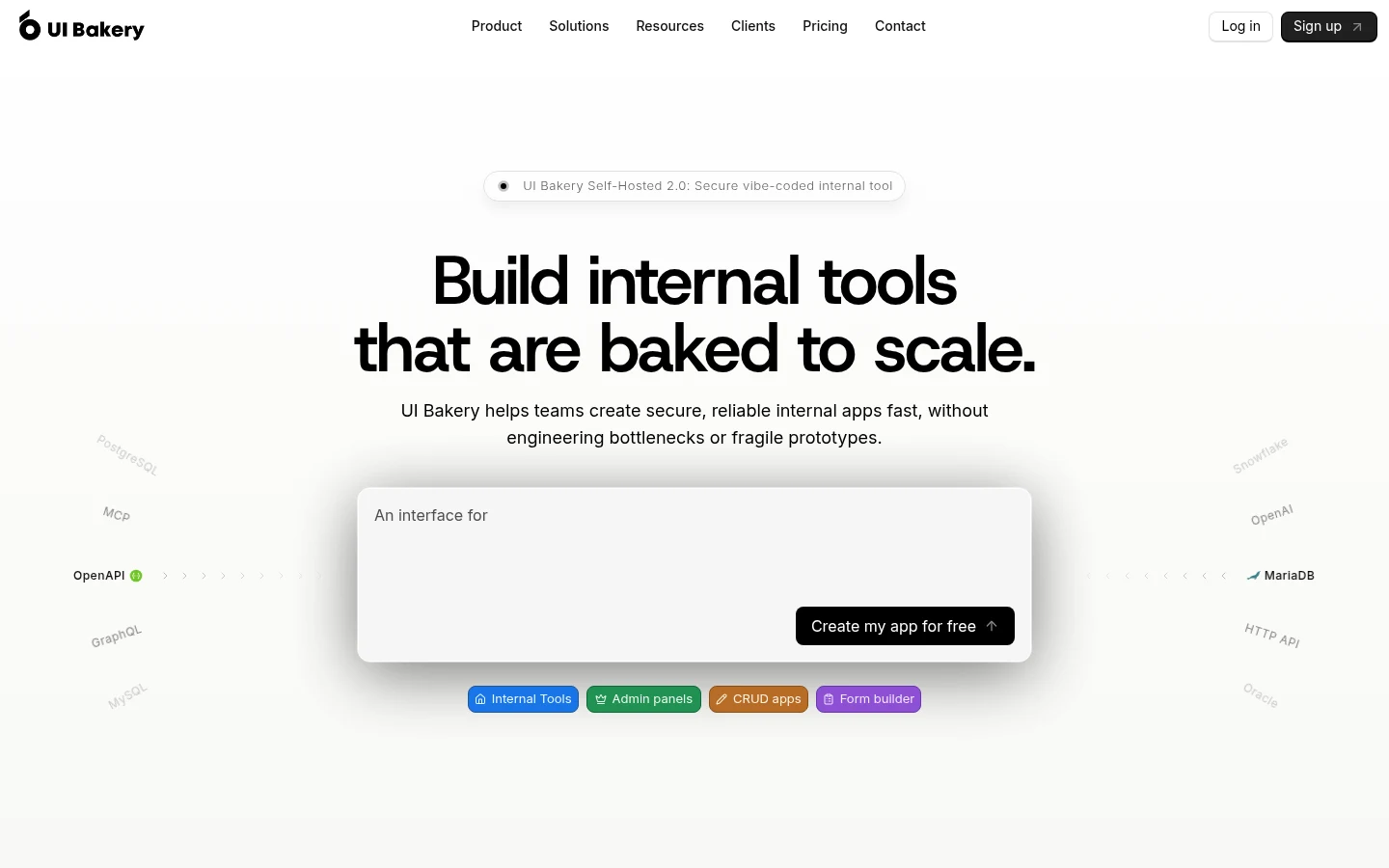
Overview: UI Bakery is a low-code and AI app builder for internal tools, sold as a cloud service or as a self-hosted edition. It bills developers only, defined as anyone with a role that lets them edit, and it doesn't bill viewers up to 50 workspace view seats.
So the 40 people who only use the apps never reach the invoice.
Key features:
- Unlimited apps and data sources on every plan, Free included, so adding a database doesn't change your plan.
- Up to 50 workspace view seats on Builder and Team, with no per-viewer charge.
- A self-hosted edition whose Team plan costs the same per developer as cloud Team.
Pricing: Builder costs $20 per developer a month billed annually or $25 monthly, so 3 developers come to $60 or $75. Team is $35 per developer billed annually ($40 monthly) and adds role-based access control and audit logs. Builder includes 5,000 automation executions a month, and each extra 5,000 costs $50.
Pros: Free viewers up to 50 seats, cloud and self-hosted Team priced alike, unlimited data sources
Cons: A 51st viewer pushes you to a custom Enterprise quote, RBAC and audit logs wait for Team, and the self-hosted Free card says "Unlimited seats" while UI Bakery's own comparison table lists 50 viewer seats
Where it fits: At this size UI Bakery undercuts Retool Team by $170 a month on annual billing and $241 on monthly. Even its Team plan, at $105 or $120 for 3 developers, stays below Retool Team.
Final verdict: The lowest cloud bill among the six app builders here, as long as your internal audience stays at 50 or fewer.
3. DronaHQ
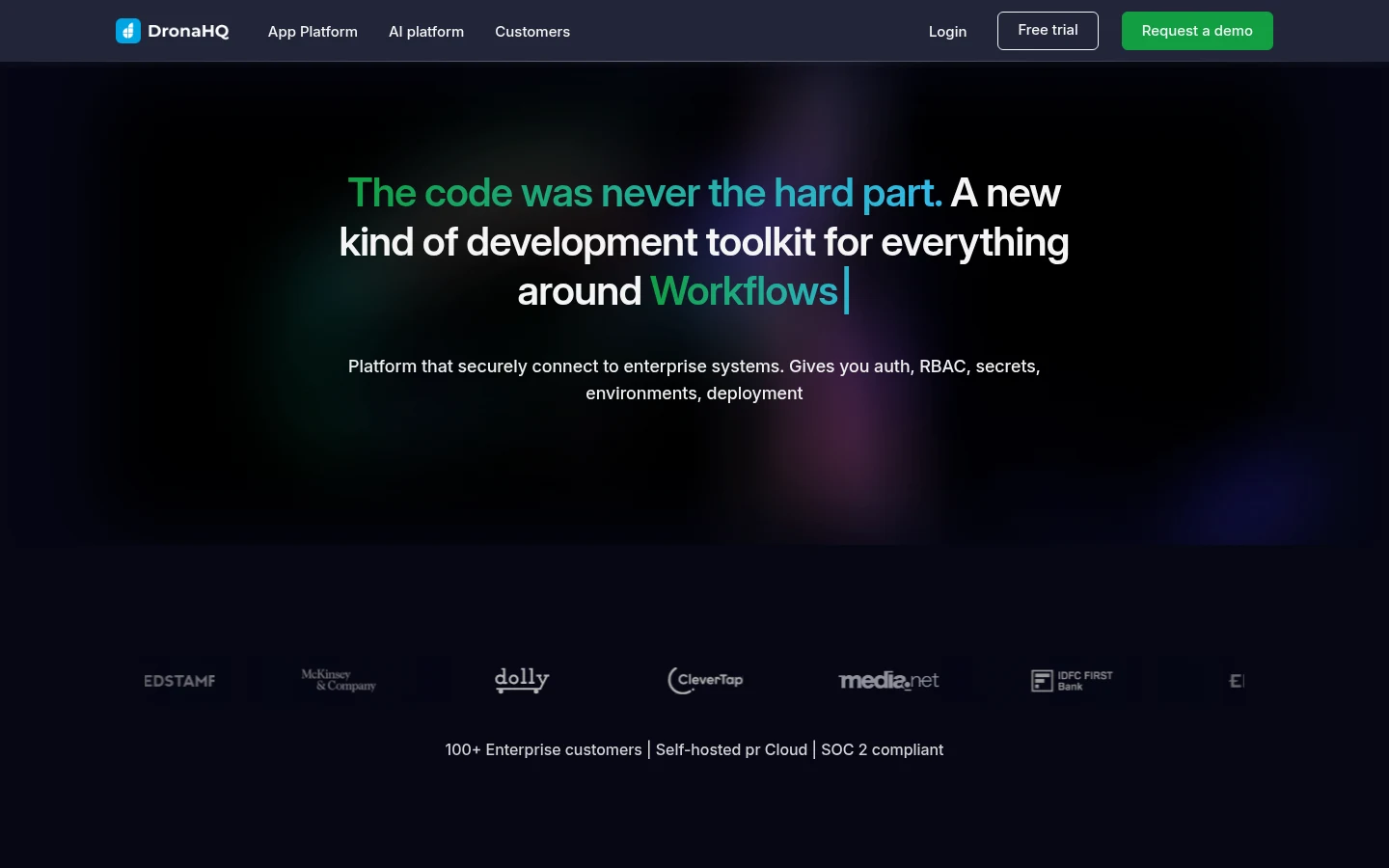
Overview: DronaHQ, made by Deltecs Infotech, is a low-code builder for internal apps that now sells an AI agents platform too. Its pricing headline reads "Unlimited users | Pay as you go at $0.002/task," and that's the whole idea: no seat fee, a monthly task allowance instead.
A task is "Any server-side call like DB query, API call etc." So the bill tracks how hard your apps work, not how many people open them.
Key features:
- Unlimited users on the cloud plans, so a 41st ops hire adds nothing to the bill.
- Unlimited apps and unlimited connectors on Starter.
- Git source control, available only on a self-hosted DronaHQ instance.
Pricing: Cloud Starter is $140 on monthly billing or $100 a month paid annually, with 25,000 tasks, and extra tasks cost $0.002 each. Business is $500 billed annually or $700 monthly, with 125,000 tasks and SAML/OIDC SSO, and self-hosting starts at $1,500 a month billed annually.
Pros: No per-user fee at any team size, unlimited connectors from the entry plan, a one-month Business trial with no credit card
Cons: The bill moves with query volume, SSO starts at $500 a month, audit logs and granular permissions are Enterprise-only
Why buyers shortlist it: Forty users who each trigger 15 server calls a working day, across 22 days, use 13,200 tasks, which fits Starter with room to spare. A heavier app adds $2 for every 1,000 tasks past the allowance.
Final verdict: Beats Retool Team on monthly and annual billing alike while your apps stay under 25,000 tasks a month, but it's a poor fit for self-hosting on a budget.
4. Superblocks
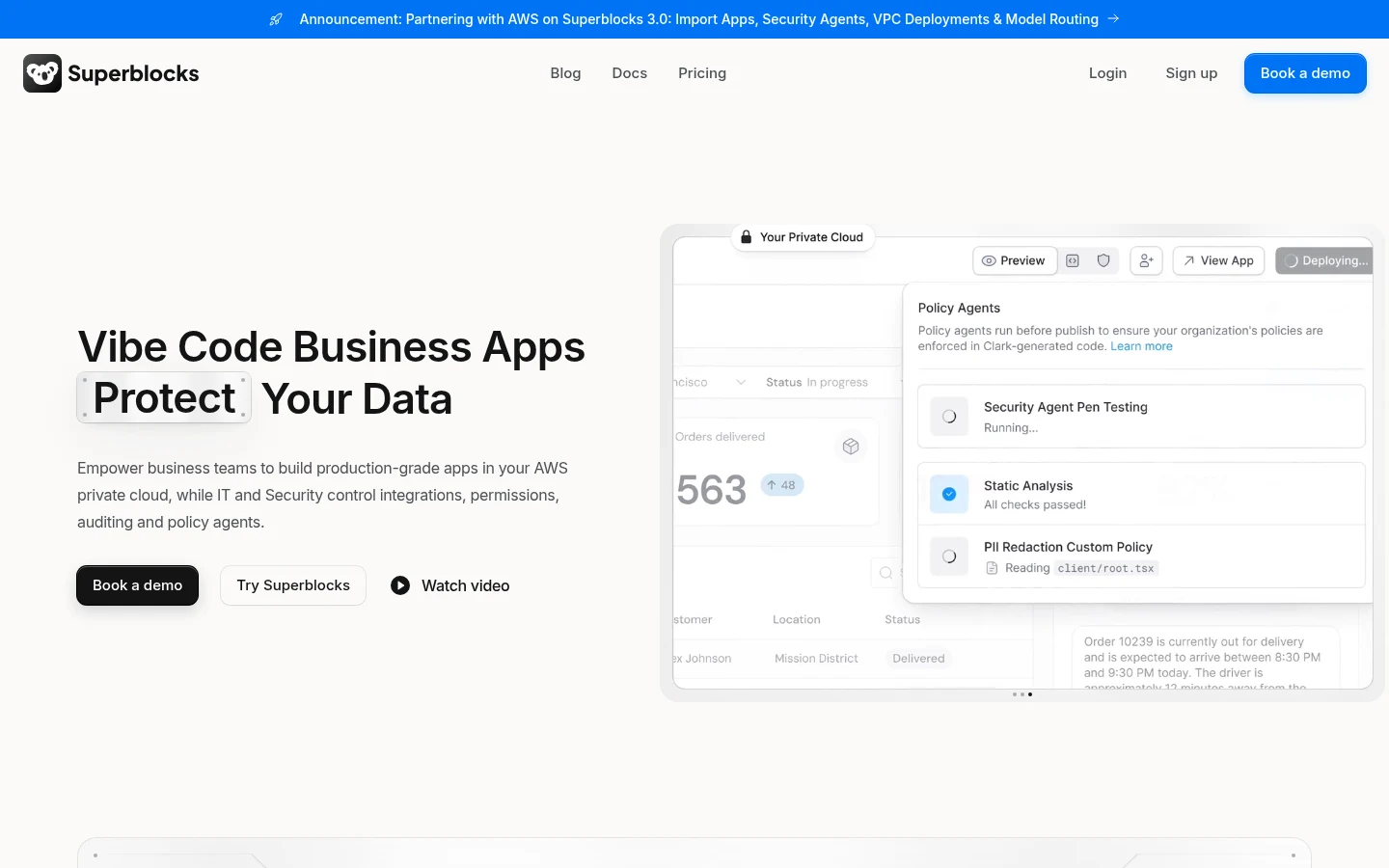
Overview: Superblocks now calls itself an "enterprise AI vibe coding platform," built around Clark, an AI agent that generates internal apps you can then edit. It also publishes its own Retool comparison, so weigh its claims about rivals with that in mind.
Its Teams plan is priced per team, not per seat, and it charges for apps one at a time.
Key features:
- Up to 15 builders and unlimited end users on a single Teams plan.
- Clark AI, staging and production environments and 50+ integrations on Teams.
- Generated code that you own, per Superblocks' FAQ, though Git source control is listed on Enterprise.
Pricing: Teams costs $100 a month billed annually or $125 monthly, with one hosted app included and $10 a month for each app after that. With five apps it comes to $140 billed annually or $165 monthly, and there's a 14-day free trial.
Pros: A price that ignores headcount up to 15 builders, unlimited end users, a published rate for each added app
Cons: Only one app included, SSO and audit logs are Enterprise-only, and so is VPC deployment
Its real strength: A team that wants an AI agent drafting its internal apps gets one on the entry plan without counting seats. On annual billing it stays below Retool Team's $230 up to 13 apps, and the 14th app ties it.
Final verdict: A saving over Retool Team at a small app count, though a team that needs SSO or audit logs ends up at a quote.
5. ToolJet
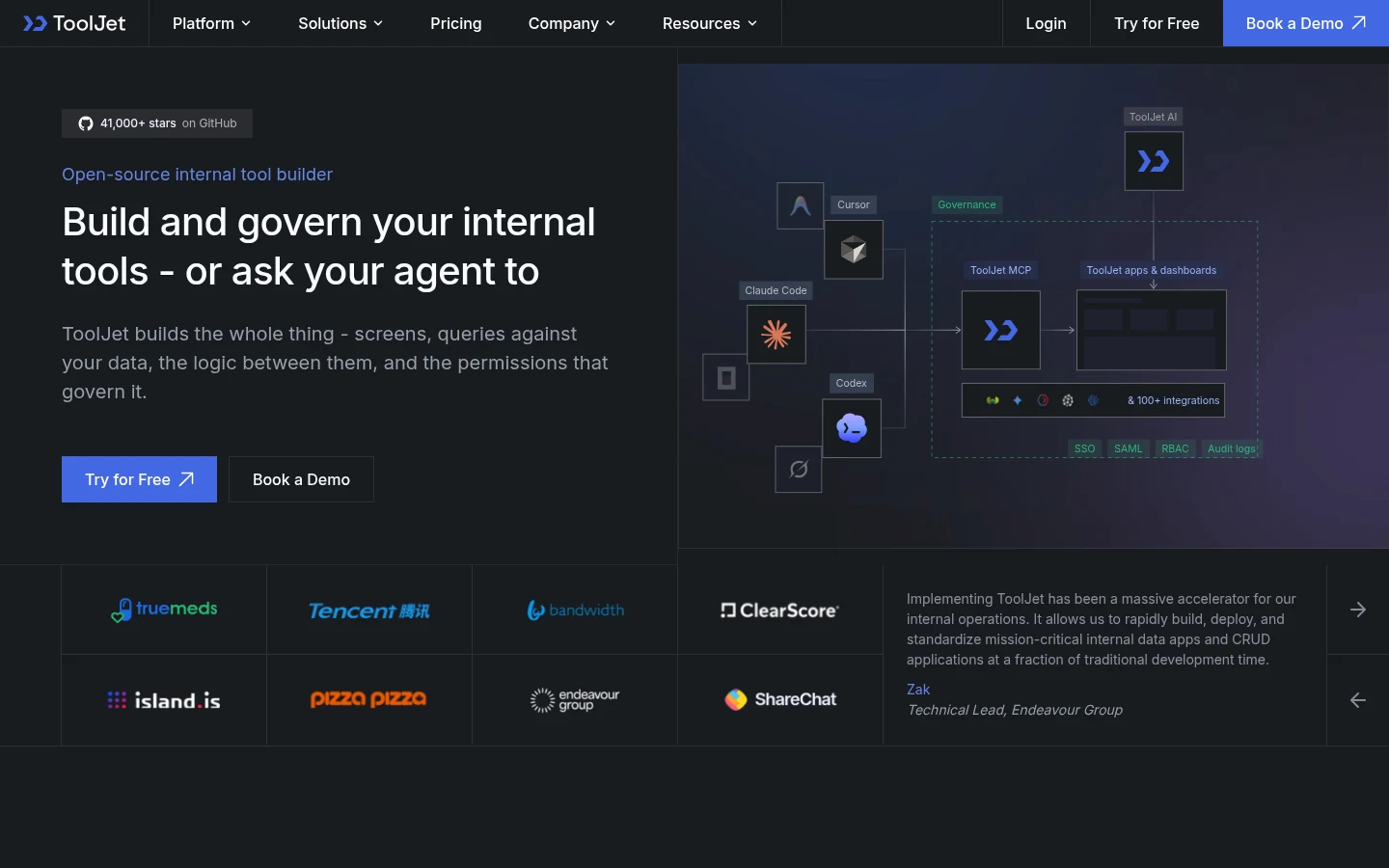
Overview: ToolJet is an internal-tool builder with a Community Edition on GitHub under the AGPL v3 license, which its README says connects to 90+ data sources and self-hosts on Docker or Kubernetes. It also offers ToolJet MCP, in beta, for building from Claude Code, Codex or Cursor.
ToolJet charges per builder and bundles end users into each plan up to a cap, so viewers cost nothing until you pass 50 or 100.
Key features:
- End users included in the builder price: up to 50 on Pro and 100 on Team.
- Unlimited builders on Pro, with version control.
- ToolJet MCP, which lets builders work from a coding agent without spending ToolJet AI credits, per its FAQ.
Pricing: Pro costs $79 per builder a month billed annually or $99 monthly, so 3 builders come to $237 or $297, with up to 10 apps. Team is $199 per builder billed annually ($249 monthly) and adds SSO, audit logs and Git sync, which puts 3 builders at $597 or $747.
Pros: Viewers bundled into the builder price, a free self-hosted plan, an MCP route for teams already using coding agents
Cons: Per-builder rates run from $79 to $249, Pro caps you at 10 apps and 50 end users, both free tiers stop at 2 builders
What it's good at: Matching Retool's controls for less. ToolJet Team undercuts Retool Business on both toggles and adds SSO, which Retool keeps on Enterprise, while Pro roughly ties Retool Team.
Final verdict: Closer to a tie with Retool Team than a saving, so choose ToolJet for its bundled end users and self-hosted route rather than for the entry price.
6. Budibase
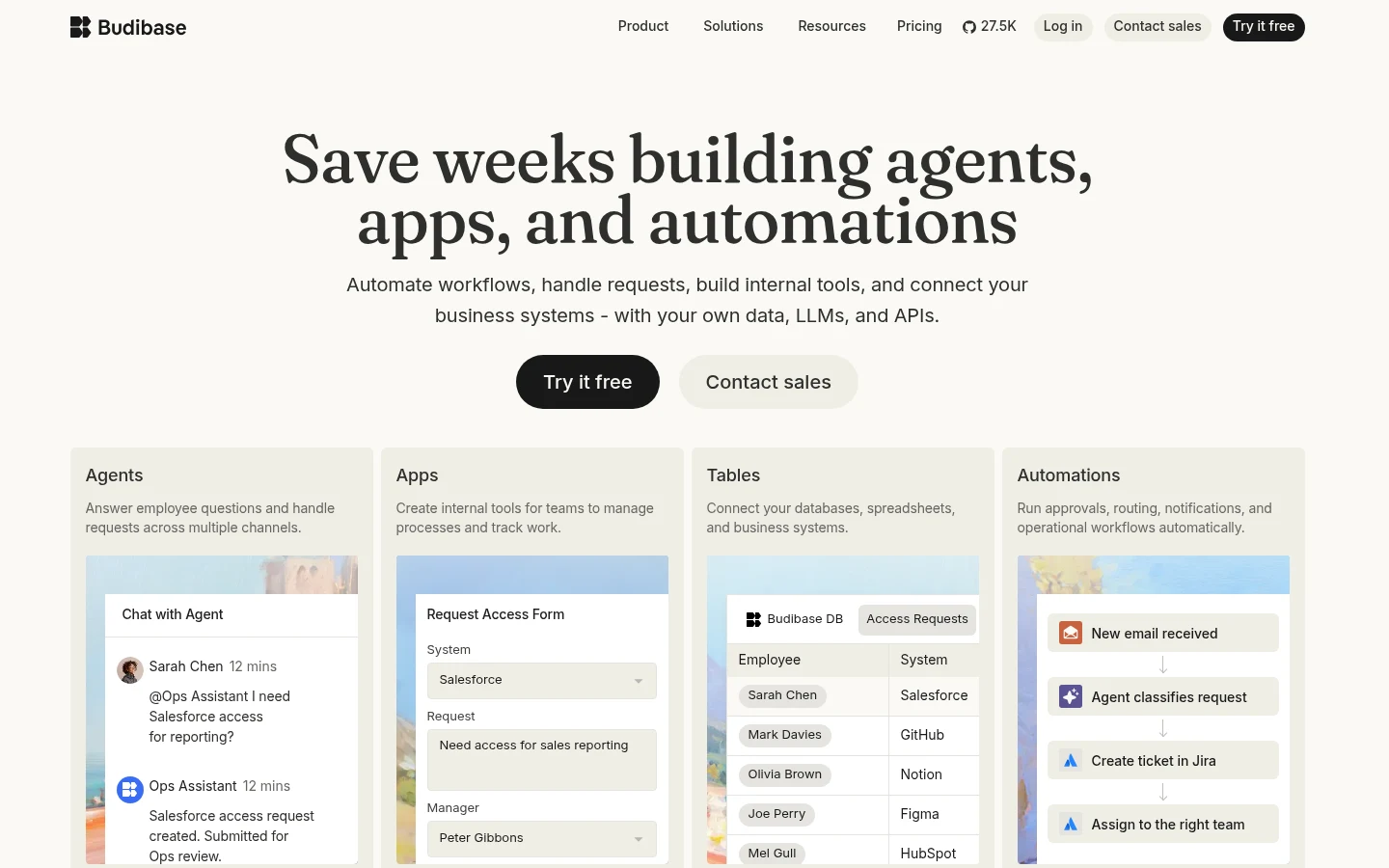
Overview: Budibase is an open-source platform for apps, automations and AI agents, released under GPL v3, with its client and component libraries under MPL. Its pricing has two parts: seats, and "actions," a hard monthly limit on agent tool calls, automation steps and row changes.
Custom SQL and API requests don't count as actions, so a dashboard that mostly reads data barely touches the allowance.
Key features:
- A free self-hosted plan with unlimited users, apps and actions in one workspace.
- Hard action caps on cloud plans, so there are no overage charges.
- SSO on the free self-hosted plan, and enforced SSO on cloud Business.
Pricing: Cloud Premium costs $49 a month billed yearly or $59 monthly, with 1 creator included, extra creators at $50 yearly or $60 monthly, and end users at $5 yearly or $6 monthly each. For 3 builders and 40 users that's $349 billed yearly or $419 monthly.
Pros: A free self-hosted edition with no user cap, no overage surprises, SQL and API queries kept off the action meter
Cons: Cloud end users are a paid add-on on Pro, Premium and Business, automations stop when the action cap is hit, the free self-hosted plan allows only one workspace
Why it made this list: On cloud, Budibase costs more than Retool Team at this size, so it's here for the self-hosted plan, which its FAQ calls "free to use indefinitely." The cloud plan still undercuts Retool Business by $401 a month on yearly billing and $496 on monthly.
Final verdict: Self-host Budibase if someone on your team can run it, and treat the cloud plan as a cheaper Retool Business rather than a cheaper Team.
7. Appsmith
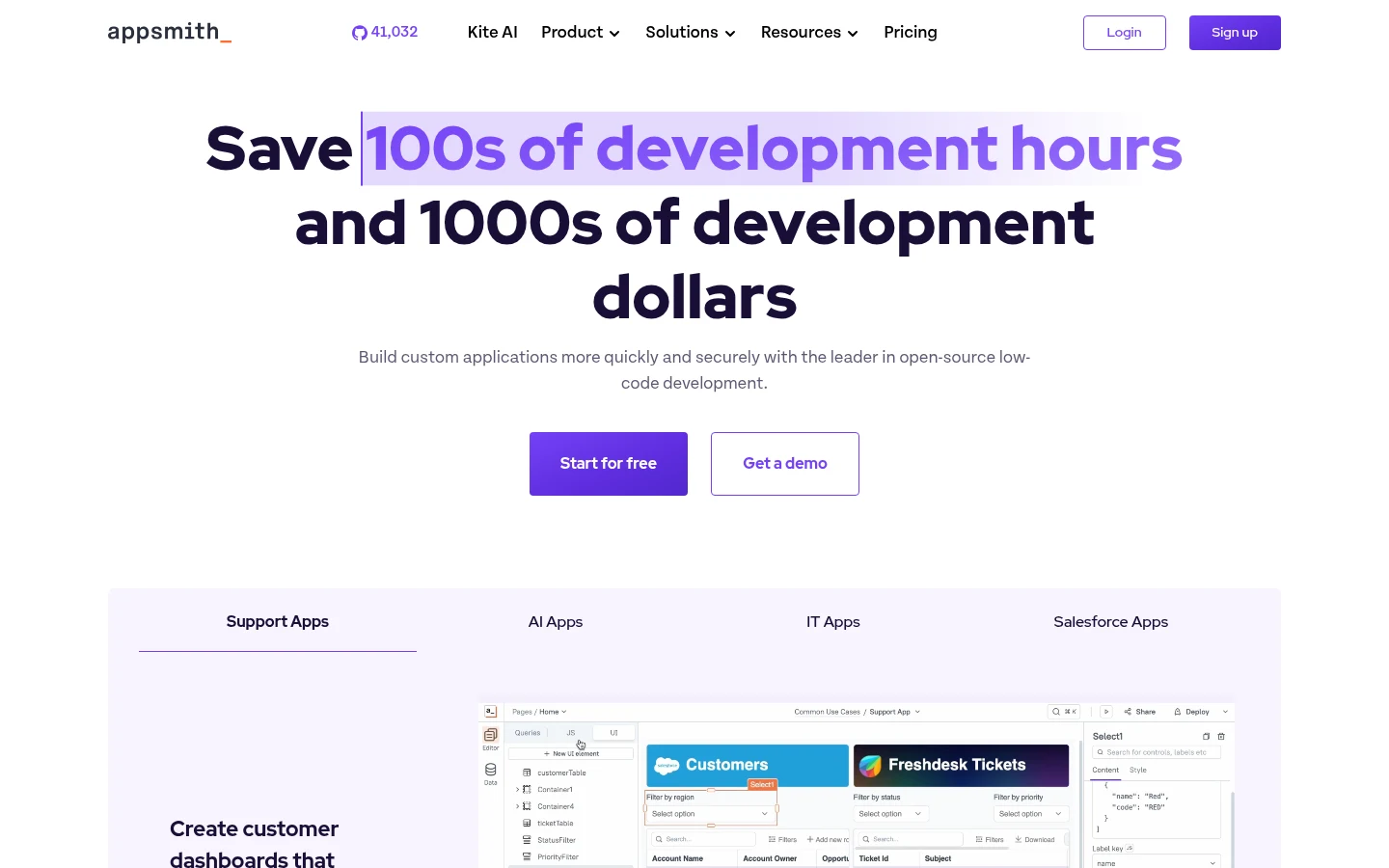
Overview: Appsmith is an open-source internal-tool builder under the Apache 2.0 license, and its GitHub page says it "Integrates with 25+ databases and any API." Its cloud pricing uses one rate for everyone, so builders and viewers each pay $15 a month.
The pricing page puts it as "No extra costs for developers, no complicated classes of users." Its FAQ counts any member added to a workspace as a billed user, for the full month.
Key features:
- A free, self-hosted Community Edition.
- Unlimited environments and Git repositories, workflows, custom roles and audit logs on Business.
- A published Enterprise price: $2,500 a month for 100 users, typically billed annually.
Pricing: Business costs $15 per user a month for up to 99 users, charged by credit card at the end of each month, and the pricing page shows no annual toggle. For 43 people that's $645 a month.
Pros: One flat rate with no builder premium, an Apache 2.0 self-hosted edition, Enterprise priced in public
Cons: Viewers pay the same $15 as builders, cloud Free stops at 5 users, Business stops at 99 users
Why it works as a Retool alternative: Appsmith cloud never undercuts Retool Team, because its $15 is above every Team rate on either toggle. It does undercut Retool Business at any mix that includes a builder, since Business already charges $15 or more per viewer.
Final verdict: Choose Appsmith cloud for Business-level roles and audit logs at less than Retool Business, or self-host the Community Edition when the license fee is what you want to avoid.
Where each pick actually costs less
"Cost less" depends on which Retool plan you're leaving and how you pay for it. This table compares each pick at 3 builders and 40 internal users with Retool Team ($230 billed annually, $316 monthly) and Retool Business ($750, $915).
| Tool | Cheaper than Retool Team? | Cheaper than Retool Business? | Free self-hosted edition |
|---|---|---|---|
| Awesomic Studio | Basic and Pro on sticker price; a usage budget, not seats | Yes on sticker price, all three plans | None listed; hosting is built in |
| UI Bakery | Yes, $60 annually / $75 monthly | Yes | Yes, though its plan card and comparison table disagree on viewer seats |
| DronaHQ | Yes, $100 / $140 under 25,000 tasks | Yes | None on its pricing page; self-hosting starts at $1,500/month |
| Superblocks | Yes, $140 / $165 with 5 apps | Yes, without Enterprise controls | None on its pricing page; VPC deployment is Enterprise-only |
| ToolJet | No on annual (+$7), yes on monthly (-$19) | Yes, Team at $597 / $747 | Yes, listed at 2 builders and 50 end users |
| Budibase | No, $349 / $419 on cloud | Yes | Yes, unlimited users in one workspace |
| Appsmith | No, $645 on cloud | Yes | Yes, the Community Edition |
One caveat on the title: if your whole team is five people or fewer, Retool Free costs nothing, and only the free tiers on this list can match it.
The six app builders also show five different ways to charge for the same job. UI Bakery and ToolJet bill builders and bundle viewers, Appsmith bills every user alike, Superblocks charges per team plus per app, DronaHQ charges a flat fee plus tasks, and Budibase charges seats plus actions.
Pick the pricing model that fits next year's team, then compare prices inside it: a company growing its ops desk, support team or design ops after a funding round usually adds seats in batches, not one at a time.
The worked costs also use the cheapest plan that fits, not the plan that matches Retool Business. UI Bakery's audit logs start on Team, while Superblocks and DronaHQ keep audit logs on Enterprise.
Retool alternatives: open source and self-hosted options
Retool can be self-hosted, but its own pricing pages disagree on which plans include it. Its plain-text pricing says every tier supports self-hosting, while the main pricing page lists it only on Enterprise. The self-hosted Team and Business tiers stop at 100 users, and unlimited users, SSO and the full self-host feature set need Enterprise.
Budibase, ToolJet and Appsmith publish their source, under GPL v3, AGPL v3 (the Community Edition) and Apache 2.0 respectively. All three let you run the builder on your own servers with no license fee.
The license is the small line item
Someone still patches, upgrades and backs up the server. The Bureau of Labor Statistics puts the median software developer wage at $135,980 a year in May 2025, about $11,330 a month in salary alone. A few days of that time each month can cost more than any app builder's cloud bill in this article, which runs from $60 to $645 at our team size.
That's why self-hosting pays off mostly for teams that already run servers, or that need the tool inside their own network. If nobody on your team can own the server, the hourly versus subscription math decides whether part-time help beats paying for a hosted plan.
Where self-hosting changes the risk
In August 2023, a spear-phishing attack let an intruder into the accounts of 27 Retool cloud customers, according to Retool's own write-up, which adds that "There was no access to on-prem or managed accounts." Retool reverted all 27 takeovers, but the episode is why some security teams want internal tools on infrastructure they control.
How hard is it to leave Retool?
Plan on a rebuild, not an import. Each builder stores apps in its own format, and that cost repeats every time you switch.
In a 2021 study of ten low-code platforms published in Business & Information Systems Engineering, Bock and Frank found that "In most cases, the representations generated in one LCP [low-code platform] cannot be used in another." They called it "a serious threat to the protection of investment." Their sample wasn't representative and they left cost analysis out of scope, but the lock-in point applies twice here: leaving Retool, and later leaving whatever replaces it.
A move that keeps the ops team working usually runs in this order:
- List every app, query, resource and workflow in Retool, with who edits each one in a typical month.
- Copy your queries out as plain SQL, since SQL is the part most likely to move unchanged.
- Rebuild the busiest app first on the new tool's free plan or trial.
- Recreate roles and test them with a viewer account before anyone relies on them.
- Run both versions for two weeks, then cut Retool seats at the end of a billing cycle.
A rebuild is also the cheapest moment to fix the screens your ops team works around, so sketch the UX workflow for the busiest app before you drag a single component.
Mistakes to avoid when comparing Retool alternatives
The most common mistake is comparing an entry plan with Retool Business. If you need audit logs, SSO or fine-grained roles, price the plan that has them, which often means ToolJet Team, Appsmith Business or an Enterprise quote.
The second is counting only builders. Budibase cloud charges for every end user, Appsmith charges viewers the same $15 as builders, and Retool bills anyone who edits in a cycle at the builder rate.
The third is missing the second meter. DronaHQ counts tasks, Budibase counts actions, UI Bakery counts automation executions, Superblocks counts apps and Retool counts workflow runs, so model a busy month, not a quiet one.
The last is treating permissions as a checkbox. Role-based screens are where enterprise UX gets hard, because an approval tool that shows a clerk the same fields as a finance lead invites mistakes that no plan feature prevents.
How to choose the right Retool alternative
Start from your user mix and the controls you can't drop, then let price break the tie between Retool alternatives for building internal tools.
If most of your users only view apps
UI Bakery, DronaHQ and Superblocks all keep viewers off the bill, up to 50 viewer seats on UI Bakery and unlimited on the other two. Pick DronaHQ if your apps are light on queries, Superblocks if you'll keep the app count low, and UI Bakery if you have few developers.
If headcount will grow
Price each tool at the size you'll reach in 12 months, not today's. UI Bakery moves to Enterprise at 51 viewers, ToolJet Pro stops at 50 end users and Appsmith Business at 99 users, while DronaHQ and Superblocks don't count end users at all.
If you need enterprise controls
If you searched for top rated Retool alternatives for enterprise, the plan matrix matters more than the stars. Appsmith is the one pick that prints an Enterprise price, and that plan includes SAML/OIDC and SCIM. ToolJet Team includes SSO and audit logs, while Superblocks, DronaHQ and UI Bakery keep their fullest controls on Enterprise.
If you build mostly with AI
The top Retool alternatives for AI-native workflows here are Superblocks, whose Clark agent generates apps on the Teams plan, and ToolJet, whose MCP plugin lets builders work from Claude Code, Codex or Cursor. Retool itself says it "entirely rebuilt the app builder" as an AI-native product, so test the new version before you leave.
For dashboards rather than apps that write data, our Studio is one of the AI-native alternatives to Retool for analytics, as long as you can bring the data as files or links. If a dashboard needs a live warehouse connection, one of the data visualization tools that query your database directly fits better than any app builder here.
Run the numbers for your own team
Take three counts from last month: builders, anyone else who edited an app, and viewers. Price them on Retool's builder and internal-user rates on both toggles, then on the two or three picks above that keep the controls you need, and compare a busy month.
If the move is also a chance to clean up screens your team squints at, a UI designer can lay them out before anyone rebuilds them in the new tool.
And if the tool you need is mostly a dashboard, Get started with Awesomic Studio on Basic for $20 a month and see whether agents can build it from your spreadsheet.
FAQ
Is there a free Retool alternative?
Yes, several. UI Bakery's Free plan includes unlimited apps and data sources but no workspace viewer seats, ToolJet's free cloud plan covers 2 builders, 50 end users and 10 apps, and Appsmith's cloud Free plan covers up to 5 users. For a larger team, the closest Retool free alternative is Budibase's self-hosted open-source plan, with unlimited users and only the server to pay for.
Which Retool alternatives are open source?
Budibase uses GPL v3 (MPL for its client and component libraries). ToolJet's Community Edition uses AGPL v3, and Appsmith uses Apache 2.0. Each has a free self-hosted edition, though ToolJet's free self-hosted plan lists 2 builders and 50 end users, and Appsmith's pricing page doesn't state a user cap for Community.
Are there Retool alternatives for regulated industries?
Look for tools that run inside your own network. DronaHQ's FAQ points HIPAA buyers to its self-hosted version, which costs $1,500 a month on annual billing. Appsmith offers airgapped hosting as an Enterprise add-on, Budibase and ToolJet sell air-gapped options too, and Superblocks offers VPC deployment on Enterprise. Check each vendor's compliance documents before you commit.
Do Retool alternatives handle custom backend integrations?
Across these Retool alternatives, custom backend integrations are rarely the blocker, because all six app builders connect to databases and APIs directly. UI Bakery allows unlimited data sources on every plan, DronaHQ includes unlimited connectors on Starter, Superblocks lists 50+ integrations, ToolJet's Community Edition lists 90+ data sources and Appsmith says it works with 25+ databases and any API. Budibase doesn't count custom SQL or API requests against its action caps.
Is Retool cheaper than its alternatives for a small team?
For five users or fewer, Retool Free costs nothing and includes 500 workflow runs a month, so only the free tiers here can match it. Past five users the answer depends on how many people only view apps, because Retool bills every internal user, while UI Bakery, DronaHQ and Superblocks don't charge viewers on the plans priced here.