










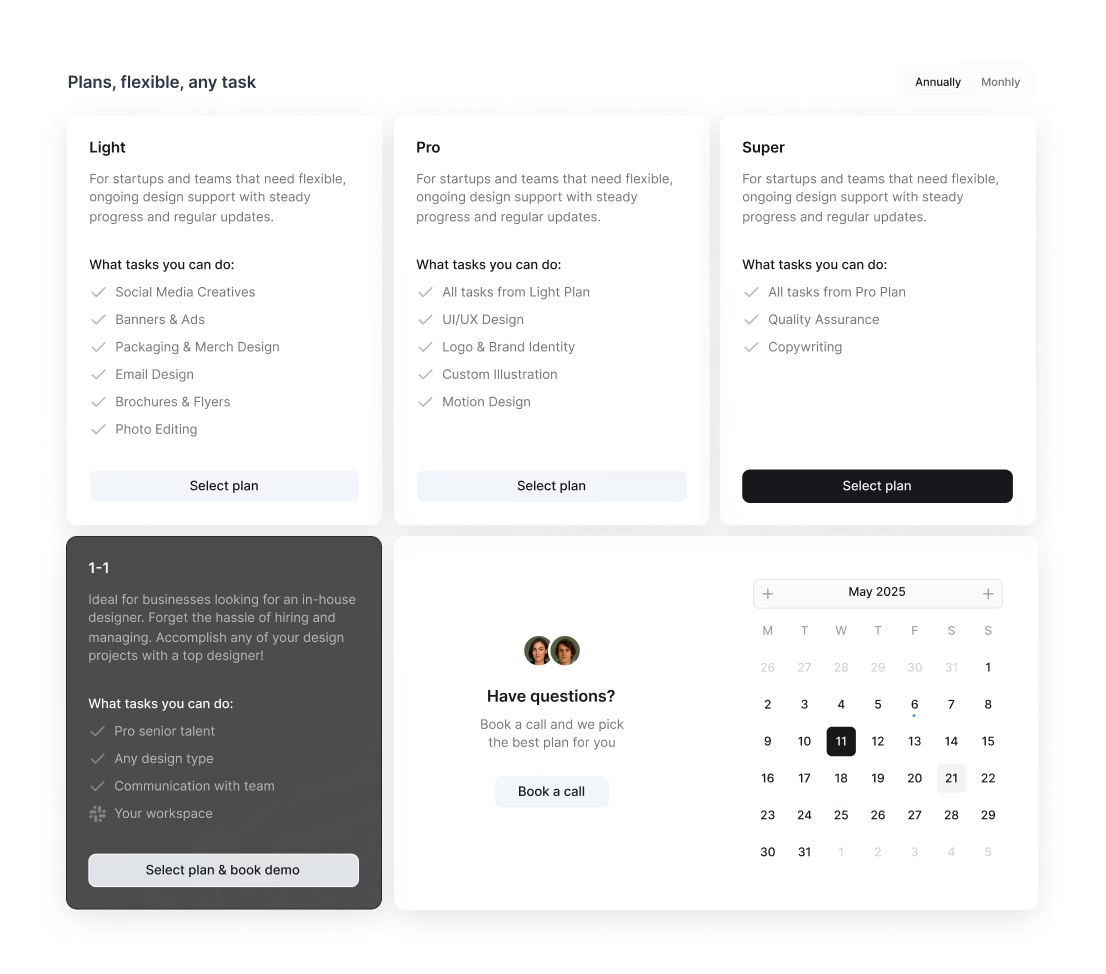
/ month


/ month


/ month
quarterly commitment
Yes, there's a better way to hire a product designer




4,000+ companies didn`t wait. They`re onboard.
































Why awesomic


0.82% talent





One subscription and your hiring problems solved

We say no to 99.18% of product designers



FAQ


How quickly can I start working with a product designer for hire?
You can start working with a product designer for hire within 24 hours. Submit your project through the subscription service, and we`ll match you to vetted experts skilled in prototyping, UX research, and testing. Get daily updates and unlimited revisions until perfect.
Can I hire a product designer for short-term or one-off projects?
Yes, you can hire product designers through Awesomic for short-term or one-off projects. Our vetted experts deliver high-quality research, prototyping, and testing with unlimited revisions, starting in as little as 24 hours. Scale your plan as needed with a simple subscription.
Are product designers experienced in startups, SaaS, or enterprise teams?
Absolutely. Our product designers boast 7 to 15+ years of experience in industries like FinTech, AI, Healthcare, SaaS, and Enterprise. They`ve delivered top-quality work for clients such as Coca-Cola, Disney, and PandaDoc, ensuring fast, reliable, and scalable results.
Can I switch designers if my needs change?
Yes, you can switch product designers anytime without extra cost. We match you with vetted experts skilled in tools like Webflow, Framer, and prototyping to fit evolving needs. Unlimited revisions and quick daily updates ensure your project stays on track with the right designer.
What does "top 1% product designers" actually mean?
Only 0.82% of product designers pass our strict vetting process, including portfolio review, multi-step skill tests, community and leadership approvals. They deliver fast, expert work with unlimited revisions. Hiring a freelance product designer here guarantees senior-level skills, quick turnaround, and no hassle.
How many revisions are included?
Every subscription for a product designer for hire includes unlimited revisions. You get daily updates and can request changes as often as needed until the design fits perfectly. If you want, you can also ask for a new designer at no extra cost.
Is this cheaper than hiring a full-time product designer?
Yes, subscribing to Awesomic costs significantly less than hiring full-time. Plans start at $500/month for part-time product designers, offering unlimited revisions, daily updates, and quick 24-hour matching. You get expert deliverables without salary, benefits, or hiring delays.
Can I pause or cancel my product designers subscription at any time?
Yes, you can pause or cancel your subscription anytime without penalties. Our flexible plans let you adjust as your needs change. Hire digital product designer with zero hassle, pay a flat monthly rate, and stop whenever you want. No long-term contracts or hidden fees.
Do product designers work in my time zone?
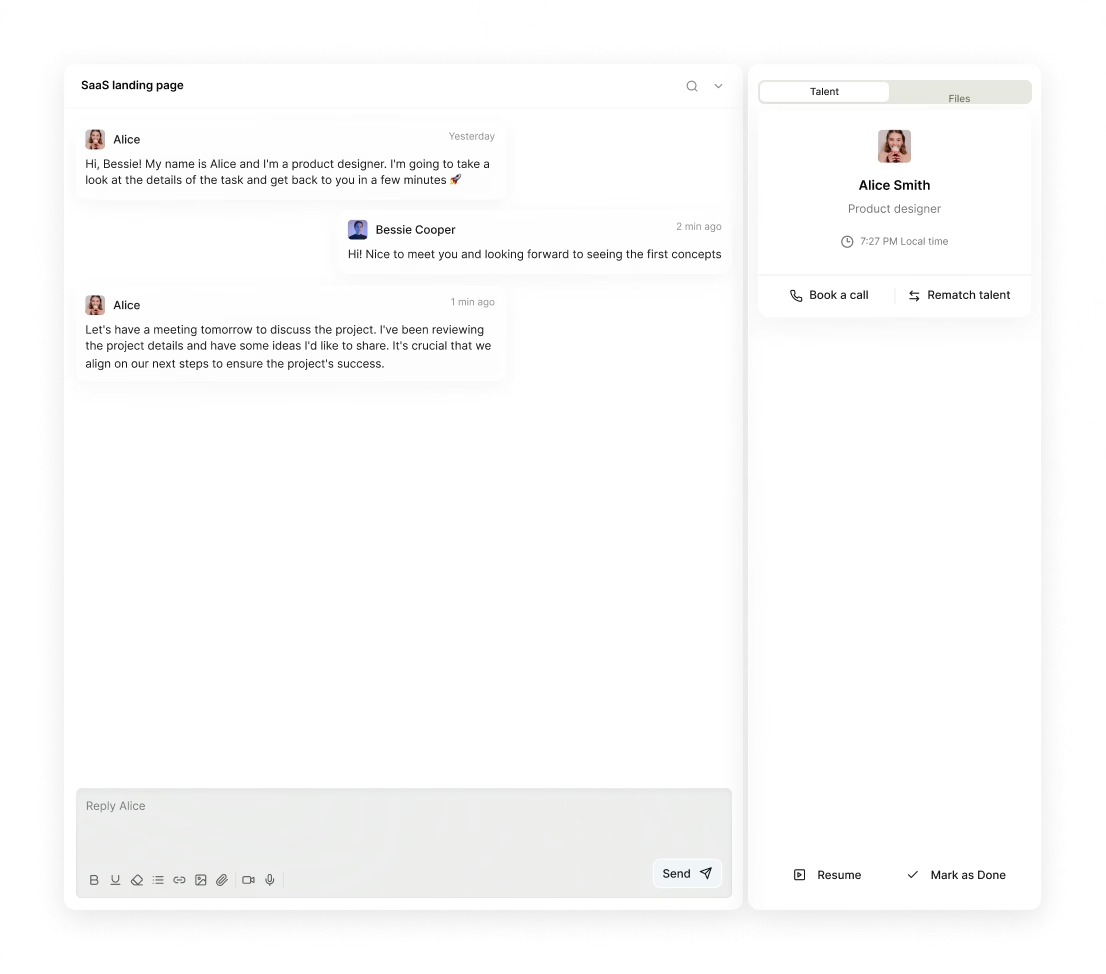
Yes, our digital product designers for hire work globally and adapt to your time zone. With daily updates and direct communication via app, Slack, or calls, you get fast, reliable deliverables and seamless collaboration no matter where you are.
Can I work with the same product designer long-term?
Yes, you can work with the same product designer long-term through our subscription model. We match you to vetted experts who stay committed, delivering daily updates and unlimited revisions. If needed, you can switch talent anytime without interrupting your project flow. Hire freelance product designer with confidence and flexibility.

Related roles you may need
Hiring guide:


A product that people love isn't designed by accident. It's designed by someone who can hold the user's problem in one hand and the business objective in the other – and find a solution that satisfies both. That's what a product designer does. Not just make things look good. Make things work.
If you're scaling a SaaS product, building a mobile app, or reworking a core user flow, the right product designer can compress months of iteration into weeks. The wrong one can produce beautiful screens that miss the problem entirely. This guide will help you hire the right one.
What does a product designer actually do?
A product designer owns the full design process for a product or feature – from understanding the problem to delivering the interface. Unlike a pure UI designer (who focuses on visual execution) or a pure UX researcher (who focuses on insight), a product designer spans the entire cycle.
Core responsibilities include:
- Problem framing → Working with product managers and engineers to define the right problem before any design starts.
- User research → Running interviews, surveys, and usability tests to understand user needs, mental models, and pain points.
- Information architecture → Structuring flows, navigation, and content hierarchy before designing screens.
- Wireframing and prototyping → Creating low and high-fidelity prototypes to test ideas quickly before committing to final design.
- Visual UI design → Designing polished, production-ready screens that work across all states and breakpoints.
- Design system contribution → Creating and maintaining reusable components within the team's design language.
- Usability testing → Validating designs with real users and iterating based on what they find confusing.
- Developer collaboration → Working closely with engineers through implementation to catch drift and ensure quality.
- Design QA → Reviewing built features against designs before they ship.
Product designers typically use Figma as their primary tool for design and prototyping, supplemented by research tools like Maze, UserTesting, or Dovetail for synthesis. Strong product designers also have a working knowledge of analytics platforms like Mixpanel, Amplitude, or Google Analytics.
Through Awesomic, you can hire a product designer who has been vetted across all phases of this cycle – not just someone who can produce attractive mockups.
When do you need to hire a product designer?
The right time to hire a product designer is before your current approach starts breaking things. That moment comes earlier than most teams expect.
Common triggers:
- You're building a new product feature and the scope is complex enough that guessing the right UX would be expensive.
- Your existing product has low engagement on key features and you don't know whether it's a discovery, clarity, or flow problem.
- Your engineering team is making UX decisions because there's no designer in the loop – and the results show it.
- Your product has grown faster than your design process, leaving inconsistency and technical debt across the interface.
- You're entering a new user segment with different needs and workflows than your current product was designed for.
- You've raised funding and need to level up the product experience to support sales and retention goals.
- Your NPS or user satisfaction scores indicate a quality problem that marketing can't fix.
Warning signs: long onboarding drop-off rates, support volume driven by confusion rather than bugs, features that get shipped and then barely used, or a growing backlog of UX-related complaints in your user feedback channels.
Awesomic matches you with a product designer who has worked in your product category – whether that's B2B SaaS, consumer mobile, fintech, or developer tools – so the ramp time is short and the strategic contribution starts fast.
What skills should a great product designer have?
Hard skills:
- Figma mastery: flows, prototyping, components, variants, auto-layout, and developer handoff.
- UX research methods: user interviews, usability testing, survey design, and synthesis.
- Information architecture: defining site maps, user flows, and task flows before any visual design.
- Data literacy: reading product analytics to identify where users drop off, where they succeed, and what to prioritise.
- Visual design: strong enough UI skills to produce production-ready screens – not just wireframes handed to another designer.
- Prototyping: building interactive prototypes in Figma or Framer to test flows before development.
- Design system thinking: building and maintaining components that scale without fragmentation.
Soft skills:
- Strategic thinking: the ability to prioritise which problems are worth solving and which tradeoffs are acceptable.
- Narrative clarity: communicating design decisions to stakeholders in terms of user outcomes and business impact, not visual preference.
- Curiosity about users: the genuine desire to understand how and why people use the product, not just to validate existing assumptions.
- Collaborative confidence: able to push back on product decisions that aren't in the user's interest, and accept technical constraints without compromising the experience unnecessarily.
- Ambiguity tolerance: most interesting product design problems are poorly defined – the ability to operate without a complete brief is essential.
Industry knowledge:
- Product development lifecycle: how discovery, design, development, and release actually work in agile environments.
- Platform design patterns: iOS, Android, and web – knowing when conventions should be followed and when they can be broken.
- Conversion and engagement mechanics: what design patterns drive activation, retention, and upgrade behaviour in digital products.
- Competitive and market awareness: understanding what alternatives users have and how design can create differentiation.
What types of product designers can you hire?
| Type | Pros | Cons | Best for |
|---|---|---|---|
| Freelancers | Fast to engage, specific expertise | Limited bandwidth, weak on long arcs | Defined feature projects, audits |
| In-house | Deep context, embedded in team | Slow to hire, high cost | Product companies with sustained design volume |
| Agencies | Full team, structured process | Expensive, slower iteration, context-limited | Major product overhauls with strategy scope |
| Subscription / TaaS | Senior talent, fast start, scalable | Less embedded than in-house | Startups and scaleups with ongoing design needs |
Within product design, there are also meaningful specialisations worth distinguishing:
- Full-stack product designers → Cover the full cycle from research to UI – the most versatile and most in-demand type.
- Systems-focused product designers → Specialise in design systems and component governance, often embedded in platform teams.
- Growth-focused product designers → Specialise in activation, conversion, and retention flows – most valuable in B2C or product-led growth contexts.
Awesomic's matching process identifies which type you actually need for your brief, not just the nearest available designer.
How much does it cost to hire a product designer?
Typical rates
- Freelancers → $75–$130/hr mid-level; $130–$200/hr senior.
- Agencies → $150–$350/hr; full product design engagements often $30,000–$120,000+.
- In-house salaries → $100,000–$160,000/year depending on seniority and location.
What drives the price up
- Full-cycle vs. UI-only scope: product designers who run research add cost but prevent expensive build cycles on the wrong solutions.
- Platform complexity: multi-platform products (web + iOS + Android) require more design and testing effort.
- System scope: building a design system from scratch alongside feature design is a significant additional commitment.
- Domain complexity: fintech, healthcare, and B2B enterprise products require specialist knowledge that commands premium rates.
Pricing models
- Sprint retainer → Most common for agile teams – a product designer embedded for each two-week sprint.
- Project-based → Common for defined scopes like an onboarding redesign or a new feature end-to-end.
- Monthly subscription → Ideal for ongoing design needs across multiple features and quarters.
Budget guidance
- Budget for research – a product designer who skips discovery will design confidently in the wrong direction.
- Don't scope by screens – scope by user journeys. A checkout flow has 12 screens and dozens of states, not 12 units of work.
- The cost of building the wrong feature exceeds the cost of discovering it's wrong before building it. Research is the cheaper path.
Through Awesomic, you access senior product designers on the 1 to 1 plan – flat monthly subscription, unlimited requests and revisions, no per-sprint negotiation.
Where can you find the right product designer?
- Dribbble and Behance → Good for finding visual quality, but rarely show research or process depth.
- Portfolio sites and case studies → Look for designers who show their process, not just their outputs – Medium, Notion case studies, and personal sites often contain richer work documentation.
- Layers.to → Curated product design portfolios; strong on systems and interface craft.
- LinkedIn → Best for experienced product designers with documented career history.
- Product design communities → Designer Hangout, Product Design Slack groups, and ADPList for referrals from practitioners.
- Vetted talent platforms → Awesomic for pre-screened product designers matched to your domain and stage.
Sourcing a product designer cold is notoriously difficult because the portfolio – often confidential client work – doesn't reveal what you most need to know: how they think, how they handle ambiguity, and whether they can run a research session that produces actionable insight.
Awesomic's vetting process evaluates product designers on a real-world task, not just portfolio screenshots – which is why the quality of the match is meaningfully better than cold sourcing.
How do you evaluate a product designer's portfolio?
Don't evaluate screens. Evaluate thinking.
- Does the case study show the problem, not just the solution? A great product design portfolio explains what problem existed, what research was done, and what tradeoffs were made – not just how the final design looks.
- Is there evidence of iteration? Show me the version before the final one. Designers who show evolution show that they actually use feedback.
- What research methods did they use? Interviews, testing, analytics – any or all. A designer who never mentions research is a UI designer pretending to be a product designer.
- How do they handle failure? Ask them about a project that didn't go as planned. How they answer tells you more than any polished case study.
- What outcomes did the design drive? Conversion rate improvements, retention lifts, support volume drops – connecting design to results is a sign of strategic maturity.
- Is the visual quality credible for your product type? Beautiful consumer apps and dense B2B dashboards require very different visual sensibilities.
What questions should you ask before hiring?
- Walk me through a project from research to shipped product. What decisions did you make that weren't obvious at the start?
- How do you decide what to design first when everything feels important?
- Tell me about a time you pushed back on a product decision based on user insight. What happened?
- How do you balance user needs with business constraints in your design decisions?
- How do you handle a feature request that you believe is the wrong solution to the right problem?
- What does your handoff process look like? How do you ensure developers build what you intended?
- How do you measure the success of your design work after it ships?
- Can you show me a prototype you built to test a specific hypothesis?
How do you work successfully with a product designer?
- Involve them at problem definition → The most expensive mistake is handing a product designer a fully scoped feature to design. Let them into the "why are we building this" conversation.
- Share all the context → Analytics data, user feedback, support tickets, sales call recordings – real signal is irreplaceable.
- Define the design sprint rhythm → How often does design feed into development? Weekly? Two-week cycles? Make the cadence explicit so dependencies don't create blockers.
- Establish decision rights → Who can approve a design direction: the product manager, the designer, both? Ambiguity here causes revision cycles that aren't about the design.
- Review prototypes before pixels → Approving the flow and hierarchy before the visual design is finalised saves the most time.
- Close the feedback loop → Share post-ship analytics with the designer. A product designer who sees the impact of their work improves faster and makes better decisions on the next feature.
Awesomic structures every engagement with a dedicated PM who handles communication, brief intake, and delivery tracking – so your product designer spends their time designing, not chasing approvals.
How do you know you hired the right product designer?
The right product designer makes your entire product function better over time, not just look better.
Signs you made the right call:
- Features ship with fewer edge case surprises because the designer thought through the full flow.
- User research findings start changing which features you build – not just how they're designed.
- The engineering team reports fewer late-breaking design changes during implementation.
- Retention or engagement metrics on redesigned flows improve after release.
- The design system matures with each sprint rather than accumulating exceptions.
- Product decisions become more grounded – stakeholders start asking "what did users say?" before asking "what should this look like?"
If a product designer is producing beautiful UI without evidence of research or strategic thinking – or running research without connecting it to design decisions – address the gap directly. The best product designers make both halves of the cycle work.
When you hire a product designer through Awesomic, you get someone who has been evaluated across the full product design competency – not just the visual layer. And the longer the engagement, the more valuable the relationship: deep product context compounds, and a designer who has spent three months inside your product will design better than a new hire in their first week, every time.


