




9 Best Presentation Design Subscription Services in 2026

Key takeaways:
- A presentation design subscription is a recurring fee for slide work you keep needing, which is a different purchase from commissioning a single deck and paying once for it.
- Flat monthly rates here start at $449 and reach $2,995, with higher tiers above that. Two vendors meter capacity instead, charging by the hour or by the slide, and those are not comparable to a flat fee without doing the arithmetic.
- The specialist industry is small. Federal figures count 7,901 US establishments in document preparation services, so most buyers end up choosing between a boutique and a general design subscription.
- Decks aimed at a federal audience must meet the Section 508 standards, and the GSA publishes the PowerPoint authoring guides that define what conforming actually means.
A presentation design subscription is a monthly plan under which a vendor designs slides for you on request, rather than quoting each deck as a project. You keep a queue, they work it, and the fee stays the same whether you send one deck or six.
The reason the model exists is that deck work is unusually lumpy. A sales team needs a template refresh in March, an investor update in April and a conference keynote in June, and none of those is big enough to justify a hire while all of them together are too much for the person who currently does it at midnight.
This list covers vendors who sell that arrangement as a subscription or a recurring membership. It excludes project-based deck agencies, which are a genuinely good option when the work has a start and an end, and which we cover in our roundup of presentation design agencies.
Awesomic appears first because presentation work is part of our subscription, and hiding that would be worse than stating it. Every detail below about the other eight came from the vendors' own pages, checked in September 2026.
Who actually needs a subscription rather than a deck
Not everyone here should buy one, and the honest test is frequency rather than budget.
If you need one important deck and then nothing for six months, a project quote is cheaper and cleaner. You pay for a defined outcome, you get it, and no fee renews in the background.
A monthly presentation design service starts making sense at roughly two decks a month, or at the point where somebody internal is quietly spending a day a week in slide software. That is when the recurring fee stops being an expense and starts replacing labor you were already paying for.
The awkward middle case is the template. Many teams buy a subscription to get one good master template built, then discover they have nothing to fill the queue with. If that is you, buy the template as a project and revisit the subscription when volume actually arrives.
Larger organizations tend to hit the threshold sooner, since a mid-market design partner is usually absorbing deck requests from three or four teams at once rather than one.
The 9 best presentation design subscription services
The table groups the nine by how they charge, because a flat monthly fee and an hourly membership are not the same product even when the annual spend lands in the same place.
| Service | Model | Best for | What you get | Pricing (from) | Rating |
|---|---|---|---|---|---|
| Awesomic | Broad subscription | Decks alongside brand and web work | Presentations, brand, web, product design | $1,490/month | ★★★★★ |
| Penji | Broad subscription | Volume marketing design with decks in it | Presentations, documents, marketing graphics | $995/month | ★★★★☆ |
| PitchWorx | Deck specialist | One flat fee with no tier decisions | Presentations plus seven other categories | $699/month | ★★★★☆ |
| Cueball Creatives | Deck specialist | The cheapest genuine monthly entry | PowerPoint and pitch deck design | $449/month | ★★★★☆ |
| Epiic Design | Deck specialist | Multi-brand teams ordering constantly | Unlimited presentations, unlimited brands | Quoted | ★★★★☆ |
| Design Cloud | Deck specialist | A named UK designer on a flat fee | Unlimited presentation design | Quoted | ★★★☆☆ |
| Slidey | Deck specialist | Straightforward recurring deck support | Presentation requests on a monthly fee | Quoted | ★★★☆☆ |
| SketchDeck | Metered membership | Buying deck hours, not deck tickets | Design hours with a project manager | 75 hours/month | ★★★★☆ |
| 24Slides | Metered per slide | Paying only for what you actually send | Per-slide design at published rates | $11/slide | ★★★☆☆ |
Ratings reflect fit for recurring presentation work specifically. Several of these firms also take one-off projects, which is a separate purchase priced separately.
Design subscriptions that include presentations
The two vendors below sell design capacity broadly, with decks as one output among many. Choose from here when slides are a real need but not the only one.
Awesomic
Best for: Decks alongside brand and web work
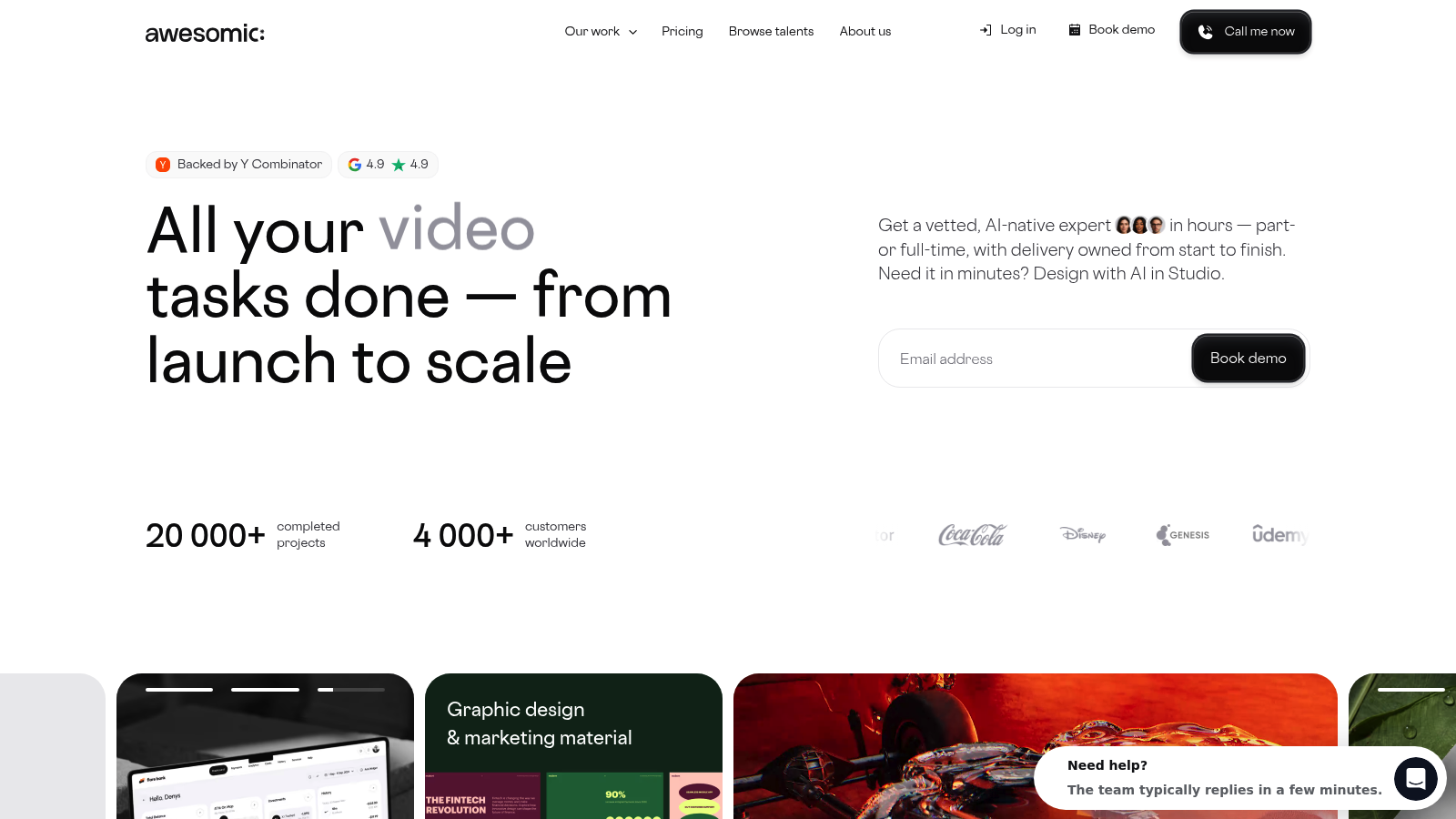
Overview: Presentations sit inside the same monthly subscription that covers your brand, site and product work, handled by one assigned designer. Slides join the queue like anything else, and the next deck goes to the same person.
That matters for decks more than for most formats, because a presentation is downstream of a brand. A designer who already built your identity does not need a style guide explained before they can lay out a slide.
The other practical effect is template continuity. Decks decay when six people edit a master file nobody owns, and having one designer maintain it is usually cheaper than the meeting about why the logo is stretched.
Endorsed, a US HR-tech company whose AI recruiting assistant the firm says cuts resume review time by up to 90%, is a fair illustration. Its engagement with us ran eight months and covered a UI/UX audit, brand guidelines, a website redesign and presentation work, all through the same subscription.
Core services:
- Slide design handled by whoever already owns your brand system
- Master template creation and ongoing maintenance
- Sales, investor and conference decks built to the same system
- Brand identity, web and product work drawn from one fee
- Copy and QA folded in once you are on All-in-One
Industries served: SaaS, HR tech, fintech, professional services, startups
Pricing: Slide work sits inside Graphic Pack at $1,490 monthly. Teams needing the site and copy alongside it take All-in-One at $2,995. A $200 AI Designer plan sits below both, a quoted Dedicated Talent plan above them, and paying by the quarter removes a fifth of the bill.
Pros: decks stay consistent with the brand because one designer owns both, template maintenance included, rates stated openly, no per-deck quoting, stop between months
Cons: we are not a deck specialist, so a boardroom-grade investor narrative may want one of the boutiques below, and one task runs live per published plan
Getting going: Sign up, describe the deck, and get introduced to the designer who will build it. Everything runs through the app with Slack alongside, on a plan that renews each month instead of closing at delivery.
Why it belongs among presentation design subscription services: Because most teams sending decks regularly also need everything the deck refers to, and splitting that across two vendors is how brands drift.
Final verdict: The right pick when presentations are one of several recurring design needs. For deck-only work, read the specialists.

Penji
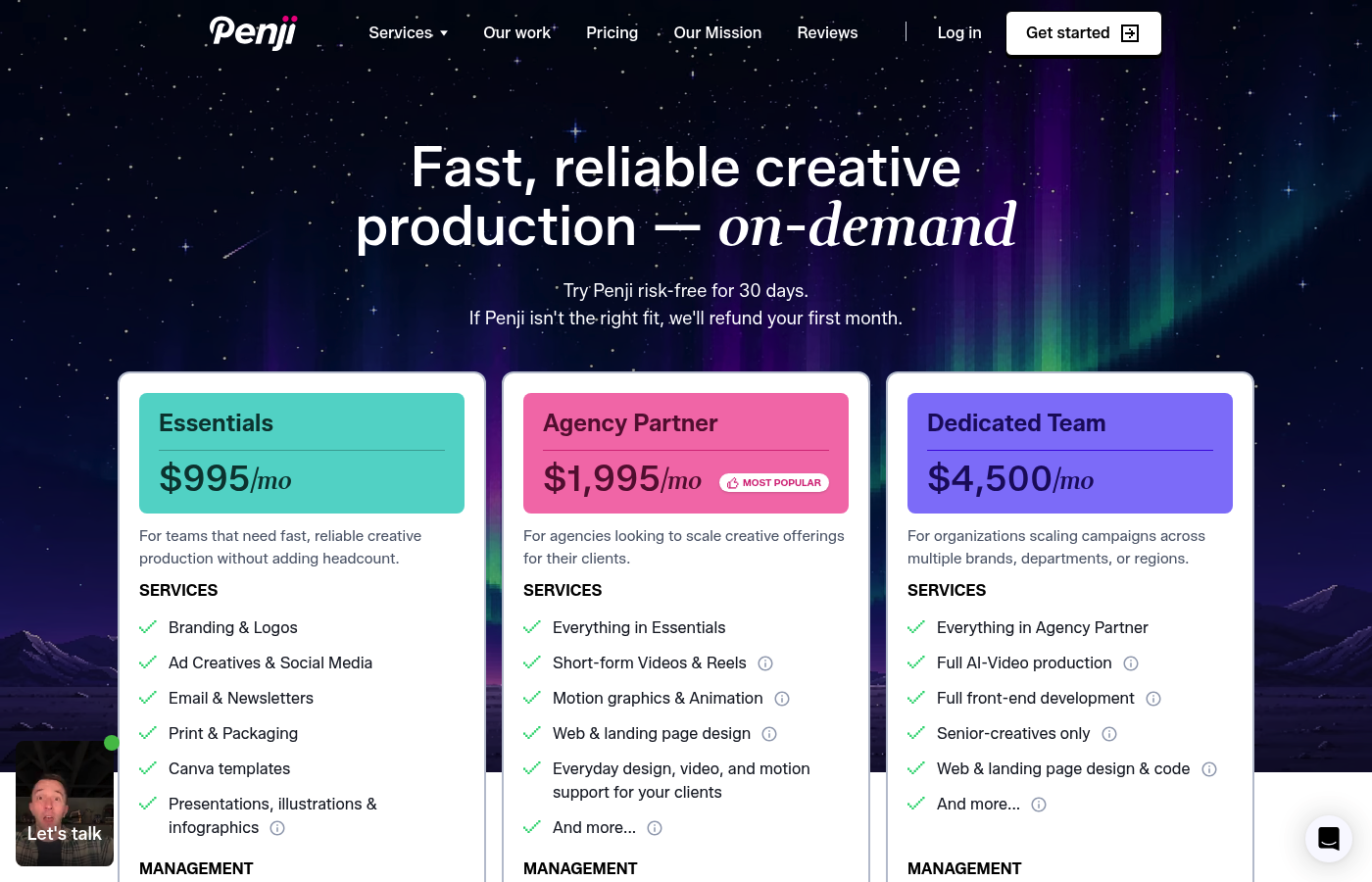
Overview: A high-volume design subscription that lists presentations and documents as included on every tier, aimed at marketing teams producing a constant stream of assets rather than occasional showpieces.
Its strength is throughput rather than narrative craft. If you need forty on-brand slides next week, that is the problem this is built for; if you need one deck that wins a Series B, it probably is not.
Core services:
- Presentations and documents included at every plan level
- Marketing graphics, illustration and infographics alongside decks
- A dedicated team at the higher tiers
Industries served: Marketing teams, agencies, SMBs, ecommerce
Pricing: Essentials runs $995 a month, Agency Partner $1,995, and a Dedicated Team plan starts at $4,500. Billing quarterly takes off 15% and annually 20%. A 30-day refund applies to the first month.
Pros: presentations included on every tier rather than sold as an add-on, three published rates, real volume capacity, refund window on the first month
Cons: built for marketing throughput rather than high-stakes narrative decks, the lowest tier is limited on concurrency, and design direction is broad rather than presentation-specialist
Notable clients or work: Publishes marketing design across presentations, documents and campaign assets.
Where it fits: Teams whose deck problem is quantity rather than consequence.
Final verdict: Good value if slides are part of a wider content machine.
Presentation specialists on a flat monthly fee
The five vendors below do decks and little else. That focus buys you people who think in slides, and a pitch deck design subscription from a specialist is the right trade when the presentation itself is the deliverable that matters. How the vendor assigns your designer decides most of the experience, which is why getting matched properly matters more than the tier you pick.
PitchWorx
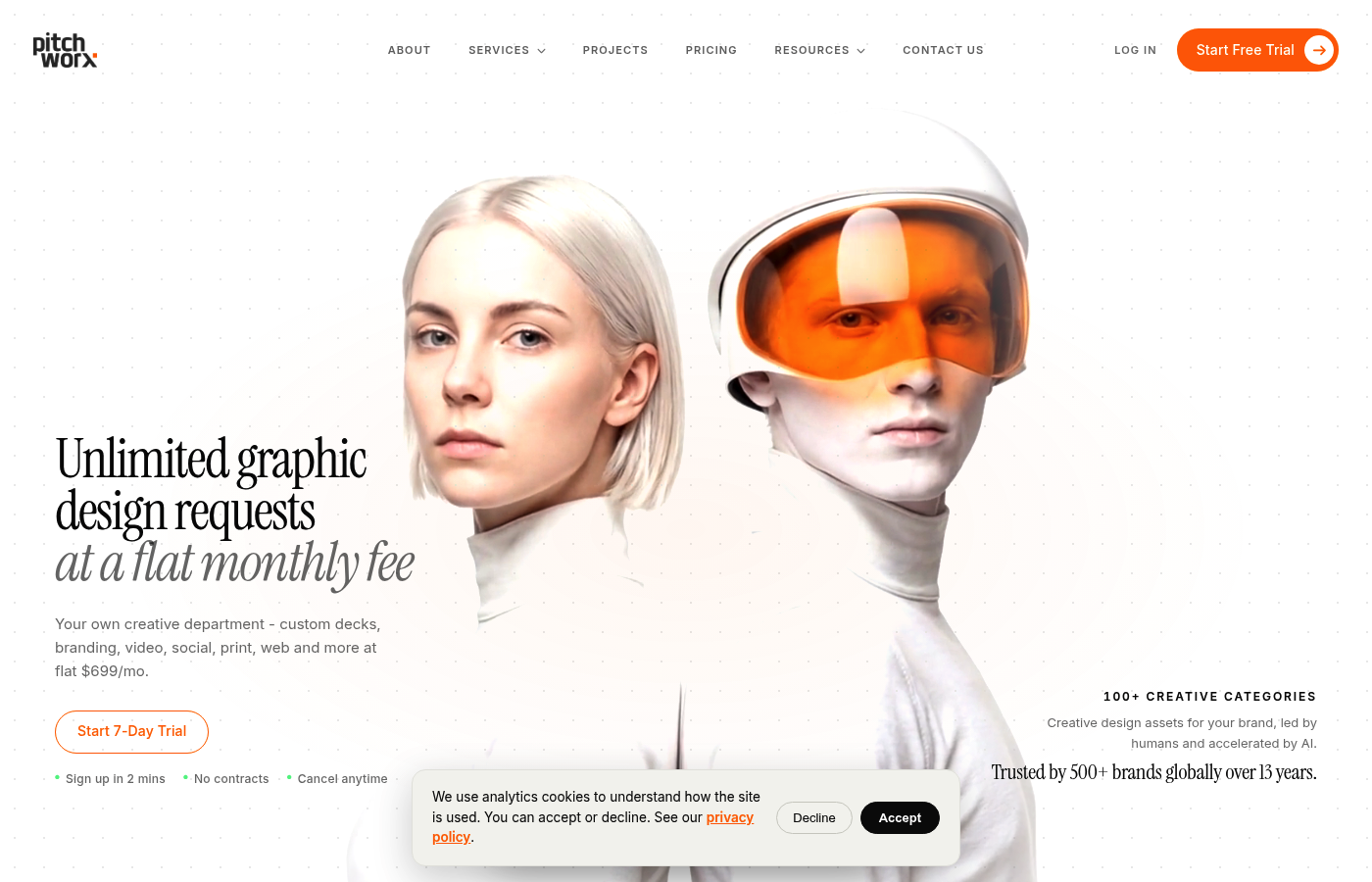
Overview: A design subscription built around presentations and sold as a single plan, which removes the tier comparison that makes most of this category tedious to shop.
PitchWorx leans on AI in delivery rather than treating it as a marketing word, and names large consumer brands among its clients, which is unusual candor at this price point.
Core services:
- Presentation and pitch deck design as the core offer
- Seven further design categories inside the same plan
- AI-assisted production to shorten turnaround
Industries served: Founders, enterprise marketing teams, consumer brands
Pricing: One plan at $699 a month, covering eight service categories with no tier ladder to climb.
Pros: a single published price with nothing to compare, eight categories rather than decks alone, names recognizable brands publicly, cheapest specialist entry with this breadth
Cons: one plan means no way to buy less if your volume is small, AI-assisted output needs checking on high-stakes work, and breadth across eight categories dilutes pure deck specialism
Notable clients or work: Names Kellogg's, PepsiCo, Samsung and Aviva among the brands it has worked with.
Its strongest suit: Removing the decision entirely, which is worth more than it sounds.
Final verdict: The simplest purchase here, and a fair price for the breadth.
Cueball Creatives
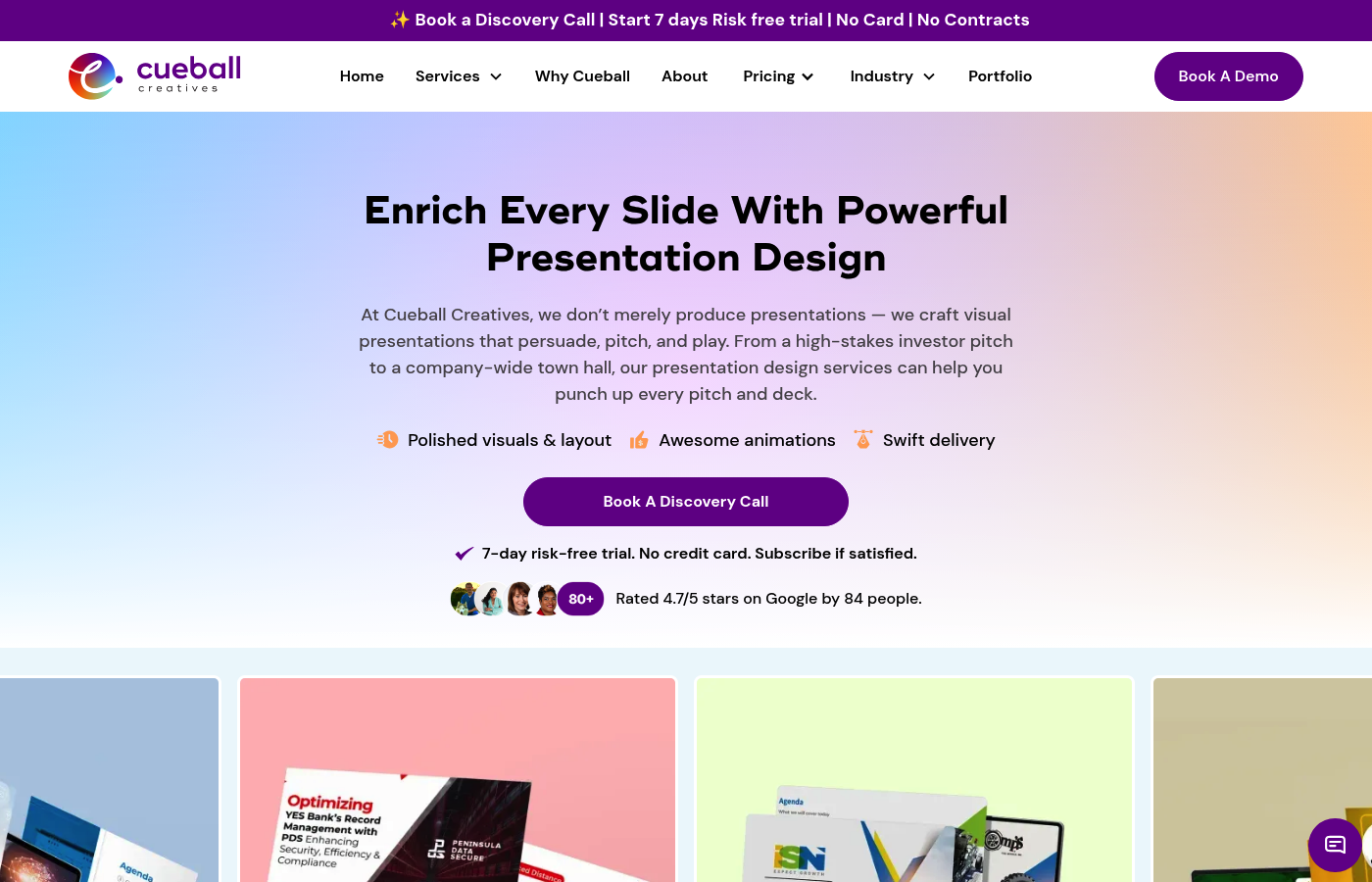
Overview: A PowerPoint and pitch deck subscription with two published tiers, pitched at startups and small teams who are currently designing slides themselves or chasing freelancers who go quiet.
Its own copy is unusually direct about the problem it solves, and the entry rate is the lowest genuine monthly figure on this list.
Core services:
- PowerPoint and pitch deck design on a monthly plan
- A dedicated designer rather than a rotating queue
- Quarterly billing at a reduced monthly rate
Industries served: Startups, small teams, founders raising
Pricing: Starter is $449 a month and Scale is $1,199. Paying quarterly drops Starter to $359 a month, billed as $1,077 for the quarter. ⚠ The saving figures shown alongside those rates are discounts, not prices.
Pros: the lowest monthly entry among specialists, a named designer at the entry tier, quarterly billing genuinely reduces the rate, two clear tiers
Cons: only two tiers, so scaling past Scale means a conversation, deck-only scope, and a small operation with a finite bench
Notable clients or work: Publishes PowerPoint and pitch deck work for startups and small teams.
Why buyers shortlist it: Under $450 buys a dedicated designer, which is rare anywhere on this page.
Final verdict: The best value at the small end, provided decks are all you need.
Epiic Design
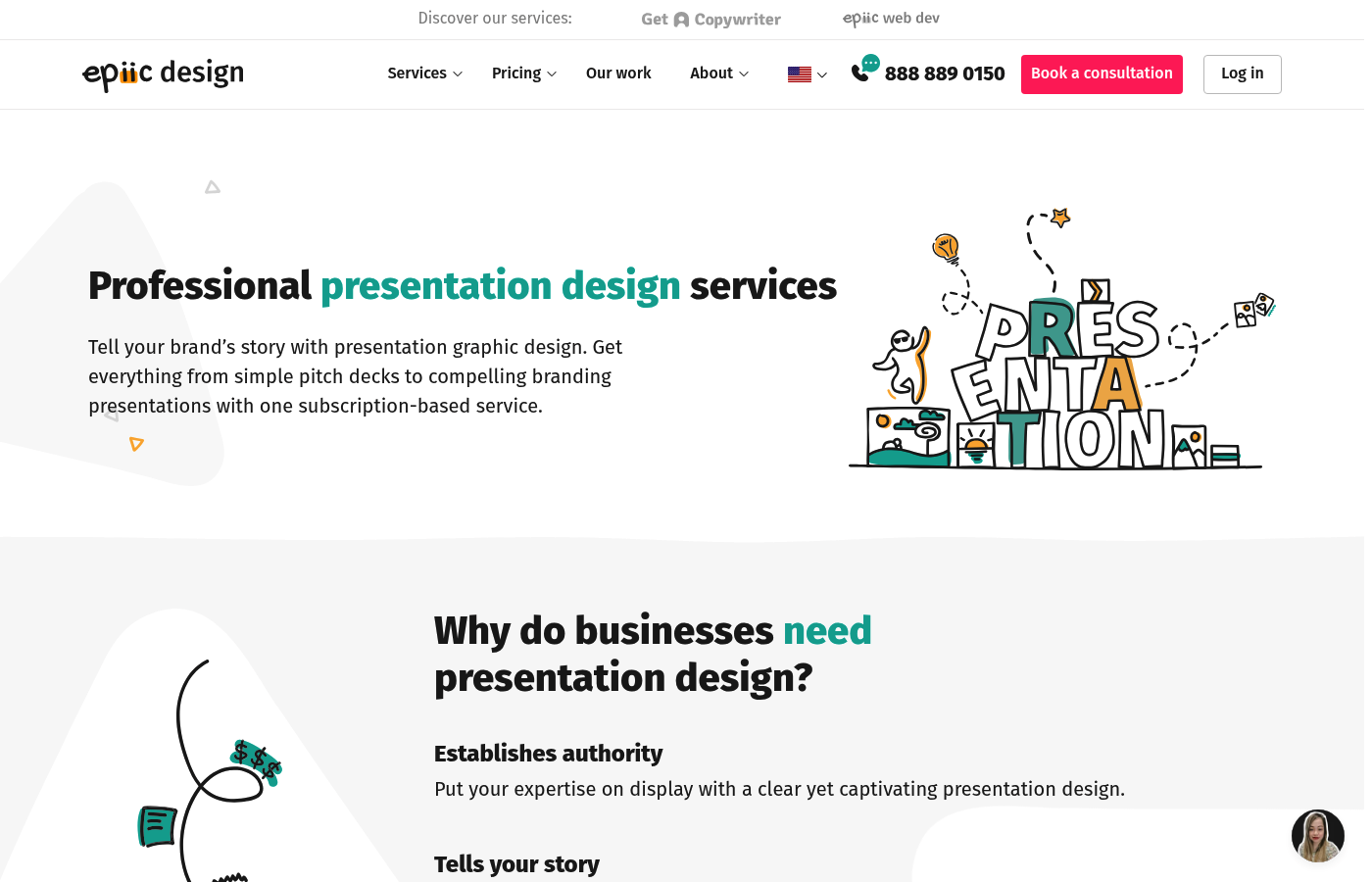
Overview: A presentation service offering a choice between a flexible subscription and one-off pricing, with unlimited brand profiles inside a single plan.
The multi-brand allowance is the distinguishing feature. Agencies and holding companies running slides for several brands normally pay per brand, and not doing so materially changes the arithmetic.
Core services:
- Unlimited presentation orders on a subscription plan
- Unlimited brand profiles under one account
- A one-off pricing route for single decks
Industries served: Agencies, multi-brand businesses, sales organizations
Pricing: No rate appears on the page. Both the subscription and the one-off option are quoted after contact.
Pros: unlimited brands under one fee, a genuine one-off route if volume drops, unlimited ordering inside the plan
Cons: nothing published to compare against, unlimited ordering says nothing about how fast things arrive, and the choice of two models adds a decision back in
Notable clients or work: Publishes presentation work delivered on both subscription and single-project terms.
Where it beats the alternatives: Anyone maintaining slide systems for more than one brand.
Final verdict: Worth a call specifically if you run multiple brands. Ask what unlimited limits.
Design Cloud
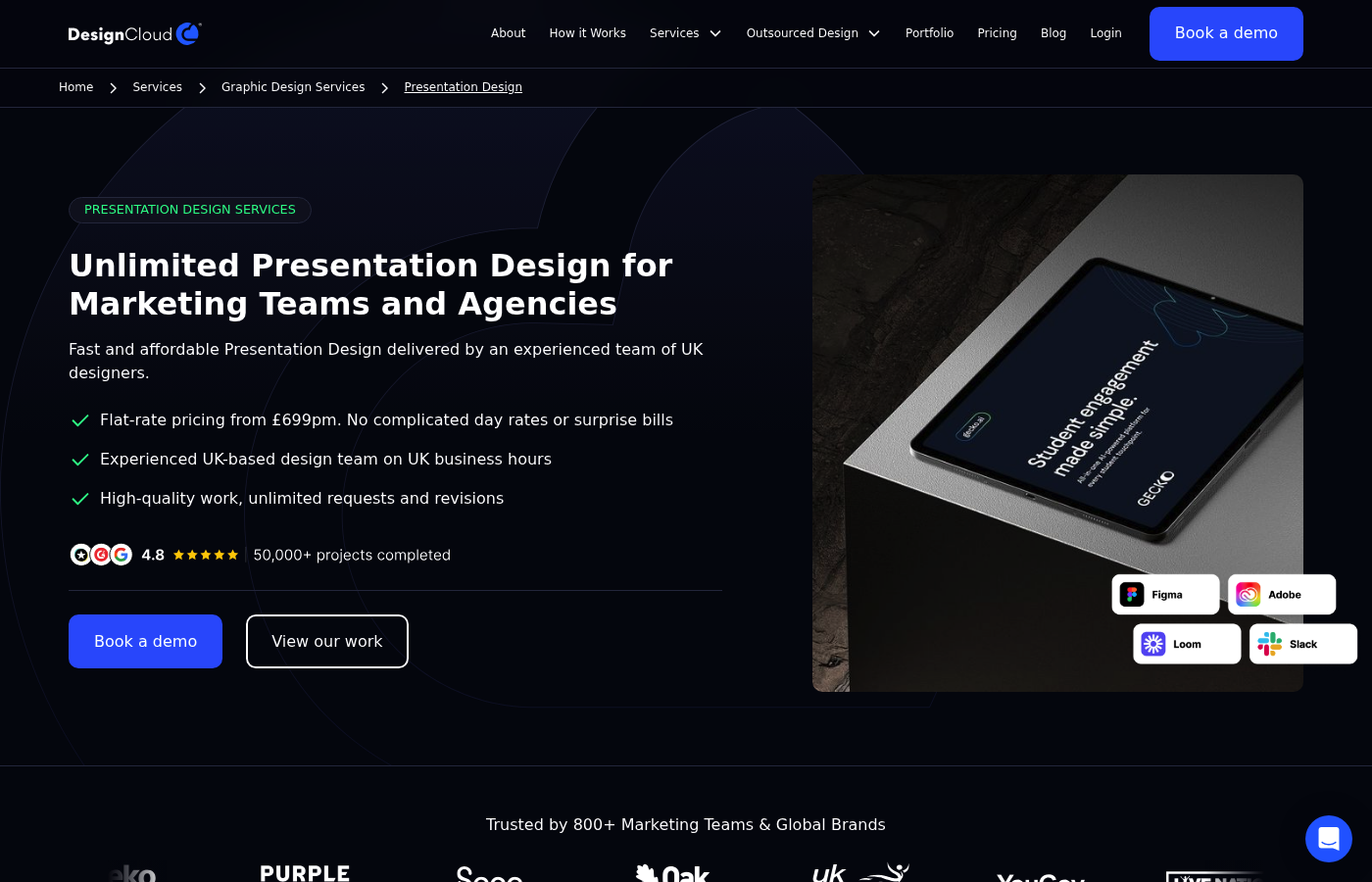
Overview: An unlimited presentation design service on a flat fee, staffed by a dedicated UK-based designer and pitched at teams who want consistency across a large slide estate.
Its promise is a single rate with no hidden extras, which is a clear position, though the rate itself is not on the page.
Core services:
- Unlimited presentation design on one flat monthly fee
- A dedicated designer assigned to the account
- Deck consistency work across existing slide libraries
Industries served: UK and international businesses, sales and marketing teams
Pricing: Not published. The site describes one flat rate with no hidden fees but does not say what it is.
Pros: a named dedicated designer rather than a pool, flat-fee simplicity, focused specifically on presentation consistency
Cons: no figure published anywhere, the designer is UK-based so US West Coast overlap is limited, and a flat fee with no stated number is hard to shortlist
Notable clients or work: Publishes presentation and deck consistency work for business clients.
Best angle: Cleaning up a sprawling slide library and keeping it clean.
Final verdict: A sound proposition once you have made them state the fee.
Slidey
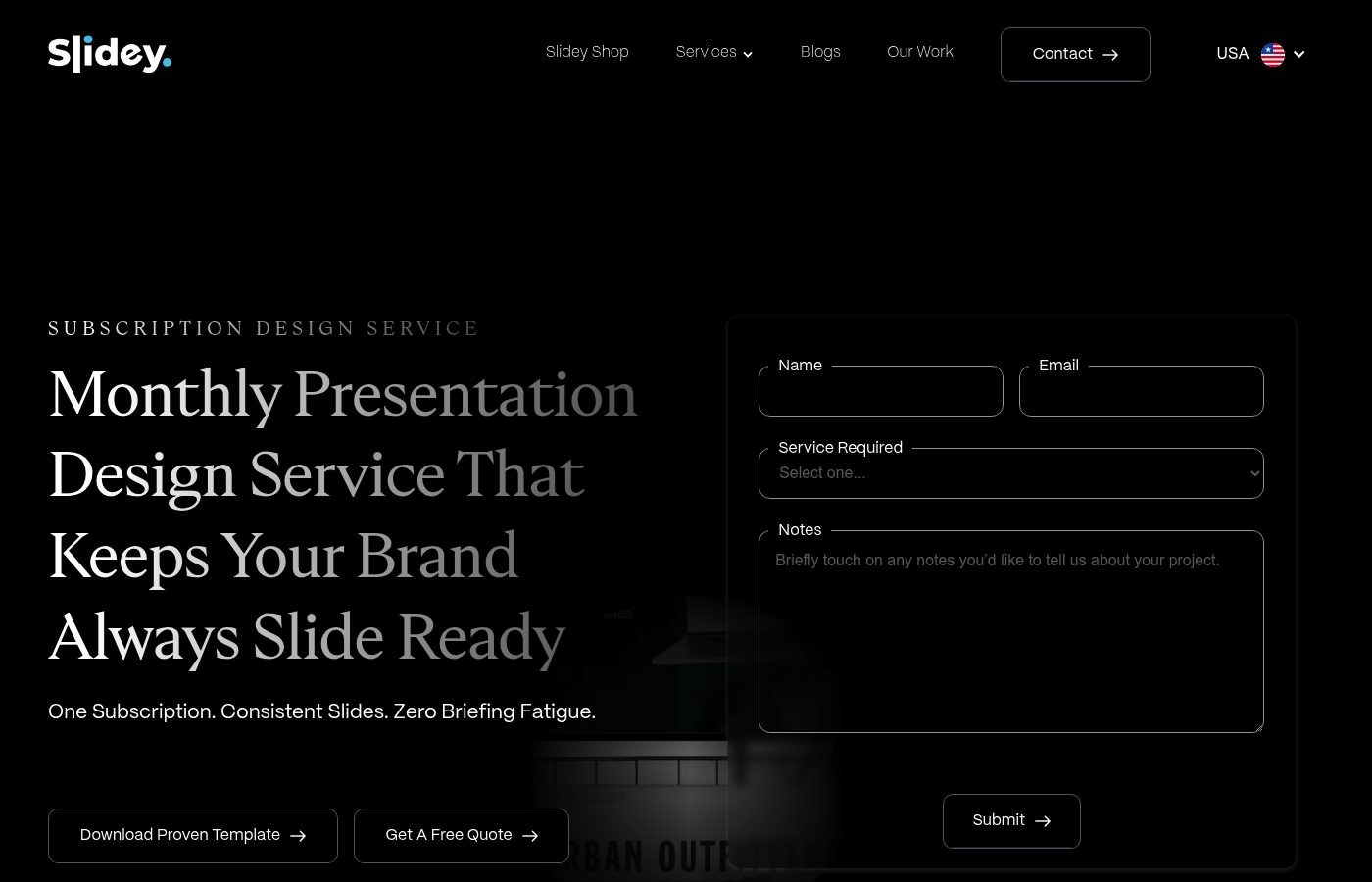
Overview: A monthly presentation design service built on the straightforward premise that clients submit deck requests as they arise and pay a recurring fee rather than a per-project quote.
Its site spends more effort than most on the operational argument, which is that cheap per-deck work usually creates internal cost elsewhere, and that is a fair point honestly made.
Core services:
- Presentation requests submitted as needed on a recurring fee
- Ongoing deck support rather than project close-out
- Template and slide-system work
Industries served: Businesses with recurring internal and client-facing decks
Pricing: No figure is rendered on the page. The recurring fee is set after a conversation.
Pros: clear framing of what recurring deck support actually replaces, requests submitted as they arise, ongoing rather than project-shaped
Cons: no published rate, less detail about team size than competitors offer, and the model description is stronger than the specifics behind it
Notable clients or work: Publishes recurring presentation support for business clients.
Where it wins: Teams tired of raising a purchase order per deck.
Final verdict: A reasonable fit for steady internal deck volume once priced.
Recurring capacity metered by hours or slides
The final two do not sell a flat fee at all. They sell measured capacity, which makes them the honest choice when your volume is genuinely unpredictable, and a closer relative of buying graphic design by the piece than of subscribing to it.
SketchDeck
Overview: An on-demand design partner selling capacity in hours rather than requests, with a membership tier for teams whose creative needs recur every month.
Because it prices by role, you can see exactly what a director costs against a production designer, which no flat-fee vendor on this list lets you do.
Core services:
- Membership capacity sold as monthly base hours
- A project tier for ad hoc needs with a smaller hour minimum
- Project manager and quality control on every engagement
Industries served: Marketing and communications teams, enterprises
Pricing: The membership tier starts at 75 base hours per month, and the project tier at 25 hours for a first engagement. Rates are published by role: $125 an hour for production, $187.50 for design and $250 for director-level work.
Pros: rates published by role, which is rare and genuinely useful, hours are auditable in a way tickets are not, project management included, a smaller project tier to start with
Cons: a 75-hour monthly minimum is a substantial commitment, hourly billing rewards tight briefs and punishes vague ones, and design breadth means it is not deck-specialist
Notable clients or work: Publishes marketing and communications design delivered on an hours basis.
Why it made this list: It is the only vendor here that tells you what each level of seniority costs.
Final verdict: The most transparent structure on the page, at a minimum most small teams will not clear.
24Slides
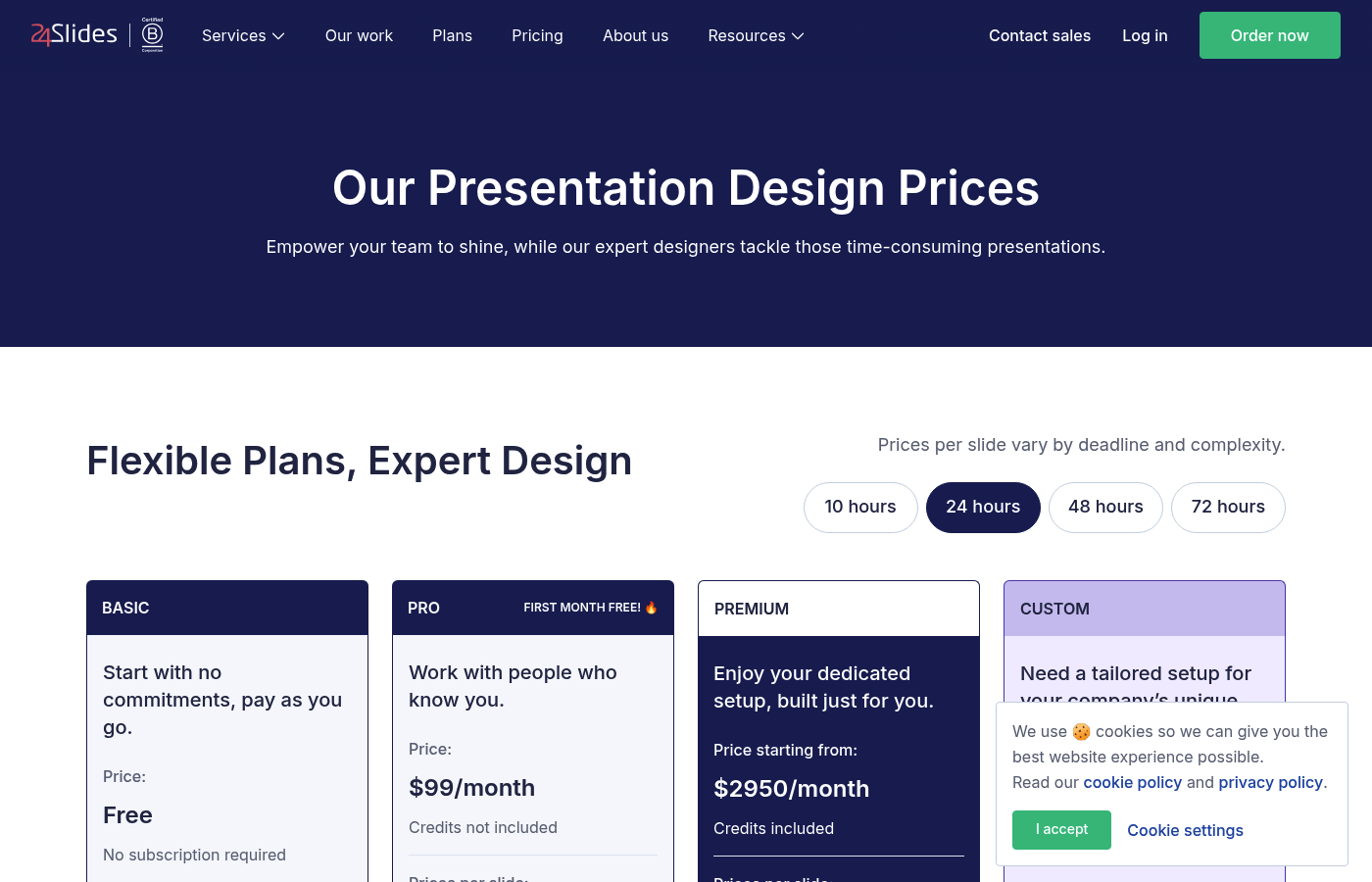
Overview: A presentation design service priced per slide rather than per month, which makes it the outlier here and, for irregular volume, sometimes the correct answer.
⚠ It is included because buyers shopping this category keep landing on it, and because a per-slide rate is worth understanding before you commit to a monthly fee you may not fill.
Core services:
- Per-slide presentation design at published rates
- Tiered options varying by deadline and complexity
- Fix-up work on existing slides as a separate rate
Industries served: Corporates, consultancies, enterprise teams
Pricing: From $11 a slide, with the exact rate set by deadline and complexity. Fix-up rates on existing decks are published separately at $14 and $16 a slide depending on tier.
Pros: you pay only for slides you actually send, published rates with no call required, existing-deck fix-up priced separately, no monthly commitment
Cons: not a subscription, so none of the continuity benefits apply, costs become unpredictable at volume, and a hundred-slide month will exceed most flat fees here
Notable clients or work: Publishes corporate and enterprise presentation work at volume.
Where it fits: Genuinely irregular deck needs, or a one-off rescue.
Final verdict: The right call below roughly forty slides a month, and the wrong one above it.
How we chose these nine
The filter was the business model. A vendor had to sell decks on a recurring basis, whether that recurs as a flat fee, a membership or a published per-slide rate you can buy repeatedly without renegotiating.
That rule removed several well-known presentation firms whose sites describe project work only, and we left them out rather than implying a subscription they do not offer. It is also why one per-slide vendor is here and clearly labeled as the exception.
Each remaining vendor was read on its own site. Four publish a monthly figure, one publishes hourly rates, one publishes per-slide rates and three publish nothing at all. ⚠ Where a page displayed a number that was not a fee, we excluded it: one vendor's quarterly panel shows the amount you save rather than the amount you pay.
Nine is a smaller list than this category's search volume suggests, and that is the finding rather than a shortfall. Most deck work is still sold as projects, which is why buyers researching how to outsource design usually meet project quotes before they meet a monthly plan.
What a presentation design subscription costs
The published figures fall into four shapes, and comparing across them requires converting everything into a monthly number before you look at the ranking.
| Model | Published cost | What it buys | Right when |
|---|---|---|---|
| Specialist flat fee | $449 to $699 | A dedicated deck designer, monthly | Decks are steady and self-contained |
| Broad subscription | $995 to $2,995 | Decks plus brand, web and marketing design | Slides are one of several needs |
| Higher-tier subscription | $1,199 to $4,500 | More concurrency or a named team | Several decks run in parallel |
| Hourly membership | 75 hours a month | Auditable capacity priced by role | Briefs are tight and volume is high |
| Per-slide | $11 to $16 a slide | Exactly the slides you send | Volume is genuinely irregular |
Set that against the specialist labor market, which is smaller than most buyers assume. Federal employment and wage data counts 7,901 establishments nationally in this line of work, employing 38,552 people at an average annual pay of $54,172 in 2024. That is a modest industry, and it explains both why the subscription options are few and why most of them are boutiques rather than scaled operations.
The practical consequence is that capacity is the constraint you should test, not price. A four-person studio on a flat fee is excellent until two clients need a deck in the same week, and the question worth asking is what happens then.
The accessibility requirement most buyers miss
Decks that go anywhere near a federal audience carry a legal standard, and almost nobody raises it during vendor selection.
The GSA's guidance on accessible presentations sets out how to build slides that conform to the Section 508 standards, and it publishes authoring and testing guides for PowerPoint specifically. Conformance is not a stylistic preference; for federal agencies and their contractors it is a procurement requirement.
What that means in practice is unglamorous and entirely learnable: every slide needs a unique title, images need alternative text, reading order has to be set deliberately rather than left to the order shapes were added, and color alone cannot carry meaning.
Ask any vendor on this list whether they build to Section 508 and how they test it. Most consumer-facing deck studios have never been asked, and the answer tells you quickly whether you are buying decoration or documents. Teams selling into government, healthcare or education should treat this as a shortlisting criterion rather than a later fix.
Questions to ask before you subscribe
Four questions separate the vendors here faster than any pricing page will, and each has a specific right answer to listen for.
Ask how many decks run concurrently, not how many requests you may file. Ask what a typical turnaround is for a twenty-slide deck rather than for a vague unit called a request. Ask whether the master template is yours to keep and edit in a native file, or whether you are renting access to something they maintain. And ask who works on your account when your designer is on holiday.
The template question is the one that catches people. A subscription that produces beautiful decks but never hands over an editable master leaves you dependent in a way that only becomes visible when you try to leave. Teams weighing this against a per-project arrangement often find our comparison of how freelance marketplaces really work clarifies which model suits their volume.
FAQ
What is a presentation design subscription?
It is a recurring monthly presentation design service under which a vendor designs slides on request rather than quoting each deck separately. You file the briefs, they get picked up in sequence, and the fee holds steady no matter how many decks you send within the plan's capacity.
The important variable is concurrency, meaning how many decks move at once. That number, not the headline rate, determines whether the plan survives a busy quarter.
How much does a presentation design subscription cost?
A pitch deck design subscription bought from a specialist starts at $449 here, while broader design subscriptions that include decks run from $995 to $2,995 and rise to $4,500 for a dedicated team. Two vendors meter instead, one at 75 base hours a month with rates from $125 to $250 an hour, and one at $11 a slide.
Convert everything to a monthly figure before comparing. A per-slide rate looks cheap until you count a heavy month, and an hourly minimum looks expensive until you divide it by the decks it actually produces.
Is a subscription cheaper than hiring a presentation designer?
Usually, at typical volumes. The specialist industry that does this work averages $54,172 a year per employee in federal data, and that is before benefits, software and the management time a hire consumes.
The calculation flips when slide volume is genuinely constant and high, since an employee who works only on your decks will always beat a queue you share. Companies at that point are usually better served by looking at corporate design firms or building the function internally.
Do I get to keep the master template?
Only if you agree it in writing, and this is the most common gap in these arrangements. Some vendors hand over a fully editable native file; others maintain the template themselves and give you exported decks, which leaves you unable to make changes without them.
Ask specifically for the editable source in its native format, plus any custom fonts or icon sets licensed for your use. A subscription you can leave cleanly is worth more than one that produces slightly prettier slides.
Can these vendors make my decks accessible?
Some can, and most have never been asked. The Section 508 standards govern presentations used by federal agencies and their contractors, and conformance involves concrete slide-level work rather than a general commitment to good design.
If accessibility matters to your audience, make it a selection question rather than a revision request. A vendor that has never tested a deck against the standard will not learn to on your timeline.
One subscription and your hiring problems solved


FAQ


Awesomic is a revolutionary app that matches companies with vetted professionals across 30+ skill sets, from design and development to marketing and product. Based in San Francisco with a global core team, we offer a faster and more flexible alternative to traditional hiring through a subscription-based model. Awesomic delivers high-quality talent on demand, without the delays of recruiting.
We function as a subscription-based service that matches you to top-tier, vetted talent. Submit a project in just a few clicks and start receiving deliverables in as little as 24 hours. Scale your Awesomic plan up or down as your business needs change.
Every Awesomic subscription comes with unlimited revisions. You receive daily progress updates via the app, and you can provide feedback or request iterations as needed. If your project requires a different approach, you can request a talent rematch at any time, at no extra cost. You can also add teammates to collaborate and streamline feedback
A talent marketplace is a platform that utilizes data and intelligent matching algorithms to connect professionals with projects based on their skills, experience, and availability. While often used internally by large companies, Awesomic applies this model at scale, matching vetted global talent to your most critical business needs.
Hiring is time-consuming, expensive, and risky. Awesomic eliminates that problem. We rigorously vet all talent for technical ability, communication, and soft skills, ensuring only senior-level professionals work on your projects. You skip the job posts, interviews, and delays, and get straight to results.
No, Awesomic goes beyond design. While many clients utilize us for branding, UI/UX design, or motion graphics, we also provide vetted talent in no-code web development, product design, marketing, and more. Think of us as an extension of your team. A flexible, high-performing creative partner from planning to execution, whether you're building awesome products or scaling your team.
You can talk directly with your matched talent via the Awesomic app, connect via Slack, email, or schedule video calls. No matter the plan, you’ll receive daily updates in the app for every active task. You can also tag us in for any issues through our in-app customer chat.


