




12 Best Outsource Design Agencies for 2026

Key takeaways:
- Outsourcing design splits into three models that price and fail differently: studios, subscriptions and talent marketplaces. Picking the wrong one costs more than picking the wrong vendor.
- Paying for a logo does not make you its owner. Under US copyright law, commissioned design only counts as work made for hire if it falls into one of nine narrow categories, and graphic and web design are not among them.
- Deloitte found that outsourcing's expected productivity and cost gains are frequently held back by weak governance and contracting rather than by weak suppliers.
- Ask every candidate who owns the source files, who owns the fonts, and what happens to your work if the contract ends tomorrow.
Design gets outsourced for one of two reasons, and they lead to completely different decisions.
The first is capacity: you have a design function, it works, and there is more work than people. The second is capability: you have no design function and need one to exist by Thursday. A talent marketplace solves the first badly and the second well. A strategy-led studio does the reverse.
Below are twelve providers worth considering, grouped so you can tell which model each one belongs to. We're first, and we have been explicit about where a specialist studio or a marketplace will serve you better than a subscription.
The three ways to outsource design
Almost every provider in this category is one of three things wearing different marketing.
Agencies and studios take a defined project, run discovery, and deliver a finished thing. You get senior strategic thinking and a considered process. You also get statements of work, change orders, and a several-week gap between deciding you need something and someone starting it.
Subscriptions and flat-rate services charge monthly for a queue. You submit tasks, they come back, and the price does not change with volume. The tradeoff is that you are buying execution capacity rather than strategic partnership, and a genuinely novel positioning problem is not what the model is built for.
Talent marketplaces connect you directly with individual designers, either vetted or open. Buyers searching for outsource web design agencies usually end up here first, because the entry cost looks lowest. You get flexibility and often the lowest cost per hour. You also inherit the management burden: briefing, quality control, continuity and cover when someone disappears.
The most common expensive mistake is buying a studio engagement for work that was really a queue, or buying a queue when the actual problem needed a week of strategic thinking first. Our comparison of freelance, in-house and subscription routes goes deeper on where each breaks down.
Who owns the design after you pay for it
This is the section most outsourcing roundups skip, and it is the one most likely to cost you real money.
American buyers tend to assume that paying an external designer makes the company the owner of the result. That assumption is often wrong, and the US Copyright Office is explicit about why.
Circular 9 sets out that a work made for hire arises in two ways. Work created by an employee within the scope of employment is automatically work made for hire. Work commissioned from someone who is not your employee is a much narrower case: it qualifies only if it satisfies all four criteria, and the first is that it must fall within one of nine enumerated categories. Those are a contribution to a collective work, part of a motion picture or other audiovisual work, a translation, a supplementary work, a compilation, an instructional text, a test, answer material for a test, or an atlas.
Read that list again with design work in mind. A logo is not on it. Neither is a brand identity system, a website, an app interface or a set of social templates. It follows that commissioning a logo from a contractor or an overseas studio does not, on its own, make it work made for hire, and the Copyright Office states that where a work is not work made for hire, the individual who created it is the author and the copyright owner.
There is one important exception in the other direction. "Part of a motion picture or other audiovisual work" is on the list, so commissioned video and animation can qualify where a logo cannot, provided the parties also "expressly agree in a written instrument signed by them."
The practical fix is short. Ask for a written assignment of copyright, signed, covering the specific deliverables, rather than relying on a work-for-hire clause that may not apply to what you are buying. Ask separately about typefaces, because a typeface license covers a specific company and specific uses, and settling the invoice does not move it to you.
Deloitte's Global Outsourcing Survey makes the same point from the other end, reporting that the productivity and cost benefits organizations expect from outsourcing are often limited by exactly these governance and contracting weaknesses rather than by supplier quality. The vendor is rarely the problem. The paperwork usually is.
The 12 best outsource design agencies
The table groups by model first, because that decision comes before vendor choice. Pricing reflects each provider's published rates where they exist. Speed of access varies just as much as price does, and the fastest freelance platforms will put someone on a task in hours where a studio needs weeks.
| Provider | Model | Best for | Where it's based | Pricing (from) |
|---|---|---|---|---|
| Awesomic | Subscription | Ongoing design across many formats | San Francisco, CA | $1,490/month |
| ustwo | Studio | Digital products that need real strategy | New York, NY | Quote only |
| ParallelHQ | Studio | UI and UX for SaaS and AI products | Austin, TX | Quote only |
| Bilberrry | Studio | Web, app and AI builds end to end | Seattle, WA | Quote only |
| Gravitate | Studio | Web design tied to marketing outcomes | Vancouver, WA | Quote only |
| Toptal | Marketplace | Senior designers, vetted, fast | Remote, US-founded | Hourly, varies |
| Near | Marketplace | Full-time Latin American designers | Austin, TX | Monthly per hire |
| DesignCrowd | Marketplace | Crowdsourced concepts and logos | Sydney, Australia | Per project |
| Draftss | Subscription | Design plus front-end development | Remote | Flat monthly |
| DotYeti | Subscription | Flat-rate design with named designers | Dover, DE | Flat monthly |
| No Limit Creatives | Subscription | Graphic and video on one plan | Bend, OR | Flat monthly |
| Design Buffs | Subscription | On-brand marketing design at speed | Remote | Flat monthly |
Locations come from each provider's own site. Several are deliberately distributed, and where a provider names a headquarters we used it.
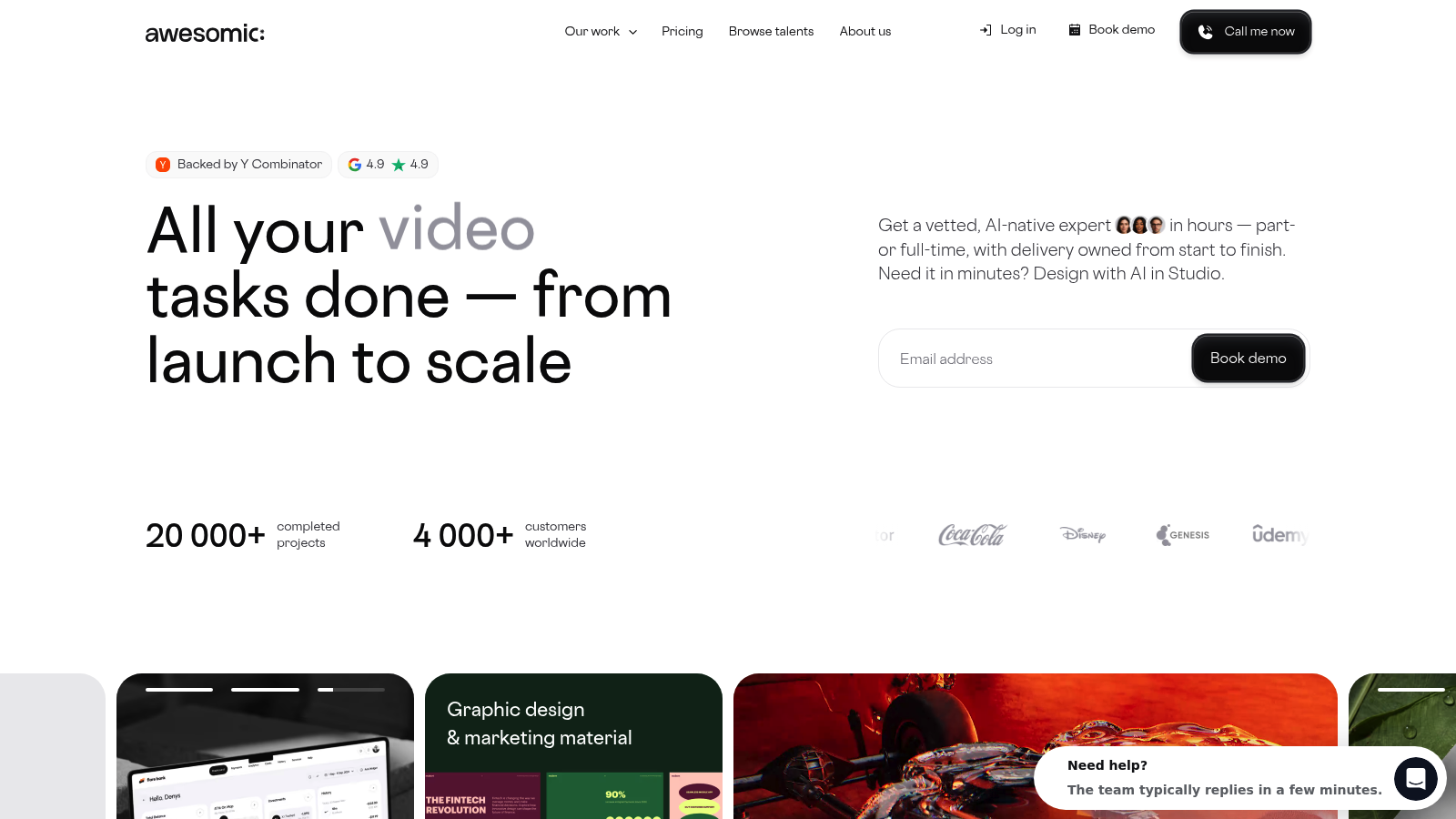
1. Awesomic
Best for: replacing a hiring cycle you cannot complete or cannot justify.
Outsourcing usually gets framed as a cost decision. Often it is really an availability decision, and Kyivstar.Tech is the clearest illustration we have.
The Ukrainian technology company hired senior in-house designers twice. Both times those designers were mobilized into the Armed Forces, and each replacement cycle meant four months or more with no creative output at all. Getting headcount approved was a fight; getting budget approved for a service subscription moved quickly. So they stopped trying to hire.
What replaced it was not a project engagement. We plugged into their existing Slack and Kanban workflow with no onboarding deck and no project-manager relay, briefs going in and designs coming back the same day. They were matched with Yuriy, a senior designer who has stayed with the account long enough to know the brand properly, delivering first iterations within 24 hours. Every asset still clears Kyivstar's legal and PR review, which is the real test of whether speed came at the cost of quality.
That is the shape of the model. You are not buying a project, you are buying continuity that does not depend on one person's employment status.
How it works: work goes in as tasks, a screened specialist picks one up within hours, revision rounds are uncapped, and the number of live tasks flexes month to month.
Services: brand identity, web and product design, UI/UX, Webflow and Framer build, motion and video, presentations, social and ad creative, copywriting and QA on the higher tier.
Pricing: Graphic Pack costs $1,490 monthly, or $1,190 on the quarterly plan with its three-month floor. All-in-One costs $2,995 monthly, or $2,396 quarterly, and adds no-code development, copywriting and QA. Dedicated Talent pairs one full-time specialist with a dedicated PM and is scoped individually. AI Designer is $200 monthly.
Proof: 4,000-plus customers, 20,000-plus delivered projects, 4.9 scores on Trustpilot and Google Play, and a talent pool that admits 0.82 percent of applicants. Y Combinator backed.
Honest limits: if your problem is a six-week research and positioning exercise before anyone opens a design tool, a studio below is the better buy. Subscriptions are built for continuous output, not for discovery. See how we structure work with agencies if you are an agency looking to white-label capacity.

2. ustwo
Model: studio.
ustwo is a digital product studio with a New York office on Jay Street alongside London and Sweden. It works on substantial product problems rather than marketing collateral, and is known as much for its own games and products as for client work.
This is a genuine partner engagement, priced accordingly, and worth it when the product question is unresolved rather than the design capacity being short.
Services: product strategy, UX and UI design, design systems, product development.
Pricing: enterprise project scoping, no public rates.
Why buyers shortlist it: it will push back on the brief, which is the thing you are actually paying a studio for.
3. ParallelHQ
Model: studio.
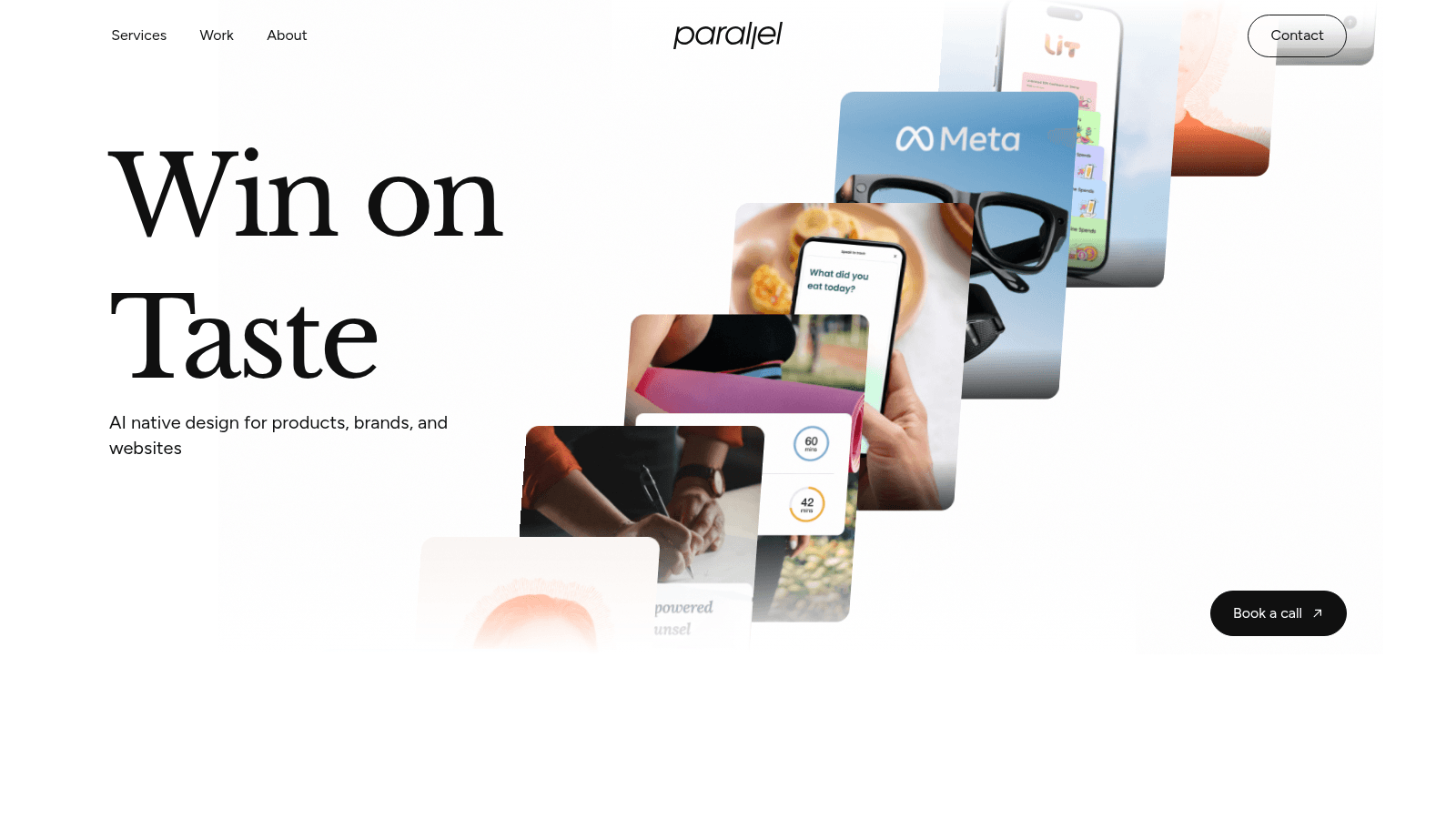
ParallelHQ positions itself as a UI and UX design agency for AI startups and SaaS companies, operating from Austin with a team in Bengaluru. That structure is common in this category and worth knowing about up front, since it affects both cost and working hours.
Its focus on a single product category means it arrives with pattern knowledge rather than learning your category on your budget.
Services: UI and UX design, product design, design systems, web design.
Pricing: scoped per engagement.
Where it fits: early-stage software teams that need product design specifically, not general marketing design.
4. Bilberrry
Model: studio.
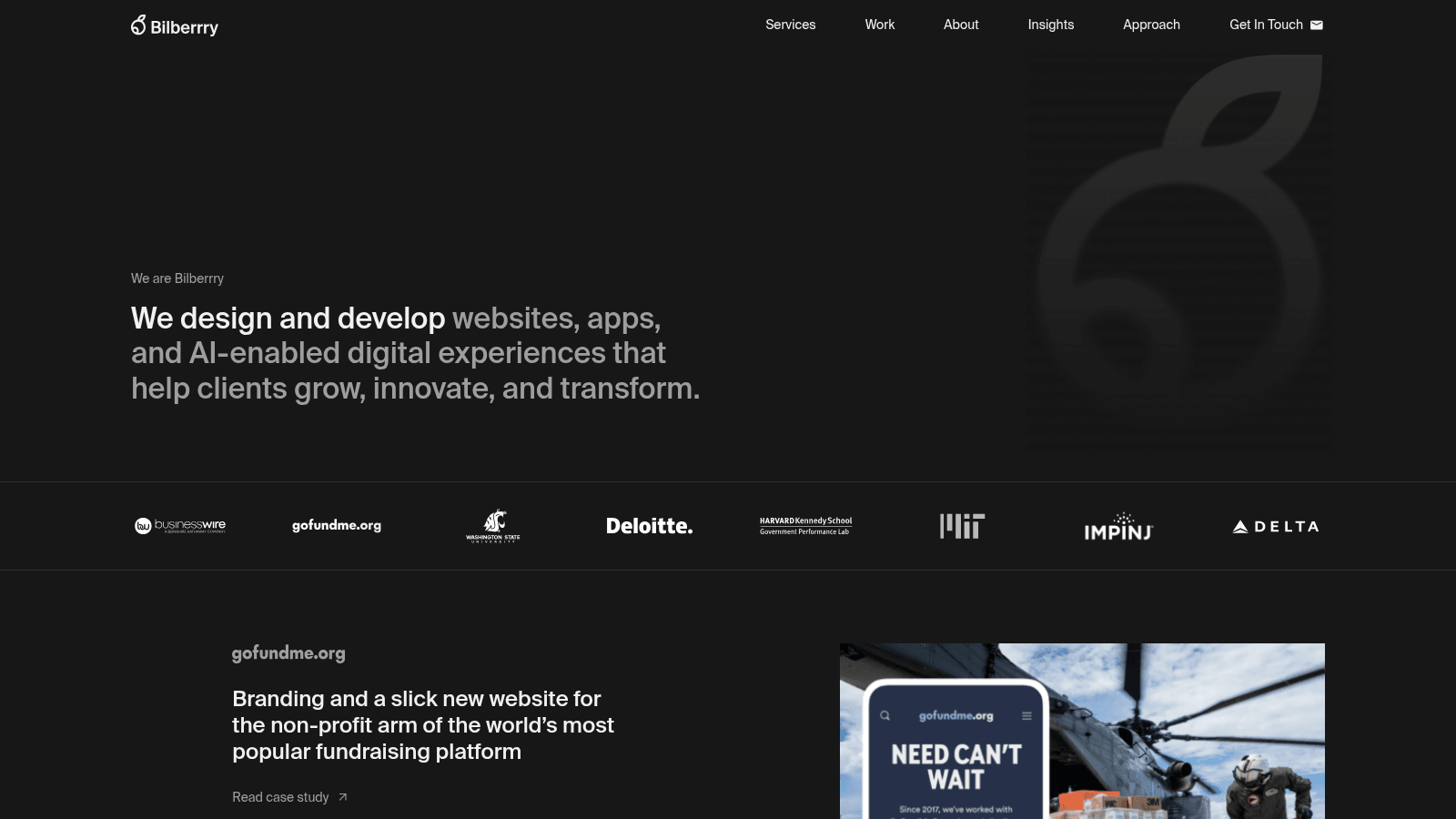
Bilberrry works from 1st Avenue in Seattle as a digital agency covering web, apps and AI work. It sits in the useful middle ground between a boutique design studio and a full development shop, taking projects from design through to build.
That combination suits companies without engineering capacity who need the thing shipped, not just designed.
Services: web design and development, mobile and web apps, AI integration, branding.
Pricing: project-based.
Its real strength: design and build under one contract removes the handoff that causes most timeline slippage.
5. Gravitate
Model: studio.
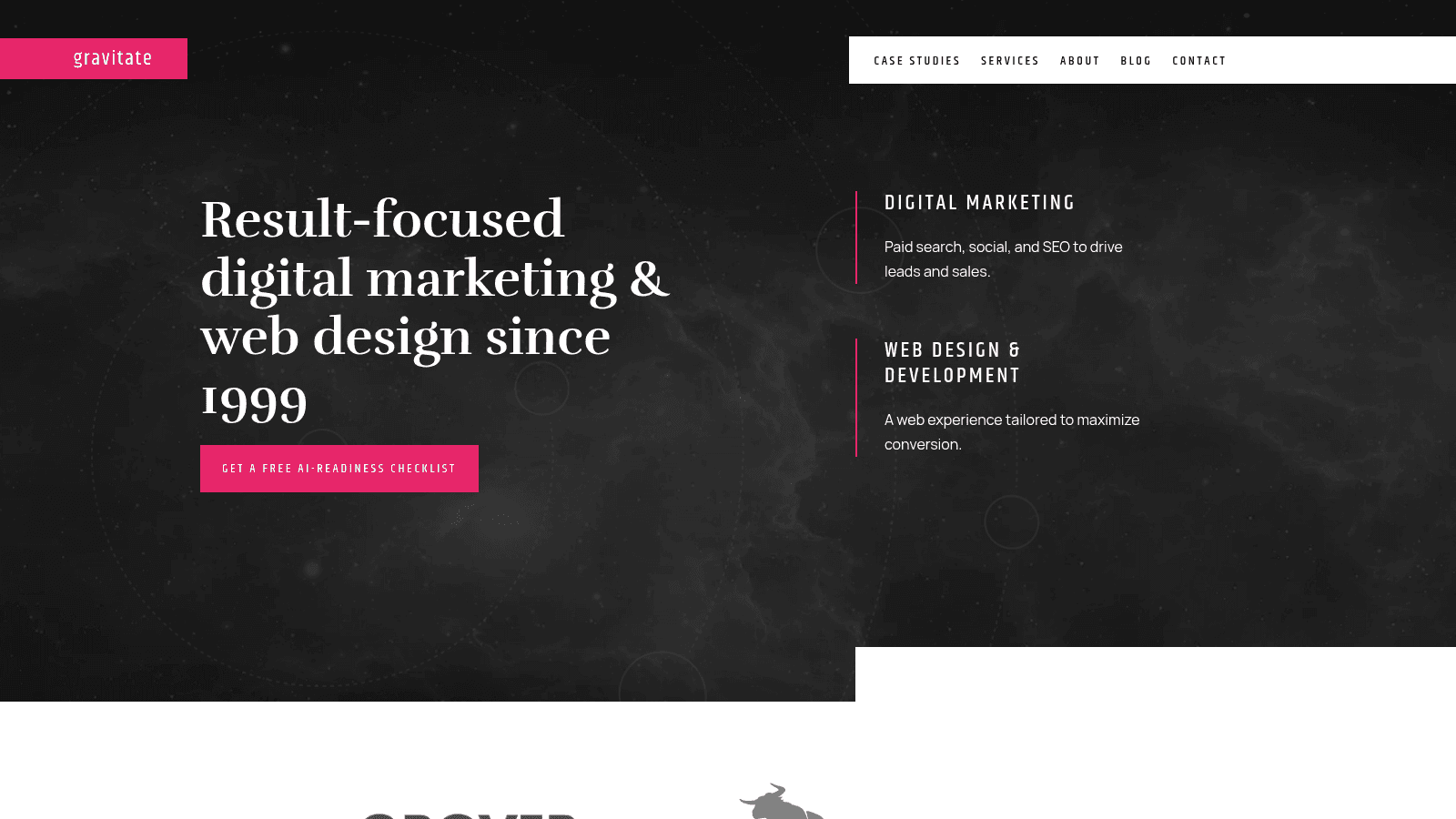
Gravitate has operated since 1999 from Main Street in Vancouver, Washington, combining web design with digital marketing. Operating continuously for that long is unusual in a category where agencies appear and disappear quickly.
Its marketing orientation means design decisions get argued on performance grounds rather than aesthetic ones.
Services: web design and development, SEO and paid media, content, brand.
Pricing: project and retainer, quoted.
Why it made this list: if the website has a conversion number attached to it, a marketing-led studio beats a pure design studio.
6. Toptal
Model: marketplace.
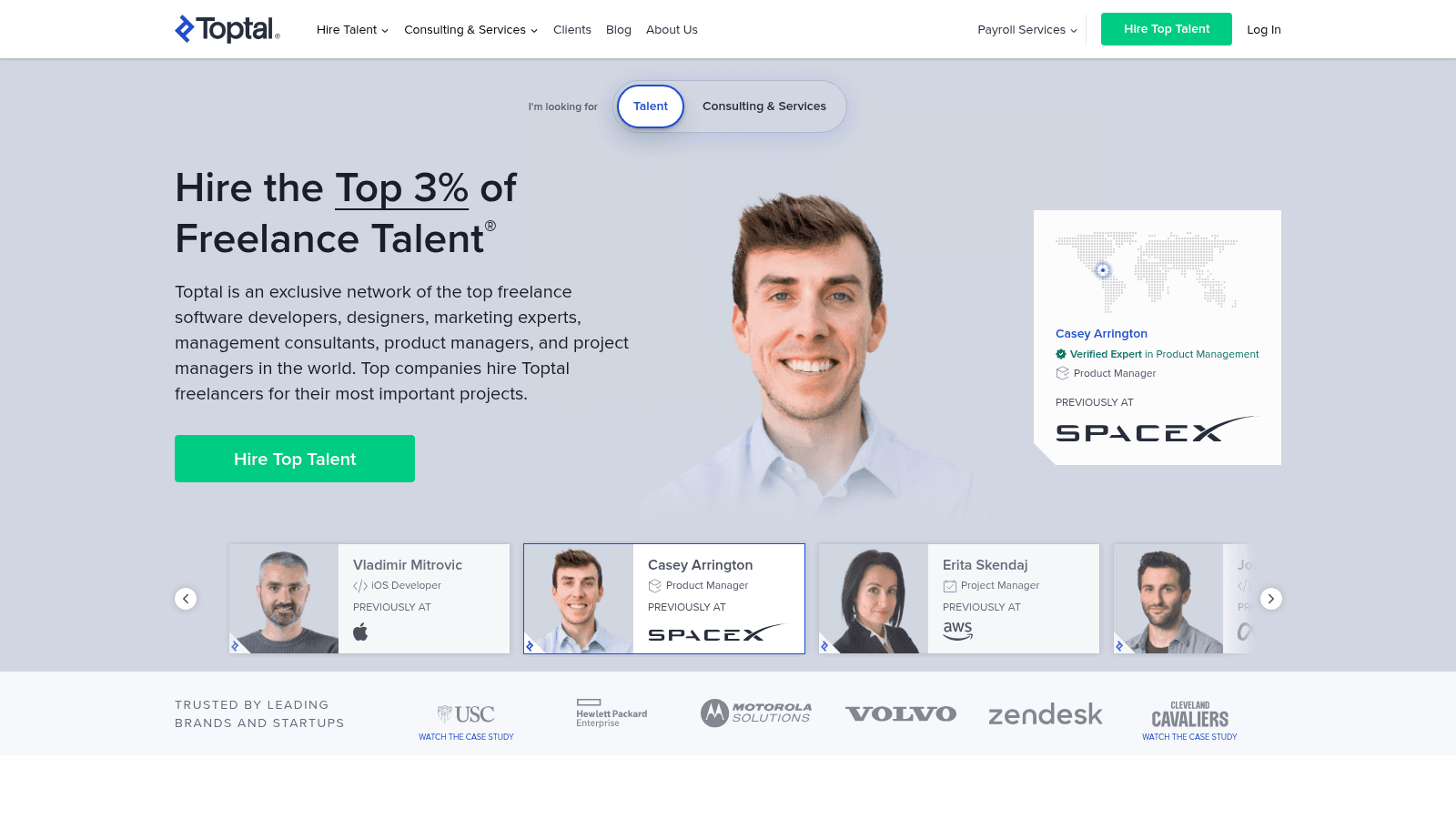
Toptal screens freelance designers and developers heavily and connects them to clients directly, positioning on the strength of its vetting rather than the size of its pool. You hire an individual and manage them yourself.
That works well when you know exactly what you need and have someone internally able to direct it, and badly when you were hoping the vendor would supply the direction.
Services: freelance product designers, UI/UX designers, brand designers, on hourly or full-time arrangements.
Pricing: hourly rates vary by designer, typically at the premium end of freelance.
Where it beats the alternatives: when you need one senior specialist for a defined stretch rather than a team or a queue.
7. Near
Model: marketplace and staffing.
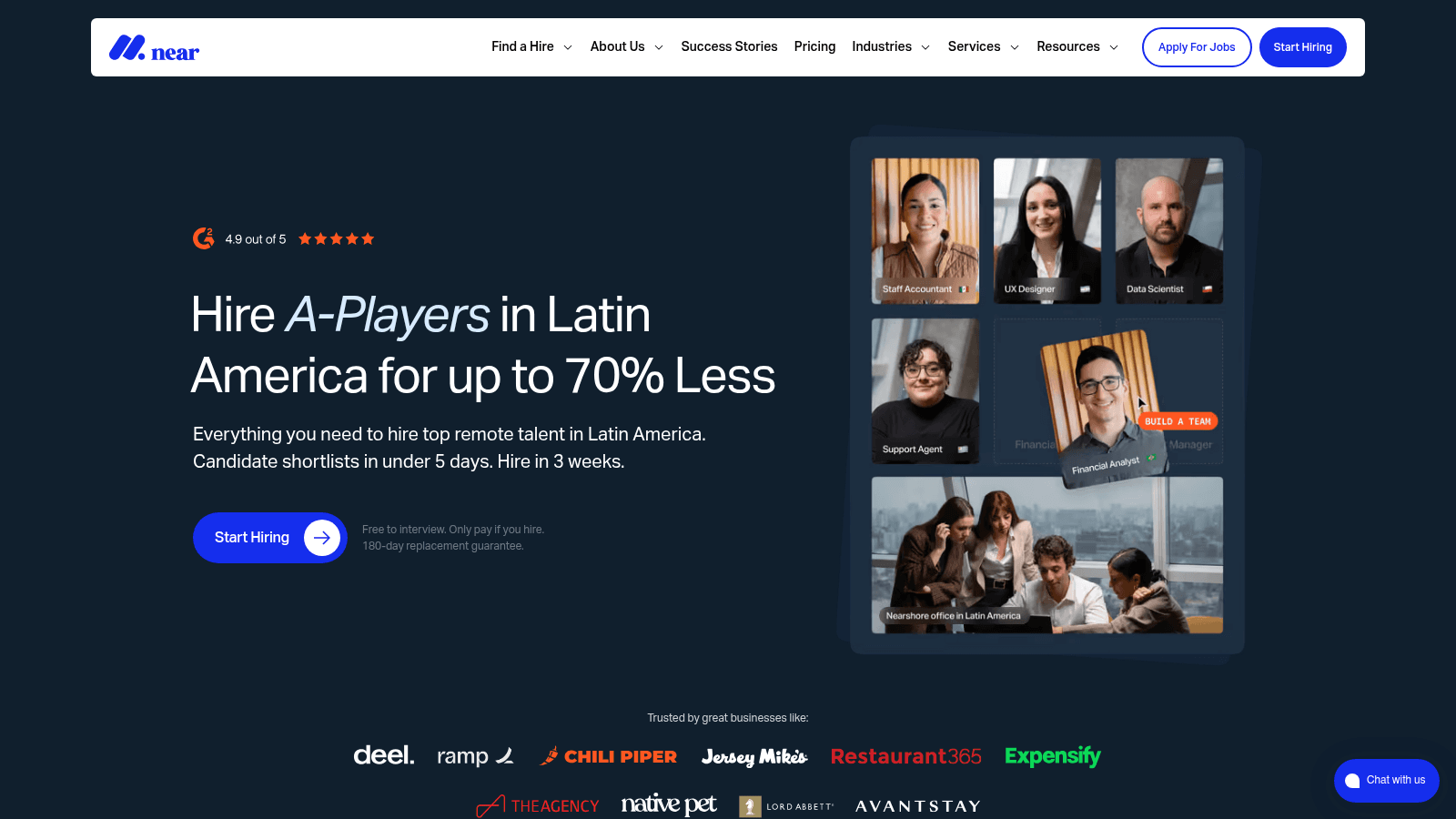
Near recruits full-time remote talent in Latin America for US companies, with offices listed in Austin and Sydney. The pitch is time-zone overlap with the United States at a lower cost base than domestic hiring.
This is closer to recruitment than to agency work: you get a person who works for you, along with the management responsibility that implies.
Services: sourcing and placing full-time remote designers and creative staff, with payroll and compliance handled.
Pricing: monthly fee per placement.
Why buyers shortlist it: it solves the availability problem without the marketplace churn, provided you actually have someone to manage the hire.
8. DesignCrowd
Model: crowdsourced marketplace.
DesignCrowd runs design contests where many designers submit concepts against a brief and you pick a winner. It is Australian, with a presence in several markets including the US.
The model produces volume of ideas cheaply. It also means most participating designers work for free, and the winning concept arrives without the reasoning behind it, which matters more on brand work than on a one-off graphic.
Services: logo design, web design, graphic design, packaging, via contest or direct hire.
Pricing: per project, set by you when you post the brief.
Where it fits: low-stakes, high-volume needs where seeing thirty directions is worth more than a considered process.
9. Draftss
Model: subscription.
Draftss offers unlimited graphic design, UI and front-end development on a flat monthly plan, covering a wider technical range than most flat-rate services.
Including development in the same subscription is unusual and useful for small teams that would otherwise need a second vendor to implement whatever gets designed.
Services: graphic design, UI/UX, front-end development, WordPress and Webflow, illustrations.
Pricing: flat monthly plans by number of active requests.
Its real strength: design and code from one queue, which suits founders without engineering support.
10. DotYeti
Model: subscription.
DotYeti provides flat-rate unlimited graphic design with a named designer assigned to the account rather than a rotating pool. Its published business address is on Walker Road in Dover, Delaware, with a distributed creative team.
The named-designer detail matters more than it sounds, since brand consistency is the usual casualty of round-robin task assignment.
Services: graphic design, brand identity, social and ad creative, presentations, packaging.
Pricing: flat monthly tiers by turnaround speed and volume.
Why it earns a place here: continuity of designer at a flat-rate price point is a genuinely useful combination.
11. No Limit Creatives
Model: subscription.
No Limit Creatives runs unlimited graphic and video design from Scalehouse Loop in Bend, Oregon. Video sitting inside the same plan as graphics is the differentiator, since most flat-rate services treat motion as an upsell or exclude it.
For marketing teams producing steady social output across both formats, that removes a vendor.
Services: graphic design, video editing, motion graphics, social creative, ad variations.
Pricing: flat monthly plans, with video included on the higher tiers.
Where it fits: social-heavy marketing teams that need volume in both stills and video.
12. Design Buffs

Model: subscription.
Design Buffs focuses on marketing design for B2B and SaaS teams, leaning on speed and staying on-brand rather than on open-ended creative exploration.
The narrower scope is deliberate. A service that only does marketing design for software companies can standardize more of the process than a generalist can.
Services: marketing and ad creative, landing pages, ebooks and reports, social, presentation design.
Pricing: flat monthly subscription.
Why buyers shortlist it: a specialist queue produces more consistent output than a general one, if your needs sit inside its specialism.
What outsourced design actually costs
The three models are priced on different units, which makes direct comparison harder than it should be. The table converts them to a rough monthly equivalent for a team with steady but not enormous design needs.
| Route | Typical monthly cost | What you are really buying |
|---|---|---|
| Freelancer, ad hoc | $2,000 to $8,000 | Hours, with management on you |
| Vetted marketplace, part-time | $4,000 to $12,000 | A senior individual, still managed by you |
| Design subscription | $1,490 to $2,995 | Output capacity with delivery managed |
| Studio retainer | $10,000 to $40,000 | Strategy, process and senior direction |
| In-house designer | $9,000 to $14,000 loaded | A person, plus recruiting and ramp time |
The in-house row is the one companies underestimate, because the salary is only part of it. Recruiting time, benefits, software licenses, management overhead and the risk that the hire leaves all sit on top, and none of it flexes down in a quiet quarter.
Kyivstar's experience is the extreme version of that risk, but a milder form of it applies everywhere: a single in-house designer is a single point of failure. Structuring the team so that outsourced capacity absorbs the peaks is covered in our guide to structuring a design team.
How to run an outsourced design team so it works
Most outsourcing disappointments trace back to the brief and the contract rather than to the designer. These steps prevent the common ones:
- Write the brief around the outcome and the constraints, not the deliverable. "A landing page that converts trial signups from paid social" beats "a landing page."
- Send brand assets, fonts and prior examples with the first task, not after the first draft misses.
- Agree what a revision round is, in writing, before work starts.
- Name one internal person who gives feedback. Committee feedback is the single biggest cause of blown timelines.
- Get a signed copyright assignment covering the deliverables, plus written confirmation of font licensing.
- Ask for source files at each milestone rather than at the end of the contract.
Step five is where the Copyright Office guidance becomes practical rather than theoretical, and step six is what protects you if the relationship ends badly. Neither takes long, and both are far cheaper to do at the start than to litigate later.
Continuity deserves its own line in the contract. Interface and UX decisions compound in a way marketing assets do not, so outsourced product design rewards keeping the same designer far more than it rewards the lowest hourly rate.
Choosing between the three models
Answer one question first: is the hard part deciding what to make, or making it?
If it is deciding, buy a studio. ustwo, ParallelHQ, Bilberrry and Gravitate all sell thinking as much as execution, and paying subscription rates for a problem that needed research will produce fast work in the wrong direction.
If it is making, buy a subscription or a marketplace hire. The distinction between those two is management capacity. A marketplace gives you a person and expects you to direct them; a subscription gives you output and manages the person for you. Teams without a design lead should be honest that they are buying management as well as design. Our guide to outsourcing graphic design works through that self-assessment in more detail.
And whichever you choose, settle ownership before the first file arrives. It is the cheapest insurance in this entire category.
If continuous design capacity without a hiring cycle is what you need, that is what our talent model is built around.
FAQs
What does it cost to outsource design work?
It depends on which model you buy. Subscription plans sit between $1,490 and $2,995 monthly, covering continuous output with the delivery managed for you. Vetted marketplace designers typically cost $4,000 to $12,000 a month part-time, though you manage them yourself. Studio retainers start around $10,000 and climb well past $40,000 because you are buying strategy and senior direction alongside production. Compare all three against a loaded in-house cost of roughly $9,000 to $14,000 a month for one designer, which includes benefits, software and recruiting but flexes down for nobody.
Do I own the designs if I outsource them?
Not automatically, and this catches a lot of buyers. Under US copyright law, work commissioned from a non-employee only counts as work made for hire if it falls within one of nine narrow categories and both parties sign a written agreement saying so. Logos, brand identities, websites and app interfaces are not among those nine categories, so paying the invoice does not by itself transfer copyright. Ask for a signed assignment of copyright covering the specific deliverables, and confirm font licensing separately, since typeface licenses are issued to a named entity and do not transfer with the artwork.
Is it better to outsource design overseas or domestically?
It depends on what the work demands. Offshore studios and Latin American staffing can reduce cost meaningfully, and time-zone overlap is the variable that decides whether that saving survives contact with reality. Work that needs many short feedback loops, live calls or fast turnarounds suffers most from a large time difference. Work that runs on a clear brief and a weekly review suffers least. Contracting and IP enforcement are also simpler within one jurisdiction, which is worth weighing on brand-critical assets.
How do I know if a design subscription will work for my company?
Count how many discrete design requests you generated in the last three months. Under roughly four a month, a freelancer is usually cheaper. Above that, and especially if the requests span several formats such as web, social, decks and video, a subscription generally wins because per-project pricing punishes volume while a flat fee does not. The other test is strategic: subscriptions are built for execution, so if your next quarter is dominated by one unresolved positioning question, hire a studio for that piece first.
What is the biggest mistake companies make when outsourcing design?
Treating the brief as a formality. Deloitte's outsourcing research points at governance and contracting weaknesses, rather than supplier quality, as the reason expected productivity and cost benefits often fail to materialize, and design follows that pattern closely. The specific failures repeat: an outcome never stated, feedback arriving from four people with different opinions, revision limits nobody agreed, and ownership of the files left unresolved until the relationship ends. All four are fixed with paperwork and a named decision-maker before the first task.
One subscription and your hiring problems solved

FAQ


Awesomic is a revolutionary app that matches companies with vetted professionals across 30+ skill sets, from design and development to marketing and product. Based in San Francisco with a global core team, we offer a faster and more flexible alternative to traditional hiring through a subscription-based model. Awesomic delivers high-quality talent on demand, without the delays of recruiting.
We function as a subscription-based service that matches you to top-tier, vetted talent. Submit a project in just a few clicks and start receiving deliverables in as little as 24 hours. Scale your Awesomic plan up or down as your business needs change.
Every Awesomic subscription comes with unlimited revisions. You receive daily progress updates via the app, and you can provide feedback or request iterations as needed. If your project requires a different approach, you can request a talent rematch at any time, at no extra cost. You can also add teammates to collaborate and streamline feedback
A talent marketplace is a platform that utilizes data and intelligent matching algorithms to connect professionals with projects based on their skills, experience, and availability. While often used internally by large companies, Awesomic applies this model at scale, matching vetted global talent to your most critical business needs.
Hiring is time-consuming, expensive, and risky. Awesomic eliminates that problem. We rigorously vet all talent for technical ability, communication, and soft skills, ensuring only senior-level professionals work on your projects. You skip the job posts, interviews, and delays, and get straight to results.
No, Awesomic goes beyond design. While many clients utilize us for branding, UI/UX design, or motion graphics, we also provide vetted talent in no-code web development, product design, marketing, and more. Think of us as an extension of your team. A flexible, high-performing creative partner from planning to execution, whether you're building awesome products or scaling your team.
You can talk directly with your matched talent via the Awesomic app, connect via Slack, email, or schedule video calls. No matter the plan, you’ll receive daily updates in the app for every active task. You can also tag us in for any issues through our in-app customer chat.


