




11 Best Presentation Design Agencies in USA for 2026

Key takeaways:
- Several firms ranking on page one for this search are not American. One of the highest-placed publishes a Toronto street address on its own contact page, so verify before you assume domestic.
- Investor decks are a small corner of this market. Federal wage data counts 8,006 convention and trade show organizer establishments in the United States, which is the scale of the conference and keynote work most roundups ignore.
- Posting your pitch deck publicly is a securities decision, not a marketing one. Under Regulation D it moves you into Rule 506(c), where every investor must be accredited and you must take reasonable steps to verify it.
- Check that a firm's portfolio contains real client work. One agency on this list fills its homepage work gallery with Lorem ipsum placeholder slides.
There is a specific kind of dread that arrives four days before a board meeting, when somebody opens the deck and realizes it is forty slides of inherited formatting held together by three different blues.
Presentation design agencies exist for that moment, and for the larger version of it: the sales deck the whole team improvises differently, the conference keynote that has to survive a huge screen, the training material nobody can update.
Every firm below is headquartered in the United States and was confirmed as such from its own website. That check turned out to matter more than expected.
The verification problem with this search
Search for presentation design agencies in the USA and you will get a page of results where a meaningful share are not in the USA. This is not a conspiracy; it is what happens when directories rank on service area rather than location, and roundups copy each other.
The clearest example sits near the top of the results. Stinson Design ranks prominently for the American phrasing and its own contact page maps to 401 Richmond Street West in Toronto, Ontario. It looks like a good firm. It is not a US firm.
It is not alone. BrightCarbon, which appears on most lists for this keyword, publishes offices in Manchester, Bristol and London on its own contact page. Mr.Prezident lists an Amsterdam address alongside a New York one, which is the more common pattern and the reason a single directory badge tells you very little.
None of that makes any of them a bad choice, and if your only constraint is quality then widen the search deliberately. But if you need domestic contracting, overlapping working hours, or someone who can be in the room the morning before a board meeting, that is the whole point of adding "in USA" to the query, and it is worth ten minutes on each contact page to check.
One further caution belongs here. When you review a portfolio, check that you are looking at client work rather than templates. 16X9 Design, included below on the strength of its certifications and its stated scale, fills the work gallery on its own homepage with placeholder slides reading Lorem ipsum, on a page that simultaneously claims 8,000 presentations built and 17 of the Fortune 100 as clients. Both things can be true. You should still ask to see the real deck.
Portfolio scrutiny of that kind is the whole job when you are finding a design agency, and it separates the shortlist far more reliably than a ranking does.
Presentations are four different products
The word covers jobs with almost nothing in common, and firms specialize far more than their homepages suggest.
| Deck type | Primary job | What good looks like |
|---|---|---|
| Investor pitch deck | Raise money | Narrative arc, defensible numbers, ten to fifteen slides |
| Sales deck | Win a deal | Modular, reusable by non-designers, objection handling |
| Conference keynote | Hold a room | Large-format legibility, pacing, minimal text |
| Internal and training deck | Transfer knowledge | Editable templates, accessibility, version control |
The distinction that costs money is between a one-off artifact and a system. An investor deck is a single object designed once and iterated hard. A sales deck is infrastructure, and if it cannot be edited by a sales rep on a Tuesday it will be abandoned by Friday. Agencies that excel at the first are frequently poor at the second, because the skills are storytelling versus templating.
Conference work is bigger than founders assume. In 2024 the Bureau of Labor Statistics tallied 8,006 convention and trade show organizer establishments with a combined payroll of roughly 57,000 people, with California, Florida, Texas and New York holding the largest concentrations. That is the industry generating keynote decks, booth loops and breakout sessions every week, and it dwarfs the flow of investor pitches.
Template systems for organizations at that scale are a procurement exercise rather than a design brief, which is the territory our enterprise offer is built around.
The Regulation D rule that changes how you share a deck
The rule below is the most consequential thing in this article, and almost no presentation roundup mentions it.
If you are raising money, how you distribute the deck has legal consequences. Under Regulation D, Rule 506 offers two paths. Rule 506(b) lets you include up to 35 non-accredited purchasers in any 90-day period, but it prohibits general solicitation, meaning you cannot advertise the raise publicly.
Rule 506(c) permits exactly that public solicitation. The price is steep: every purchaser must be an accredited investor, and the issuer has to take reasonable steps to verify it rather than accept a checkbox. The rule text spells out acceptable methods, including reviewing IRS forms reporting the purchaser's income for the two most recent years alongside a written representation.
The practical translation for a founder is short. Posting your pitch deck on your website, on a public deck-sharing service, or in a tweet is general solicitation. That is a legitimate strategy, and plenty of companies choose it, but it commits you to verifying accreditation for every investor who comes in afterward. Decide which lane you are in before the designer sends you a public share link, and tell your counsel which one you picked.
The 11 best presentation design agencies in USA
Each firm below publishes a United States base, verified on its own site rather than taken from a directory. Where a company does not publish a street address, the entry says so rather than guessing.
1. Awesomic
Owns: decks that have to match a brand and keep changing.
Most deck problems are really brand problems wearing a deck costume. The pitch looks nothing like the website, the sales team has forked the master file four ways, and every fix requires a new statement of work with whoever made the original.
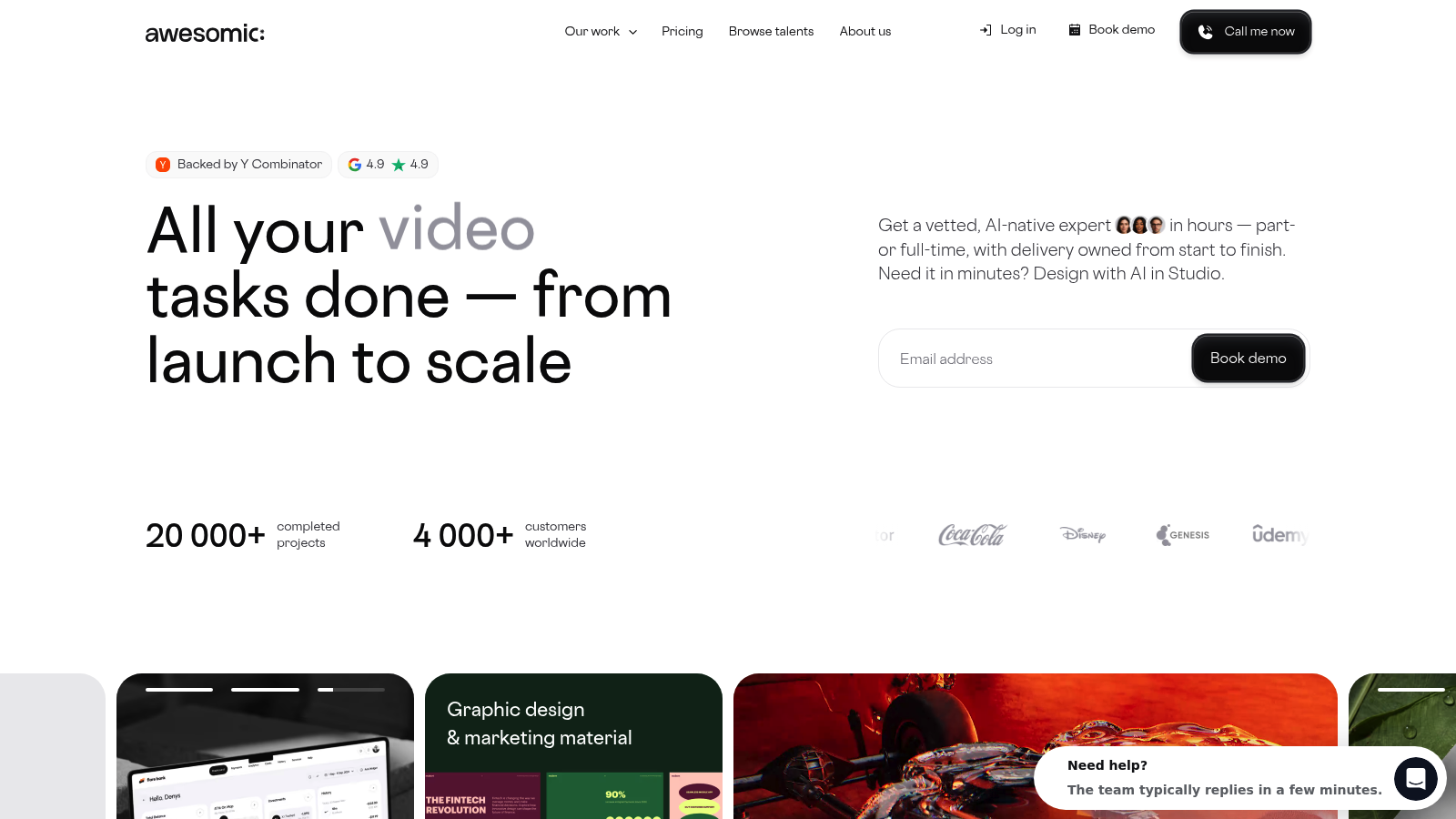
Awesomic runs on a monthly subscription. You brief a task, a vetted designer picks it up within hours, and revisions are uncapped. Presentations sit on the same plan as brand identity, web and illustration, which means the deck can be built from the same system as everything else instead of approximating it.
Endorsed is the clearest illustration. The US HR technology company, whose AI assistant screens candidates inside an existing applicant tracking system, worked with us across eight months on a UI and UX audit, new onboarding flows, brand guidelines, a website redesign and a Webflow migration. The stakeholder deck came out of that same engagement, built on the brand guidelines rather than beside them, alongside LinkedIn banner ads. As our case study puts it, a polished pitch deck matters most in a company's early stages.
That sequencing is the argument. A deck designed after the brand system, by someone with access to it, does not drift.
Services: investor and sales deck design, conference and keynote decks, editable template systems, data visualization, brand identity, plus web and product design on the same plan.
Pricing: the design-only plan, Graphic Pack, costs $1,490 each month. Where no-code build, copywriting and QA are wanted too, that becomes All-in-One at $2,995. Quarterly terms cut those figures to $1,190 and $2,396. Where a company wants one specialist full time with a project manager alongside, we quote it individually.
Proof: we have served over 4,000 companies across more than 20,000 shipped projects, hold 4.9 on Google Play and the same on Trustpilot, admit under one percent of the designers who apply, and count Y Combinator among our investors. You can browse the work on our case study index.
Honest limits: we are not a presentation training company. If what you need is executive coaching, rehearsal support or storytelling workshops for your leadership team, several firms below do that as a primary business and we do not do it at all.

2. Duarte

Owns: presentation storytelling as a discipline, taught as much as delivered.
Duarte is the most established name in this category, and its own privacy policy places its corporate headquarters at 650 Castro Street in Mountain View, California, which is worth noting because a great many roundups list it in Santa Clara.
Read its current positioning carefully before you brief it. The firm now leads with communication and presentation skills training rather than pure design services, and states that it and its founder's team have worked with 84 percent of the top companies. If you want your executives taught to present, this is the deepest bench available. If you want forty slides redrawn by Thursday, check that they still take that work.
Services: presentation and communication training, executive storytelling, presentation design, large-scale communication consulting.
Where it fits: enterprises investing in how their leaders communicate, not just in how the slides look.
3. SlideGenius

Owns: high-volume enterprise deck production with a global delivery model.
SlideGenius lists its location as Hotel Circle North in San Diego, California, and its services stretch well past slides into graphic design, motion design and interactive microapps, which is a genuinely unusual range for a presentation specialist.
Its own site lists offices in Europe and the Asia-Pacific region alongside North America, including London and Makati, so expect a follow-the-sun production model. That is exactly what you want for overnight turnarounds on a large deck and worth understanding up front if you expected a single local team.
Services: presentation design, pitch and sales decks, motion graphics, interactive microapps, graphic design.
Where it fits: enterprises with continuous deck volume and appetite for round-the-clock turnaround.
4. eSlide

Owns: high-stakes corporate decks, produced discreetly.
eSlide works from Madison Avenue in New York and concentrates on exactly one thing, which its own materials describe as high-stakes presentation design. There is no training arm, no branding practice and no attempt to be a full-service agency.
That focus suits a particular buyer. Investment banks, professional services firms and corporate development teams tend to want a designer who understands confidentiality, works inside PowerPoint rather than around it, and does not need the strategy explained twice.
Services: PowerPoint presentation design, template development, executive and board decks, data visualization.
Where it fits: finance and professional services, where discretion and PowerPoint fluency beat creative flourish.
5. Ethos3

Owns: presentation design paired with delivery coaching.
Ethos3 is based in Nashville, Tennessee, confirmed on its own blog, which refers both to its hometown and to its office in downtown Nashville. It publishes no street address.
Its footer now describes it as an award-winning presentation training company, which reflects a shift toward coaching alongside design. That combination is useful when the problem is genuinely the speaker rather than the slides, and a lot of the time it is.
Services: presentation design, presentation training and coaching, brand-aligned templates, keynote development.
Where it fits: teams where the deck and the delivery both need work, and one supplier for both is simpler.
6. VerdanaBold

Owns: decks treated as a communication problem before a visual one.
VerdanaBold describes itself as a certified woman-owned business headquartered in Chicago, and its process is refreshingly plain: discover, create, refine. It starts inside your existing PowerPoint files and brand rather than proposing a rebuild.
The scope stated on its own site goes beyond redrawing slides to writing and refining the content and coaching the team through preparing and sharing the material. That is the right shape when the underlying story, not the layout, is what is failing.
Services: presentation design and redesign, content writing and editing, template systems, presentation preparation support.
Where it fits: organizations whose decks are structurally confusing rather than merely ugly.
7. LightMix

Owns: presentation design inside a broader digital studio.
LightMix operates from Old Gallows Road in Vienna, Virginia, serving the Washington DC market, and runs presentation and PowerPoint design as a named service alongside its web design practice.
The location tells you the client base. Government contractors, associations and regional businesses buy decks differently from venture-backed startups, with more compliance review and longer approval chains, and a studio embedded in that market will not be surprised by it.
Services: PowerPoint and presentation design, web design and development, branding, digital marketing.
Where it fits: DC-area organizations wanting deck work from a studio that also owns their website.
8. TodayMade

Owns: presentation design delivered on a subscription rather than per project.
Registered at a Newark, Delaware address, TodayMade approaches presentations through a graphic design subscription model, with deck design as one service inside a broader creative offer.
The commercial logic is the same one that applies to any recurring creative need. If you produce decks continuously, buying them one at a time means re-negotiating scope every time, which is a tax paid in project management rather than design.
Services: presentation design, graphic design subscription, brand assets, marketing collateral.
Where it fits: lean teams with steady deck volume that do not want per-project quoting.
9. Empowered Presentations

Owns: boutique deck design with a motion capability attached.
Launched in Honolulu, Hawaii, as its own about page recounts, Empowered Presentations is a small firm with an unusually clear origin story and a Pacific time zone that some mainland clients find genuinely convenient for overnight turnarounds.
It also produces illustrated motion video for product demos, launches and short promotional clips, which is a useful adjacency when a deck and a launch video are being commissioned in the same quarter. It publishes a phone number rather than a street address.
Services: presentation and pitch deck design, illustrated motion video, brand visuals.
Where it fits: smaller engagements where a senior designer works directly with you rather than through an account layer.
10. 16X9 Design

Owns: on-demand PowerPoint production at claimed enterprise scale.
16X9 presents as an on-demand presentation design agency and states that its entire design team holds Microsoft PowerPoint certification, with around half its business coming from long-term clients. Its homepage counters claim 8,000 presentations built, 1,257 global clients, 32 countries served and 17 of the Fortune 100 assisted.
Two observations. Its certifications are verifiable and specifically American: it displays NMSDC minority business enterprise certification and WBENC women's business enterprise certification, neither of which is issued to companies outside the US. But the work gallery on that same homepage is populated with Lorem ipsum placeholder slides rather than client examples, so ask for the actual portfolio before you judge the craft. It publishes no street address.
Services: presentation design, PowerPoint template development, accessibility training, ongoing design support.
Where it fits: organizations needing steady PowerPoint output, once you have seen real work.
11. Pitch Deck Fire

Owns: investor decks for founders, treated as a specialty rather than a service line.
Pitch Deck Fire concentrates on pitch decks, investor presentations and the strategic work around them, running an iterative process that moves from writing the slides through design execution to delivery of editable files plus every asset created along the way.
It publishes a Colorado phone number and states that it serves clients across the globe, but no street address appears on the site. The deliverables promise is the part worth noting: receiving the source assets rather than a flattened file is what lets you update the deck between investor meetings without going back to the agency.
Services: pitch deck design and writing, investor presentation strategy, deck review, branding.
Where it fits: founders raising a round who want a specialist rather than a generalist studio.
What presentation design costs
Slide count is the unit everyone quotes and the worst predictor of price. A ten-slide investor deck with original data visualization takes longer than fifty slides of templated content, so read the bands below by complexity instead.
| Scope | Price band | What drives it |
|---|---|---|
| Investor pitch deck, 10 to 15 slides | $3,000 to $15,000 | Content writing, custom charts, iteration rounds |
| Sales deck with modular sections | $5,000 to $25,000 | Number of variants, template build, training |
| Conference keynote | $6,000 to $30,000 | Animation, large-format design, rehearsal support |
| Corporate template system | $8,000 to $40,000 | Layout count, accessibility, rollout and documentation |
| Per-slide cleanup | $50 to $250 a slide | Source file quality, turnaround |
| Design subscription | $1,490 monthly and up | Deck volume alongside the rest of the plan |
Rush work carries a premium at every firm in this category, charged either as an uplift on the quote or as an overtime rate, and it is the most avoidable line on the invoice. Ask for the rush policy in writing at proposal stage rather than discovering it the week you need it. The second avoidable cost is rebuild: handing over a deck assembled from screenshots and pasted images forces the agency to reconstruct everything as native objects before design can start. Send editable source files and you will pay less. The wider economics of buying creative this way are covered in our look at design service models.
Briefing a deck so it survives contact with your team
Presentation projects fail late and predictably, usually because nobody decided these six things at the start:
- Name the single decision you want the audience to make, and lead the brief with it.
- Say who has to edit the deck afterward, and how skilled they are in PowerPoint or Keynote.
- Confirm the delivery environment, including screen ratio, whether it presents live or gets emailed, and the software version in use.
- Supply editable source files and real data, not screenshots of charts.
- Set the accessibility bar if the deck goes to a public or regulated audience.
- Cap the approvers at two named people, and agree the number of revision rounds.
Point two decides whether the deck lives or dies. A gorgeous file built with layered custom graphics that only a designer can update will be quietly replaced within a quarter by a version somebody rebuilt in the brand's default template. Point four is where budgets leak, because reconstructing charts from images is slow, unglamorous work that gets billed at design rates. Getting the input right at the outset is most of the job, as our pitch deck guide works through in detail.
Choosing between them
Sort by job first. A raise points you at Pitch Deck Fire, or at a studio that will also help write the narrative such as VerdanaBold. Continuous enterprise volume suits SlideGenius or a subscription. Confidential financial work suits eSlide. Executive communication as a capability, rather than a file, points at Duarte or Ethos3.
Then sort by geography, but only if it genuinely matters to you. It matters for federal and regulated buyers, for anyone who needs a designer in the room, and for contracting requirements; LightMix and eSlide sit close to those markets. It matters much less if the work is remote anyway, in which case excluding excellent British and Danish firms costs you options for no gain.
Finally, ask the three questions that reveal how a firm actually works: whether you receive editable native files or a flattened deliverable, who owns the source assets afterward, and what a rush costs. Firms confident in their process answer all three immediately. For a view of how the specialist deck market prices against generalists, our roundup of pitch deck design agencies is the closest comparison.
FAQs
How much does a professional pitch deck cost in the US?
Expect $3,000 to $15,000 for a designed investor deck of ten to fifteen slides, rising when the agency also writes the narrative or builds original data visualizations. Per-slide cleanup of an existing deck runs roughly $50 to $250 a slide. Rush turnarounds add a surcharge at essentially every agency, so the cheapest lever available is starting earlier; ask each firm to put its rush rate in the proposal.
Are the top-ranked presentation design agencies actually American?
Often not. Several firms ranking on page one for this search are based in Canada, the United Kingdom, Denmark, the Netherlands or India, because directories rank by service area rather than headquarters. Check the contact page for a street address before you assume, especially if domestic contracting or time zone alignment matters to you.
Can I post my pitch deck publicly on our website?
You can, but understand what it triggers. Public distribution counts as general solicitation, which moves a Regulation D raise into Rule 506(c), where every investor must be accredited and you must take reasonable steps to verify that rather than accept self-certification. Talk to counsel before the deck goes on a public URL, not afterward.
What is the difference between a pitch deck and a sales deck?
A pitch deck is a single narrative artifact aimed at one decision, usually built once and refined heavily. A sales deck is infrastructure: modular, reusable, and edited constantly by people who are not designers. Hiring a firm that excels at the first for the second is the most common mismatch in this category.
Should we buy a template system or individual decks?
Buy a template system once your organization produces more than a few decks a month, because the alternative is paying design rates repeatedly for layout decisions already made. Buy individual decks for genuinely high-stakes one-offs such as a fundraise or a keynote. Most companies eventually need both, and the template pays for itself faster than expected. Buying creative as an ongoing capability rather than a series of projects is the broader shift our piece on design as a service describes.
One subscription and your hiring problems solved


FAQ


Awesomic is a revolutionary app that matches companies with vetted professionals across 30+ skill sets, from design and development to marketing and product. Based in San Francisco with a global core team, we offer a faster and more flexible alternative to traditional hiring through a subscription-based model. Awesomic delivers high-quality talent on demand, without the delays of recruiting.
We function as a subscription-based service that matches you to top-tier, vetted talent. Submit a project in just a few clicks and start receiving deliverables in as little as 24 hours. Scale your Awesomic plan up or down as your business needs change.
Every Awesomic subscription comes with unlimited revisions. You receive daily progress updates via the app, and you can provide feedback or request iterations as needed. If your project requires a different approach, you can request a talent rematch at any time, at no extra cost. You can also add teammates to collaborate and streamline feedback
A talent marketplace is a platform that utilizes data and intelligent matching algorithms to connect professionals with projects based on their skills, experience, and availability. While often used internally by large companies, Awesomic applies this model at scale, matching vetted global talent to your most critical business needs.
Hiring is time-consuming, expensive, and risky. Awesomic eliminates that problem. We rigorously vet all talent for technical ability, communication, and soft skills, ensuring only senior-level professionals work on your projects. You skip the job posts, interviews, and delays, and get straight to results.
No, Awesomic goes beyond design. While many clients utilize us for branding, UI/UX design, or motion graphics, we also provide vetted talent in no-code web development, product design, marketing, and more. Think of us as an extension of your team. A flexible, high-performing creative partner from planning to execution, whether you're building awesome products or scaling your team.
You can talk directly with your matched talent via the Awesomic app, connect via Slack, email, or schedule video calls. No matter the plan, you’ll receive daily updates in the app for every active task. You can also tag us in for any issues through our in-app customer chat.


