




9 Best Webflow Design Subscription Services in 2026

Key takeaways:
- A Webflow design subscription is a monthly fee for design and build in the same queue, not a project with a start and an end date. You are buying capacity, so the question is how much of it you actually need.
- Published rates run from $495 a week to $9,900 a month. Five of the nine show a number; the other four quote after a call, which makes a like-for-like shortlist harder than it should be.
- Webflow-only shops and broad design subscriptions are not the same purchase. One gives you deeper platform skill, the other covers the brand and product work around the site.
- The site itself is usually not copyrightable, according to the US Copyright Office, so ownership rests on your contract rather than on the code. Settle it before the first page ships.
A Webflow design subscription is a recurring monthly plan where a vendor designs and builds pages in Webflow for you, worked through a queue you keep filling. There is no scope document and no project close. You pay while you need pages, and you stop when you do not.
That model has been quietly taking work from two directions at once: from project-based Webflow agencies, which price a site and then charge again for the next campaign page, and from in-house hires, which are slow to make and hard to justify for a workload that arrives in bursts.
This list covers vendors whose product is a subscription with Webflow as the build platform. It deliberately excludes project-based shops, which are a different purchase with different economics and which we cover separately in our roundup of Webflow design agencies.
Awesomic sits first because Webflow build is part of what we sell, and pretending otherwise would be dishonest. Everything about the other eight came off their own sites in September 2026.
What a Webflow design subscription actually buys
The pitch is usually "unlimited," and that word does a lot of work it has not earned. What is unlimited is how many requests you may file. What is finite, always, is how many get worked at once.
So the real specification of any plan here has three parts, and none of them is the headline number.
Concurrency is how many tasks move simultaneously. Most plans on this list run one active task, which is fine for a steady trickle of landing pages and painful when a launch needs six pages in a fortnight.
Scope is whether design and development both sit inside the fee, or whether design is extra. A plan that builds what someone else designed is cheaper and only useful if you already have the designs.
Continuity is who does the work. A named person who learns your brand behaves very differently from a rotating pool, and the difference shows up around month three rather than in week one. Whether that person both designs and builds is the distinction our design engineer page draws out.
Get those three straight and the price comparison becomes possible. Skip them and you are comparing a $495 week against a $9,900 month as though they were the same product.
The 9 best Webflow design subscription services
The table splits the nine by what you are actually buying: a broad design subscription that happens to build in Webflow, or a Webflow-only development shop. Rates are the lowest figure each vendor publishes itself, and four cells read Quoted because those vendors publish nothing.
| Service | Kind | Best for | What the fee covers | Pricing (from) | Rating |
|---|---|---|---|---|---|
| Awesomic | Broad subscription | Design and Webflow build together | Design, Webflow, Framer, WordPress, brand, copy | $1,490/month | ★★★★★ |
| Design Focus | Broad subscription | A cheap way to test the model | Design and Webflow build, one request at a time | $495/week | ★★★★☆ |
| Fluid Design | Broad subscription | Buying a named person's hours | Design and Webflow, sold in monthly hour bands | $1,440/month | ★★★★☆ |
| SimpleTiger | Broad subscription | Sites built to rank | Design, Webflow development, SaaS SEO | Quoted | ★★★★☆ |
| Flowout | Webflow only | Enterprise Webflow at depth | Webflow development, design and copy as tiers | $5,900/month | ★★★★★ |
| Minute Creative | Webflow only | Agencies reselling Webflow | Webflow development, white-label track | $1,999/month | ★★★★☆ |
| Creative Corner Studio | Webflow only | Continuous Webflow capacity | Unlimited Webflow development hours | Quoted | ★★★★☆ |
| Magier | Webflow only | A straightforward unlimited queue | Webflow design and development requests | Quoted | ★★★☆☆ |
| Flowbison | Webflow only | Webflow plus the marketing around it | Webflow dev, UI/UX, CRO, PPC, maintenance | Quoted | ★★★☆☆ |
Ratings reflect fit for subscription Webflow work specifically, not general agency quality. Several of these firms also sell project work, which is a different purchase at a different price, and the wider shift toward subscription-based design services is what pulled them into this shape.
Design subscriptions that include the Webflow build
The four vendors below sell design capacity broadly, with Webflow as one of the things that capacity produces. Pick from here when the site is not the only thing you need made.
Awesomic
Best for: Design and Webflow build together
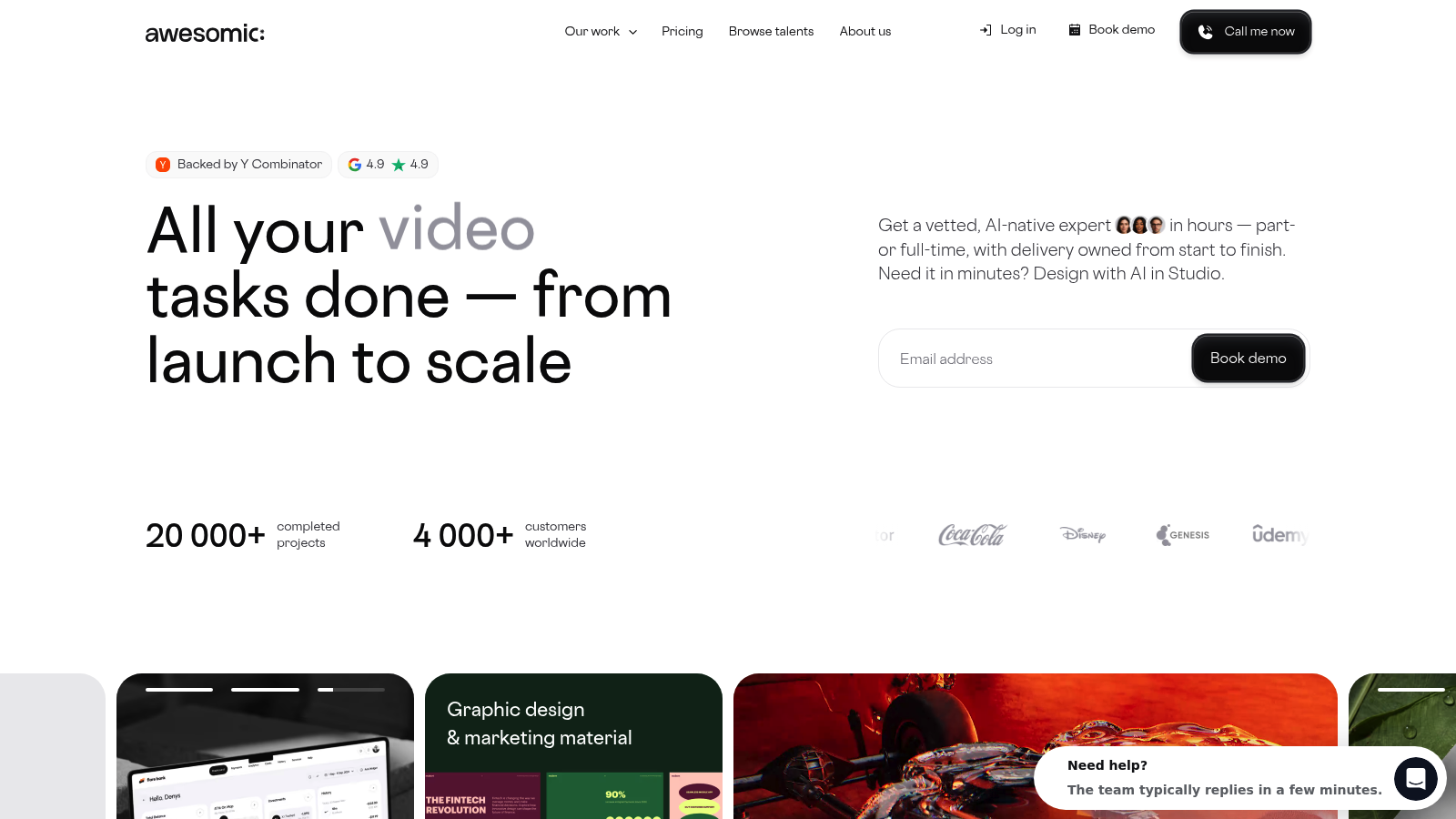
Overview: We match you with a designer who both designs the page and builds it in Webflow, on a monthly subscription rather than a scoped project. The brief goes into the app, the designer picks it up, and the same person handles the next one.
What that changes is what happens after launch. A project-based build ends at handover, so the campaign page you need three weeks later becomes a new conversation about scope. Here it is just the next brief in the queue.
We also build in Framer and WordPress, which matters more than it sounds: it means the platform decision stays a decision rather than being made for you by whoever you hired.
Hegel AI, a Y Combinator S23 company building open-source developer tooling for large language models, is a fair example of the shape. Its scope with us covered web design and branding together, which is the normal pattern for an early-stage company that needs the site and the identity to arrive at the same time.
Core services:
- Webflow design and build handled by the same designer
- Marketing sites, landing pages and CMS collections your team can edit
- Framer and WordPress when either suits the job better
- Product and interface design when the app needs attention too
- Brand identity and graphics from the same monthly fee
- Copywriting and quality assurance included at the top tier
Industries served: SaaS, developer tools, fintech, marketplaces, professional services
Pricing: Graphic Pack is $1,490 a month and All-in-One is $2,995, both published openly. Underneath sits a $200 AI Designer tier, and above them a Dedicated Talent plan quoted on a call. Paying three months up front takes a fifth off whichever tier you choose.
Pros: design and build from one person, three platforms rather than one, rates published in a category that mostly hides them, work continues after launch, month-to-month
Cons: we are not a Webflow-only specialist, so a genuinely exotic platform problem may be better served by one of the specialists below, and each published tier carries a single live task
How the work starts: You subscribe, describe the pages, and meet the designer who will build them. Briefs go through the app with Slack alongside it, and the arrangement renews monthly rather than ending on a delivery date.
Why it belongs among Webflow design subscription services: Because most teams buying one are not buying a website, they are buying the ability to keep changing a website, and that is a subscription question rather than a project question.
Final verdict: The right call when the site is one of several things you need designed. If Webflow itself is the hard part, read on.

Design Focus
Overview: A design and Webflow subscription sold by the week as well as by the month, which makes it the cheapest genuine way to find out whether this model suits how your team works.
The weekly option is the interesting part. Most vendors here want a month before you learn anything; this one lets you buy a single week, hand over a real brief, and judge the output rather than the pitch.
Core services:
- One subscription covering both the design and the Webflow build
- One active request at a time, worked to completion
- Unlimited brands under a single plan
Industries served: Startups, small marketing teams, multi-brand operators
Pricing: $495 a week, or $1,995 a month for the ongoing plan. One request runs at a time on both, and you can pause or cancel whenever you like.
Pros: the lowest entry point on this list, weekly billing makes trialing it genuinely cheap, unlimited brands on one fee, pause at any time
Cons: one live request throttles a launch, a small operation means limited surge capacity, and the weekly rate works out higher than the monthly if you stay
Notable clients or work: Publishes design and Webflow work delivered on a subscription basis.
Why buyers shortlist it: A single week costs less than most vendors' onboarding call, and it produces real work you can judge.
Final verdict: Start here if you are unsure the model fits. Move up if the queue keeps filling.
Fluid Design

Overview: A design and Webflow subscription priced in monthly hour bands rather than in requests, which suits teams that would rather buy time and direct it themselves.
Its own site is unusually direct about who does the work: the copy describes "a full 8 hours day with me." This is one person, not a bench, and the entry is written on that basis.
Core services:
- Design and Webflow build sold as monthly hours
- A single-day option for unexpected spikes in demand
- Direction handled between you and the person doing the work
Industries served: Startups, founders, small in-house marketing teams
Pricing: $1,440 a month buys around 20 hours, $1,920 around 30 and $2,560 around 40. A single 8-hour day is $800 for one-off surges.
Pros: hours are easier to reason about than a request queue, a genuine one-day option, direct access to the person building, no rotating account team
Cons: it is a solo operator, so capacity has a hard ceiling and holidays are real, and buying hours means you supply the direction
Notable clients or work: Shows design and build handled by the same person across ongoing engagements.
Where it fits: Teams with a clear brief and no appetite for account management.
Final verdict: The most transparent unit of purchase here, provided one person is enough.
SimpleTiger
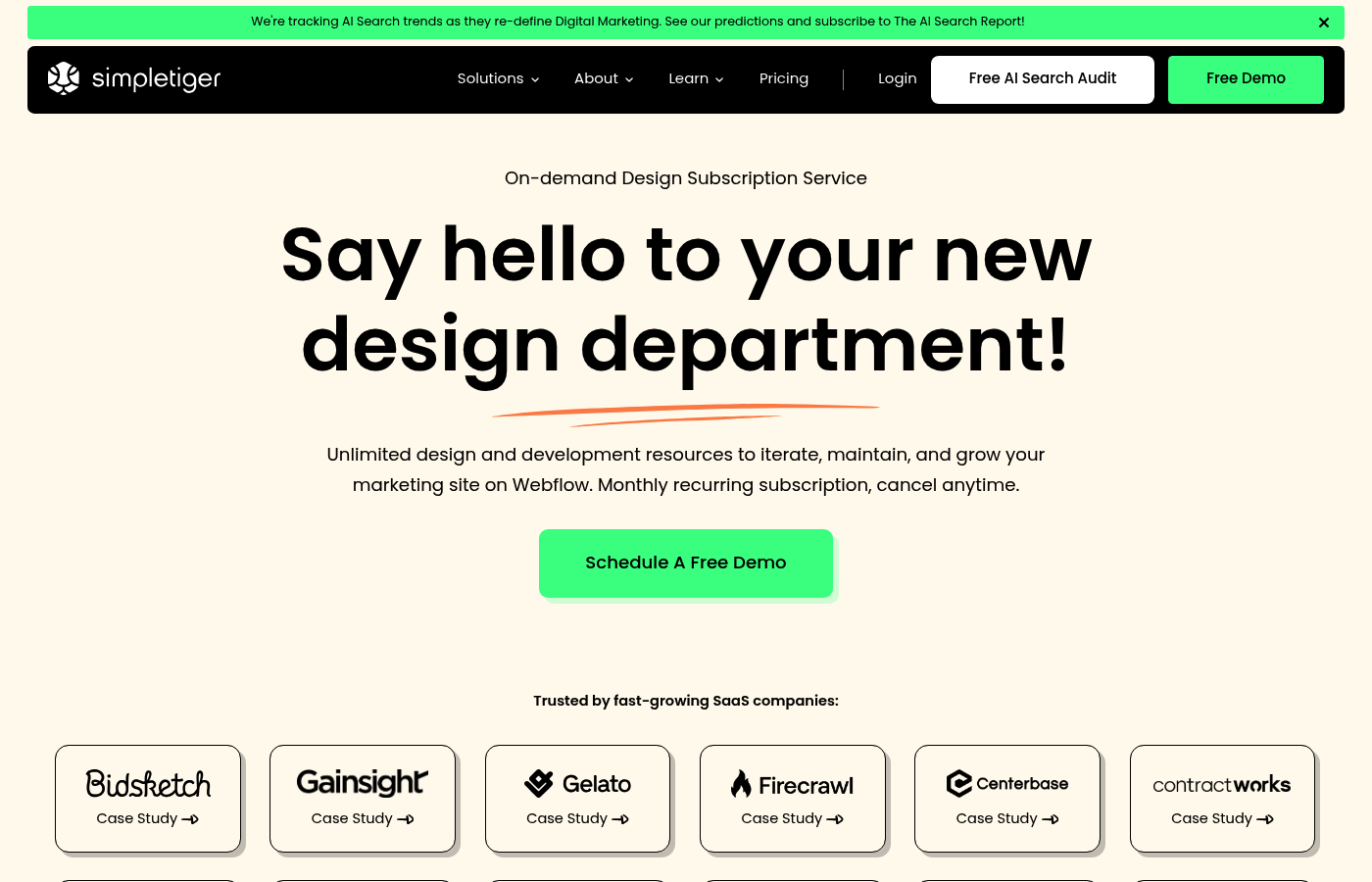
Overview: A SaaS-focused firm that runs a design subscription alongside its search work, so the pages get built with ranking in mind rather than handed to a separate team afterwards.
That combination is genuinely uncommon. Most subscriptions here will build whatever page you brief; this one has an opinion about what the page should be for, which helps when the site's job is acquisition.
Core services:
- Unlimited design requests on a subscription
- Unlimited Webflow development requests
- Search and content expertise applied to the same pages
Industries served: SaaS and software companies
Pricing: Nothing appears on the page. The subscription is scoped on a call, and no rate is published anywhere on the site.
Pros: design and search handled by one vendor, real depth in SaaS specifically, unlimited requests across both design and development
Cons: no published rate to compare, the SaaS focus makes it a poor fit outside software, and search expertise is priced into a bill you cannot see in advance
Notable clients or work: Publishes SaaS design, development and search work.
Where it beats the alternatives: When the site exists to rank and convert rather than to look finished.
Final verdict: The strongest pick if acquisition is the point of the site. Ask for the rate early.
Webflow-only development subscriptions
The five vendors below build in Webflow and nothing else. That narrowness is the product: you are buying platform depth rather than breadth of service, which matters when the platform itself keeps shifting under you, as our Webflow upgrade rundown covers.
Flowout
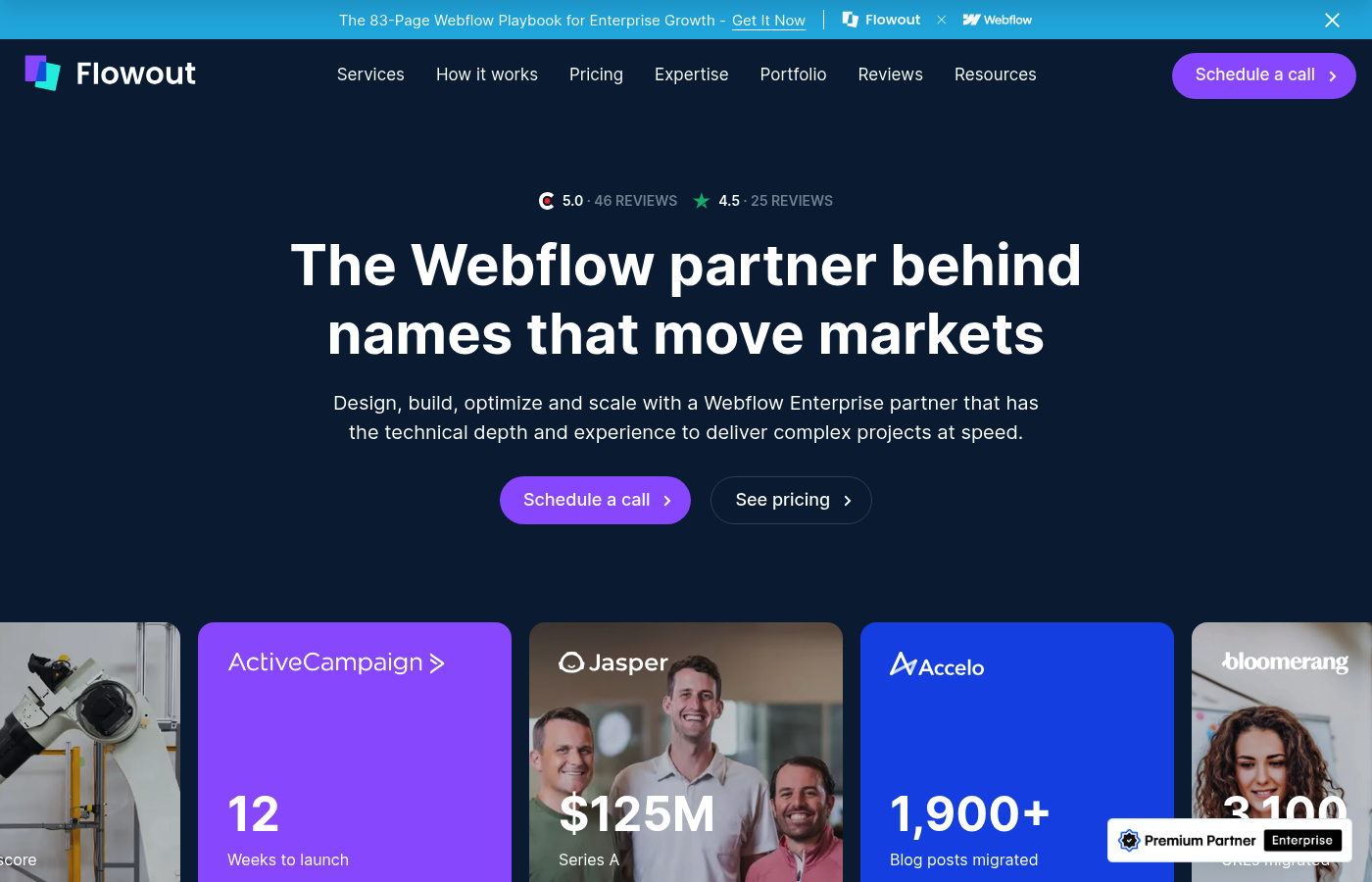
Overview: A Webflow subscription structured as three stacked tiers, where development is the base product and design and copywriting are additions on top of it rather than assumptions.
That structure is honest and it is also the most expensive on this list, because it is aimed at scale-ups and enterprise marketing teams running continuous web operations rather than at a founder who needs a homepage.
Core services:
- Webflow development as a standalone monthly subscription
- Design added at the second tier, copywriting at the third
- Hourly packages and a second developer as add-ons
Industries served: Scale-ups, enterprise marketing teams, SaaS
Pricing: Three stacked monthly tiers: $5,900 buys development on its own, $7,900 folds design in, and $9,900 adds copywriting to both. Commit quarterly and 10% comes off; commit annually and 20% does. Separately, 25 hours can be bought as a block for $2,500, and putting a second developer on the account costs another $3,900 each month.
Pros: the tier structure makes it clear what you are and are not paying for, real enterprise capacity, add a developer without renegotiating, unusually transparent for this end of the market
Cons: far and away the highest entry price here, the base tier assumes you already have designs, and the volume it is built for is more than most teams have
Notable clients or work: Its portfolio leans toward scale-ups and enterprise marketing teams running continuous site work.
Why it made this list: Because it is the only vendor here priced and staffed for continuous enterprise web operations.
Final verdict: Correct at genuine volume, and considerable overkill below it.
Minute Creative
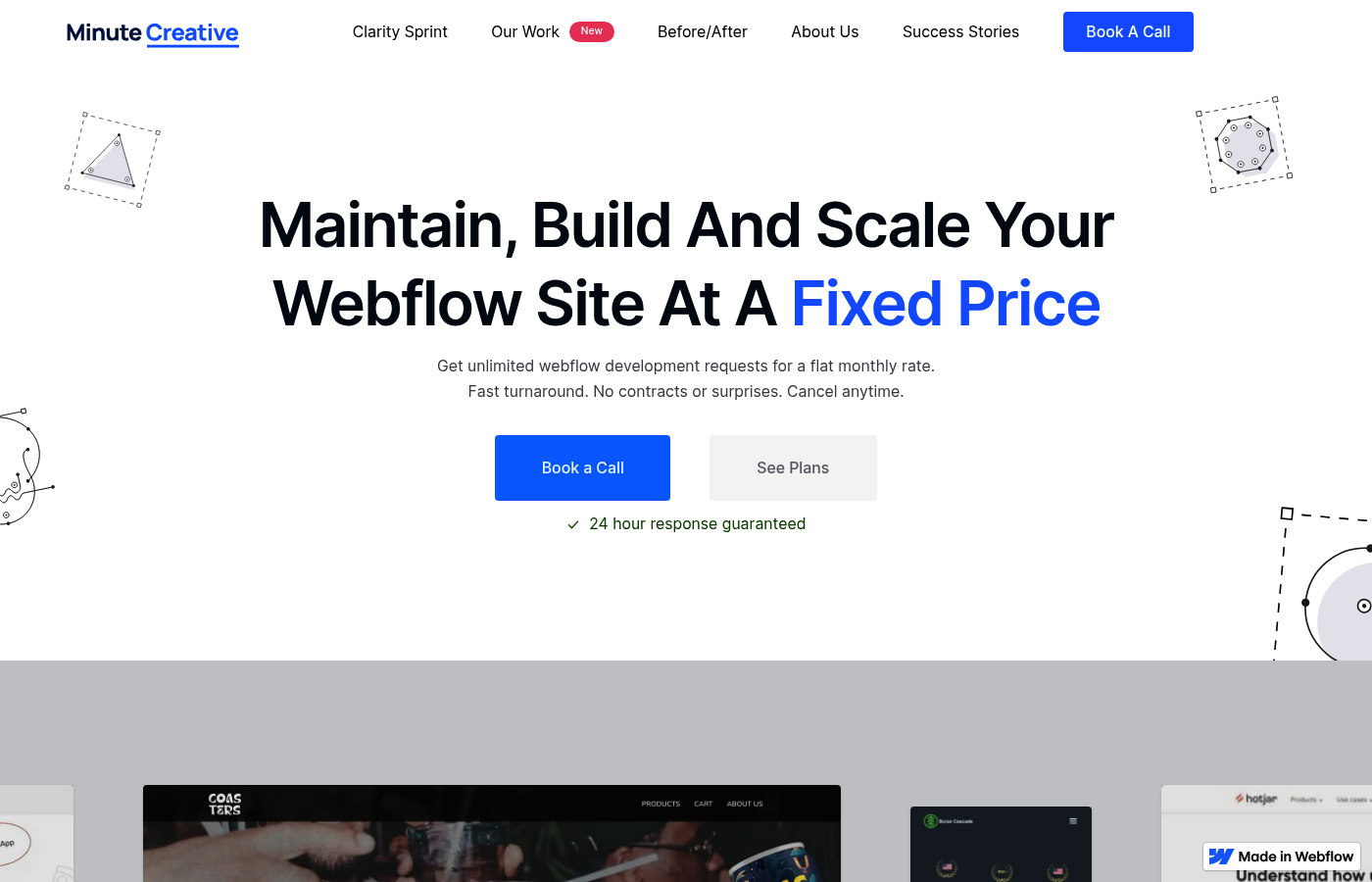
Overview: An unlimited Webflow development subscription with a second track built specifically for agencies that want to resell Webflow build under their own name.
The white-label side is what distinguishes it. If you run a marketing or brand agency and keep turning down Webflow work, this is structured to be the back end you do not have to hire for.
Core services:
- Unlimited Webflow development on a monthly subscription
- Unlimited revisions inside the plan
- A separate white-label track for agency partners
Industries served: Startups, marketing teams, agencies reselling Webflow
Pricing: $1,999 and $2,999 a month for the two published plans, with pause or cancel available at any time. The salary comparisons on its page are what hiring would cost, not what the service costs.
Pros: two rates stated plainly where most competitors stay silent, a genuine white-label route for agencies, unlimited revisions, pause at any time
Cons: development-led, so design direction is largely yours to supply, and the agency track means you may be one of several clients behind a partner
Notable clients or work: Publishes Webflow development work delivered directly and through agency partners.
Its strongest suit: Being the invisible build team behind somebody else's brand.
Final verdict: The obvious pick for an agency with Webflow demand and no Webflow developer.
Creative Corner Studio
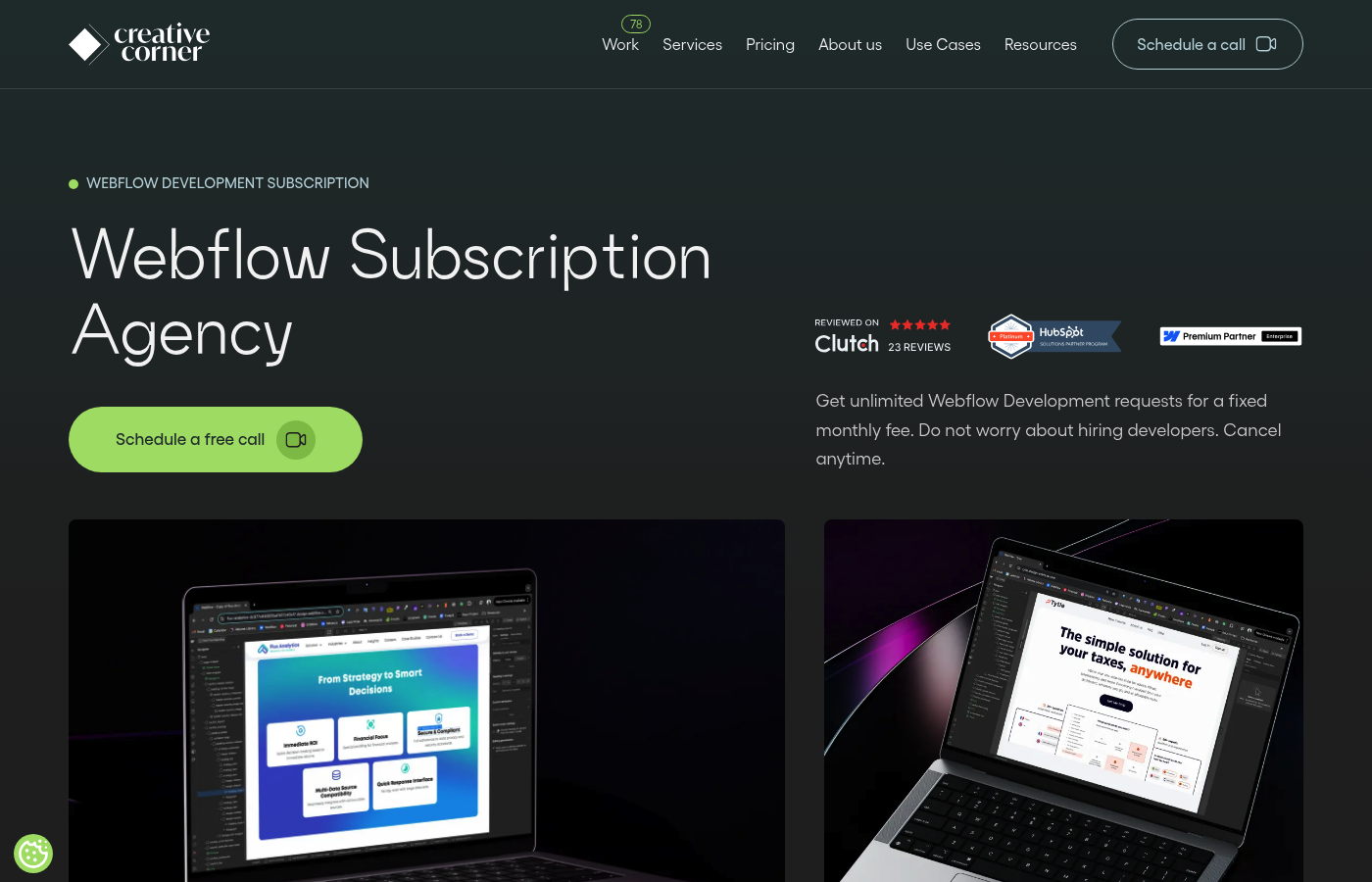
Overview: A Webflow subscription sold on continuous capacity, with unlimited development hours rather than a counted number of requests or tasks.
Selling hours without a cap is an unusual promise and worth probing on a call, because capacity that is genuinely uncapped has to be constrained somewhere, normally by how many things run at once.
Core services:
- Unlimited Webflow development within the subscription
- Unlimited hours rather than a fixed monthly allowance
- Design work alongside the build
Industries served: Startups, marketing teams, growing product companies
Pricing: No rate is rendered anywhere on the page. ⚠ A dollar range does sit in the site's underlying schema markup, but it describes project work and is invisible to visitors, so it should not be read as a subscription price.
Pros: capacity framed as hours rather than tickets, design and development from one vendor, continuous rather than project-shaped
Cons: you cannot compare it on price without a call, and an uncapped promise needs its real constraint identified before you sign
Notable clients or work: Shows continuous build engagements rather than one-off site launches.
Where it fits: Teams whose Webflow workload is genuinely constant rather than seasonal.
Final verdict: Worth a conversation, and worth asking what "unlimited hours" actually limits.
Magier
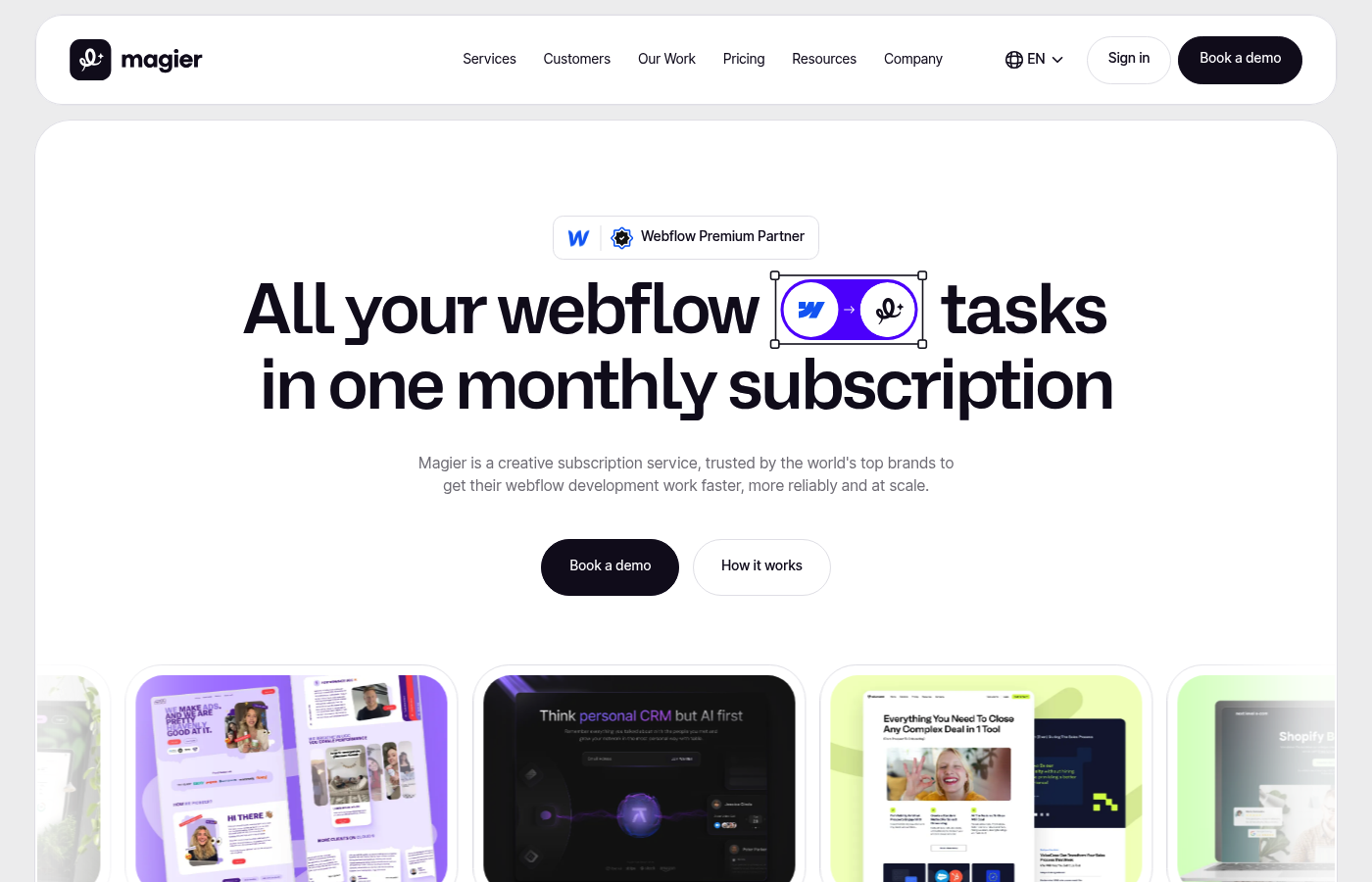
Overview: A straightforward unlimited Webflow subscription covering design and development requests, positioned without the layers of tiering that most of this list carries.
Simplicity is the offer here. There is no matrix of plans to decode, which is genuinely useful, and there is also no published number, which is not.
Core services:
- Unlimited Webflow design and development requests
- Unlimited revisions on delivered work
- Web design tasks handled inside one queue
Industries served: Startups, small businesses, marketing teams
Pricing: Nothing is published, in the page text or in its markup. The figure arrives after a conversation.
Pros: a simple single offer rather than a tier matrix, unlimited requests and revisions, design and development in the same queue
Cons: no number anywhere on the site, less published detail about the team than its competitors offer, and the simplicity means fewer levers to match a plan to your volume
Notable clients or work: A portfolio of Webflow builds, presented without tiering or case-study framing.
Best angle: Buyers who want one plan and no decision tree.
Final verdict: Easy to understand and impossible to price without asking.
Flowbison
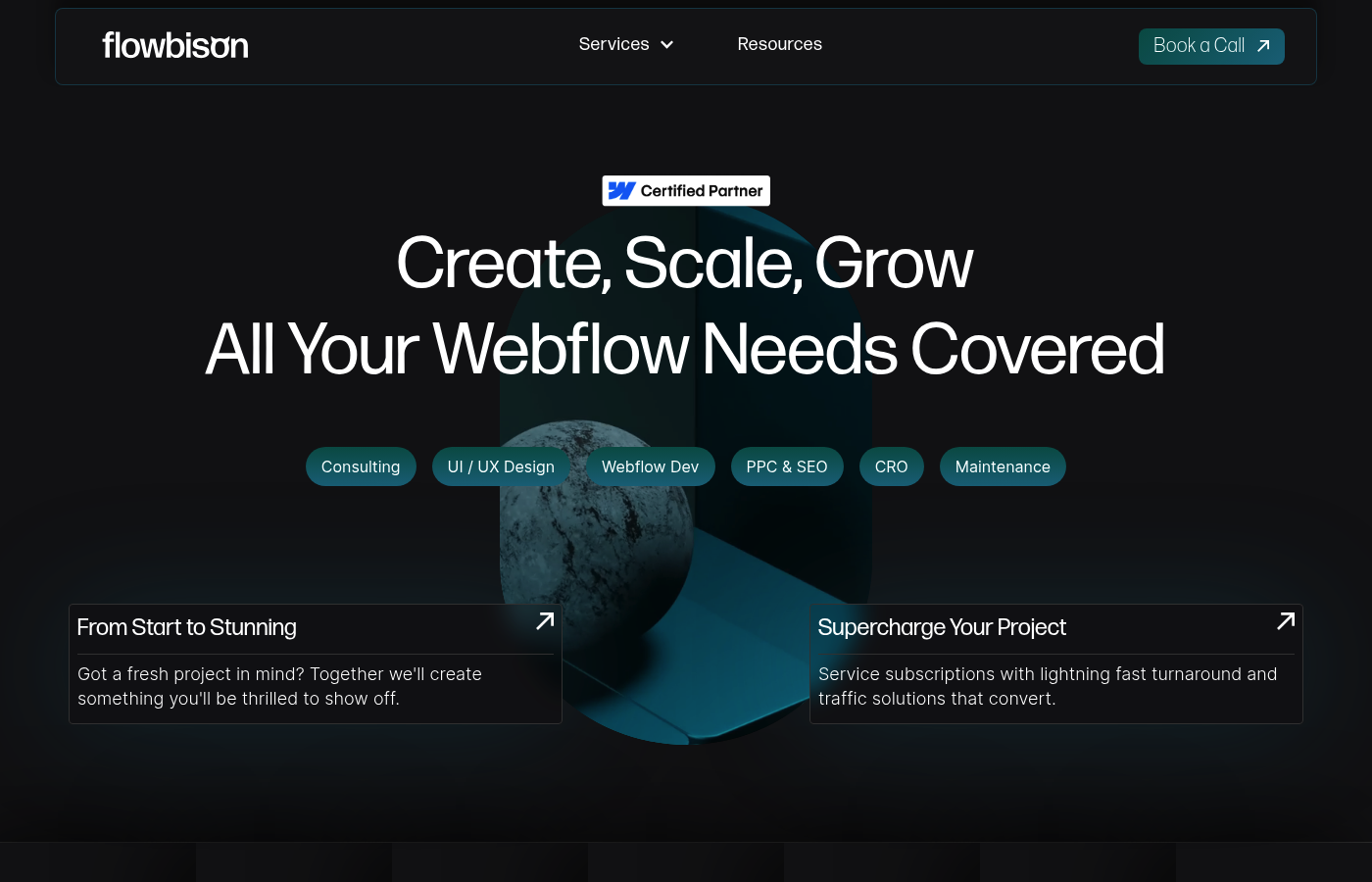
Overview: A Webflow Certified Partner selling service subscriptions that reach past the build into the marketing around it, covering conversion work, search and ongoing maintenance.
Its badge is worth noting because Webflow's partner program is a verifiable credential rather than a self-description, which is rarer on this list than you would expect.
Core services:
- Webflow development and UI/UX design on subscription
- Conversion rate optimization and paid search alongside the build
- Ongoing site maintenance rather than handover at launch
Industries served: Startups, scale-ups, marketing teams
Pricing: No figure appears on the site. Its plans are named rather than priced, including an entry tier it calls Unlimited Light.
Pros: a verifiable Webflow partner credential, marketing services attached to the build, maintenance treated as ongoing rather than optional
Cons: nothing published to compare, the breadth means less depth in pure Webflow engineering, and a named tier without a number tells you very little
Notable clients or work: Publishes Webflow, conversion and marketing work under a subscription model.
Where it wins: Teams who want the site and the traffic handled by one vendor.
Final verdict: A sensible choice when the site is a marketing channel rather than a brochure.
How we chose these nine
We started from a single rule: the product had to be a subscription. Project-based Webflow shops are a real and often better purchase, but they answer a different question, and mixing the two produces a list where nothing is comparable.
Each vendor was then read on its own site rather than through a roundup, which removed three names that looked fine at a distance. One had a homepage that now sells conversion and advertising work rather than Webflow. Another turned out to be a film and marketing agency. A third resolved to a domain listed for sale.
Pricing came last and produced less than it should have. Five vendors publish a number and four do not, so four cells read Quoted rather than a band we invented. ⚠ Where a figure appeared on a page but was not a price, we left it out: two vendors show in-house salary comparisons, and one carries a dollar range in its schema markup that no visitor ever sees.
The result is nine vendors that all sell the same shape of thing, which is the only way a comparison table earns its place. Buyers in a regulated field should weigh that against a specialist, since healthcare web design agencies carry compliance knowledge no general subscription does.
What a Webflow design subscription costs
Published rates here cluster into three bands, and which one you need follows from how much of the work you want to hand over rather than from how large your company is.
| Band | Monthly cost | What it covers | Right when |
|---|---|---|---|
| Weekly or entry plan | $495 to $1,995 | One live request, design and build | The workload is real but occasional |
| Mid subscription | $1,440 to $2,999 | A named designer or a set band of hours | Pages ship most weeks |
| Full-service subscription | $2,995 | Design, build, brand and copy together | The site is one of several needs |
| Enterprise Webflow tiers | $5,900 to $9,900 | Continuous web operations at volume | Web is a department, not a task |
| Quoted engagements | Not published | Scoped on a call | You want a specialist and will ask |
Set those against building the capability internally. Federal employment and wage data puts custom computer programming services at 199,379 US establishments employing about 1.08 million people at an average annual pay of $178,485 in 2024. One developer at that average costs more per year than the most expensive plan on this list, before benefits, equipment or the two months it takes to hire them.
The comparison is not purely financial, though. A subscription gives you a queue and a monthly decision; a hire gives you someone who learns the product and is there when something breaks at 6pm. Teams that want the second thing should hire, and should not read a cheaper monthly number as the whole argument.
What you actually own when you stop paying
Buyers skip this question and later regret it, and Webflow makes it more slippery than usual, because the site, the account and the design files can all sit in different hands.
The legal position is narrower than most people assume. The US Copyright Office states in Circular 66 that, for registration purposes, a website itself is not typically considered a copyrightable work, though it may qualify as a compilation or collective work if it meets the statutory requirements. Individual elements such as text, artwork and photographs are treated separately.
What follows is practical rather than theoretical. Because the site as a whole is weak ground for a copyright claim, what you own is whatever your contract says you own, and a handshake will not settle it.
Three things are worth naming in writing before the first page ships. Register the Webflow account to your own business entity, not the vendor's, so ending the plan does not end your access to the site. Get an explicit license for any custom code, components or templates built for you. And require the design source files at handover, not merely the published pages.
Vendors that build under their own account and hand over a published site are not necessarily acting in bad faith, but it is a materially worse position to be in, and it is much easier to fix in the contract than after a relationship ends.
Questions to ask before you subscribe
The published price tells you less than four short questions will, and every vendor here can answer all four in a single call.
Ask how many tasks run at once, and get the number rather than the word unlimited. Ask who does the work and whether it is the same person next month. Ask what the turnaround is for a page rather than for a "request," since those are not the same unit. And ask what happens to the Webflow account, the source files and any custom code if you cancel.
If a vendor is slow on the fourth question, that is information. Teams that would rather not run this conversation at all sometimes find that engaging a landing page designer directly for a defined piece of work is the simpler arrangement.
Whether the site needs to serve a regulated industry is worth settling at the same time, since compliance review changes both the page count and the timeline.
One more thing worth confirming: whether the person designing is also the person building. A subscription that splits those roles across two people reintroduces the handoff the model is supposed to remove.
FAQ
What is a Webflow design subscription?
It is a monthly plan that puts page design and Webflow build in one recurring fee, worked from a queue rather than scoped as a project. You file briefs, the vendor works them in order, and the arrangement continues until you cancel. The distinction from an agency retainer is that you are buying throughput rather than a defined deliverable, which is why the number of concurrent tasks matters more than the headline rate.
How much does a Webflow design subscription cost?
The published figures span $495 for a single week at the entry end and $9,900 monthly for a full enterprise tier covering development, design and copywriting. Five of the nine vendors publish a figure and four quote after a call.
The band you need depends on concurrency and on whether design is included or assumed, so settle those two things before comparing prices. For context, the field that builds software averages $178,485 a year per employee in federal data.
Is a subscription better than hiring a Webflow agency?
It depends entirely on whether the work ends. A project agency is usually better value for one site built once, because you pay for a defined outcome and stop. A webflow development subscription wins when pages keep arriving, since each additional page costs nothing extra and there is no renegotiation.
The awkward middle case is a big initial build followed by a trickle. There, a project for the site plus a small ongoing plan often beats either option alone.
Do I own the Webflow site if I cancel?
Usually, but only because your contract says so rather than because copyright hands it to you. The Copyright Office treats a website as generally not copyrightable in itself, so the protection you have is contractual.
Pin down three specifics in writing: which entity holds the Webflow account, whether source files come with the handover, and who is licensed to reuse any custom code built for the project. Teams that skip this step tend to discover the gap at exactly the wrong moment.
Does unlimited really mean unlimited?
No, and the word is doing marketing work rather than describing the product. On a webflow development subscription the promise covers the size of your queue, not the speed it empties. Most plans here move a single task at a time, so throughput comes down to concurrency and turnaround.
Ask how many tasks move at once and how long a typical page takes, and you will learn more than the pricing page can tell you. Scale-ups running continuous web work often need the higher tiers our guide to unlimited development subscriptions describes.
One subscription and your hiring problems solved

FAQ


Awesomic is a revolutionary app that matches companies with vetted professionals across 30+ skill sets, from design and development to marketing and product. Based in San Francisco with a global core team, we offer a faster and more flexible alternative to traditional hiring through a subscription-based model. Awesomic delivers high-quality talent on demand, without the delays of recruiting.
We function as a subscription-based service that matches you to top-tier, vetted talent. Submit a project in just a few clicks and start receiving deliverables in as little as 24 hours. Scale your Awesomic plan up or down as your business needs change.
Every Awesomic subscription comes with unlimited revisions. You receive daily progress updates via the app, and you can provide feedback or request iterations as needed. If your project requires a different approach, you can request a talent rematch at any time, at no extra cost. You can also add teammates to collaborate and streamline feedback
A talent marketplace is a platform that utilizes data and intelligent matching algorithms to connect professionals with projects based on their skills, experience, and availability. While often used internally by large companies, Awesomic applies this model at scale, matching vetted global talent to your most critical business needs.
Hiring is time-consuming, expensive, and risky. Awesomic eliminates that problem. We rigorously vet all talent for technical ability, communication, and soft skills, ensuring only senior-level professionals work on your projects. You skip the job posts, interviews, and delays, and get straight to results.
No, Awesomic goes beyond design. While many clients utilize us for branding, UI/UX design, or motion graphics, we also provide vetted talent in no-code web development, product design, marketing, and more. Think of us as an extension of your team. A flexible, high-performing creative partner from planning to execution, whether you're building awesome products or scaling your team.
You can talk directly with your matched talent via the Awesomic app, connect via Slack, email, or schedule video calls. No matter the plan, you’ll receive daily updates in the app for every active task. You can also tag us in for any issues through our in-app customer chat.


