




9 Best AI Consulting Agencies for Creative Teams in 2026

Key takeaways:
- AI consulting agencies for creative teams sell capability, not output. You are paying to change how your designers work, which is a slower and more valuable purchase than buying finished assets.
- None of the eight consultancies publishes a rate. Every one quotes per engagement, so budget comparison happens on a call and you should ask for a day rate.
- The US Copyright Office has ruled that generative AI outputs are protectable only where a human determined the expressive elements. Prompts alone do not create authorship, which changes what your team can own.
- Training only pays back if there is work to apply it to. Teams with a backlog and no capacity usually need the work done first and the capability built second.
An AI consulting agency for creative teams helps designers, marketers and brand people actually use AI in their day-to-day work, through some combination of workflow audits, tool selection, hands-on training and governance policy. The output is a team that works differently, not a folder of finished assets.
The category exists because the first wave of creative AI adoption went badly in a specific way. Companies bought licenses, told everyone to experiment, and got a scatter of individual habits with no shared standard, no quality bar and no view on who owns the results.
This list covers firms whose product is that capability transfer. It excludes design agencies that merely use AI internally, which is a different offer entirely and one we cover in our roundup of AI consulting services.
Awesomic is first, and the reason is not that we are a consultancy. We are not. The explanation is in our entry rather than hidden in a footnote.
What these firms actually change
The deliverable is unusually hard to picture, which is why buyers struggle to compare these engagements. In practice the work falls into four activities, and most firms do two or three of them well rather than all four.
Workflow audits establish which parts of your creative process are worth automating and which are not. This is the least glamorous activity and usually the most valuable, because the honest answer is often that fewer steps than expected are good candidates.
Tool selection narrows a crowded market to a stack your team can actually operate, integrated with whatever you already run. Done properly it also covers what you stop paying for.
Training turns a license into a practice. The good programs are role-specific, because what a brand designer needs from AI has almost nothing in common with what a motion designer needs.
Governance covers the rules: what may be used commercially, what gets disclosed to clients, what never goes into a prompt, and who signs off. This is the activity most teams skip and most regret skipping.
AI adoption consulting increasingly reaches past the studio into how the work gets found at all, which is why discovery questions now sit alongside production ones on our AI search page.
The 9 best AI consulting agencies for creative teams
The table splits the nine by what they primarily sell, since a six-week training course and a workflow audit are bought for different reasons and by different people.
| Firm | Focus | Best for | Delivery shape | Pricing (from) | Rating |
|---|---|---|---|---|---|
| Awesomic | Output, not capability | Teams who need the work done now | Monthly design subscription | $200/month | ★★★★★ |
| Spark Novus | Training and enablement | Marketing teams adopting AI properly | Strategy, execution, training | Quoted | ★★★★★ |
| House of GAI | Training and enablement | Design agencies and in-house studios | Training programs for design teams | Quoted | ★★★★★ |
| G3NR8 | Training and enablement | Brand leaders wanting a fixed course | Six-week live online course | Quoted | ★★★★☆ |
| Creative AI Academy | Training and enablement | Larger organizations training at scale | Enterprise training programs | Quoted | ★★★★☆ |
| Ardent Creative | Strategy and audits | Deciding what to automate at all | Audits, strategy and roadmaps | Quoted | ★★★★☆ |
| Phos AI Labs | Strategy and training | Mid-market firms wanting a playbook | Role-based training and consulting | Quoted | ★★★★☆ |
| Punchcut | Design and innovation | AI inside the product, not the process | Design and innovation consulting | Quoted | ★★★★☆ |
| Carissa Newton | Independent consulting | Working directly with one operator | Direct AI marketing consulting | Quoted | ★★★☆☆ |
Ratings reflect fit for helping a creative team adopt AI specifically. Several of these firms also do broader work that is bought separately.
Buying the output instead of the capability
One entry belongs in this group, and it exists because a significant share of teams researching this term do not have a capability problem at all.
Awesomic
Best for: Teams who need the work done now
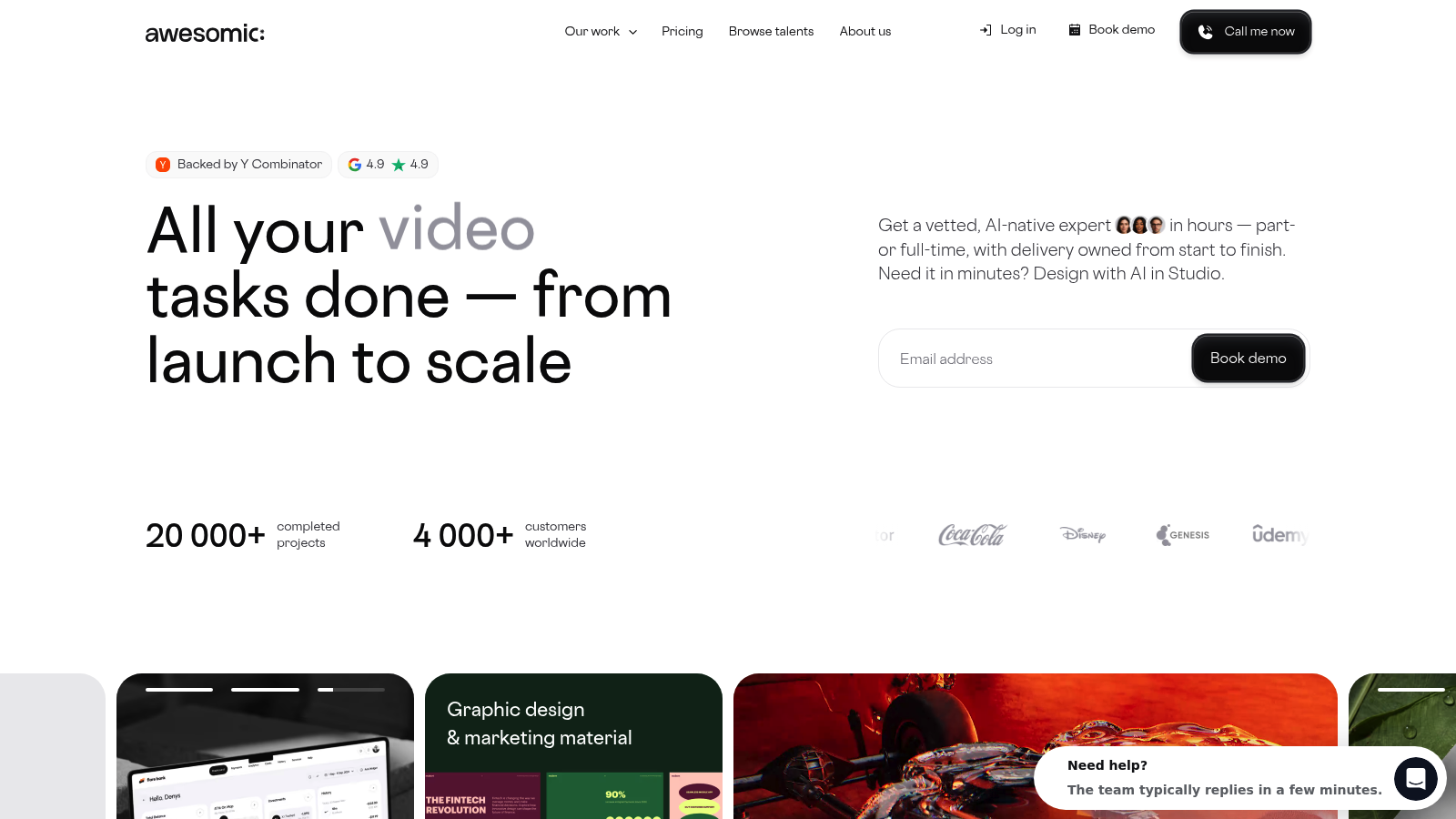
Overview: We are a design subscription, not a consultancy. Nobody here will audit your workflow, choose your stack or run a training program for your designers.
What we do instead is absorb the work. You brief, a matched designer delivers, and our AI Designer tier generates first-drafts directly for teams that want speed over craft on high-volume assets.
The reason that belongs on this page is a pattern worth naming. Plenty of creative teams pursue AI training because they are overwhelmed, and a training program does not reduce a backlog, it adds six weeks of coursework to one. Capability built on top of an unmanageable workload rarely survives contact with the next deadline.
Hegel AI, a Y Combinator S23 company in the US building open-source developer tooling for large language models, used by engineers, founders and researchers at Stanford, is a fair example. Its scope with us covered web design and branding, which is a company deep in AI itself choosing to hand the design work out rather than build the function.
Core services:
- An AI Designer tier generating first drafts at high volume
- A matched human designer for work that needs judgment
- Brand, web, product and graphic design from one subscription
- We carry the coordination rather than handing it back to your team
- Dedicated Talent when the volume justifies a full-time designer
Industries served: AI and developer tools, SaaS, fintech, marketplaces, startups
Pricing: The AI Designer plan is $200 a month. Human design starts at $1,490 for Graphic Pack and $2,995 for All-in-One, with Dedicated Talent quoted separately. Quarterly commitment takes a fifth off the monthly figure.
Pros: the only entry here with a published rate, work starts in about a day rather than after a program, AI and human output available from the same subscription, no change management required, cancel between months
Cons: we build nothing inside your team, so if the goal is genuinely to upskill your own designers, every other firm on this page is the correct purchase and we will say so plainly
Getting going: Subscribe, brief the work, and a designer picks it up. There is no discovery phase, no audit and no curriculum, which is the entire difference between this and the eight below.
Why it belongs among AI consulting agencies for creative teams: Because "our team cannot keep up" and "our team needs new skills" feel identical from the inside and require opposite solutions.
Final verdict: The right answer when the backlog is the constraint. If you want your own people to work differently, read on.

AI training and enablement for creative teams
The four firms below teach your existing people to work differently. AI training for creative teams is the purchase when you have capable designers and an inconsistent approach to AI across them, and it looks nothing like commissioning a piece of AI-assisted design work.
Spark Novus
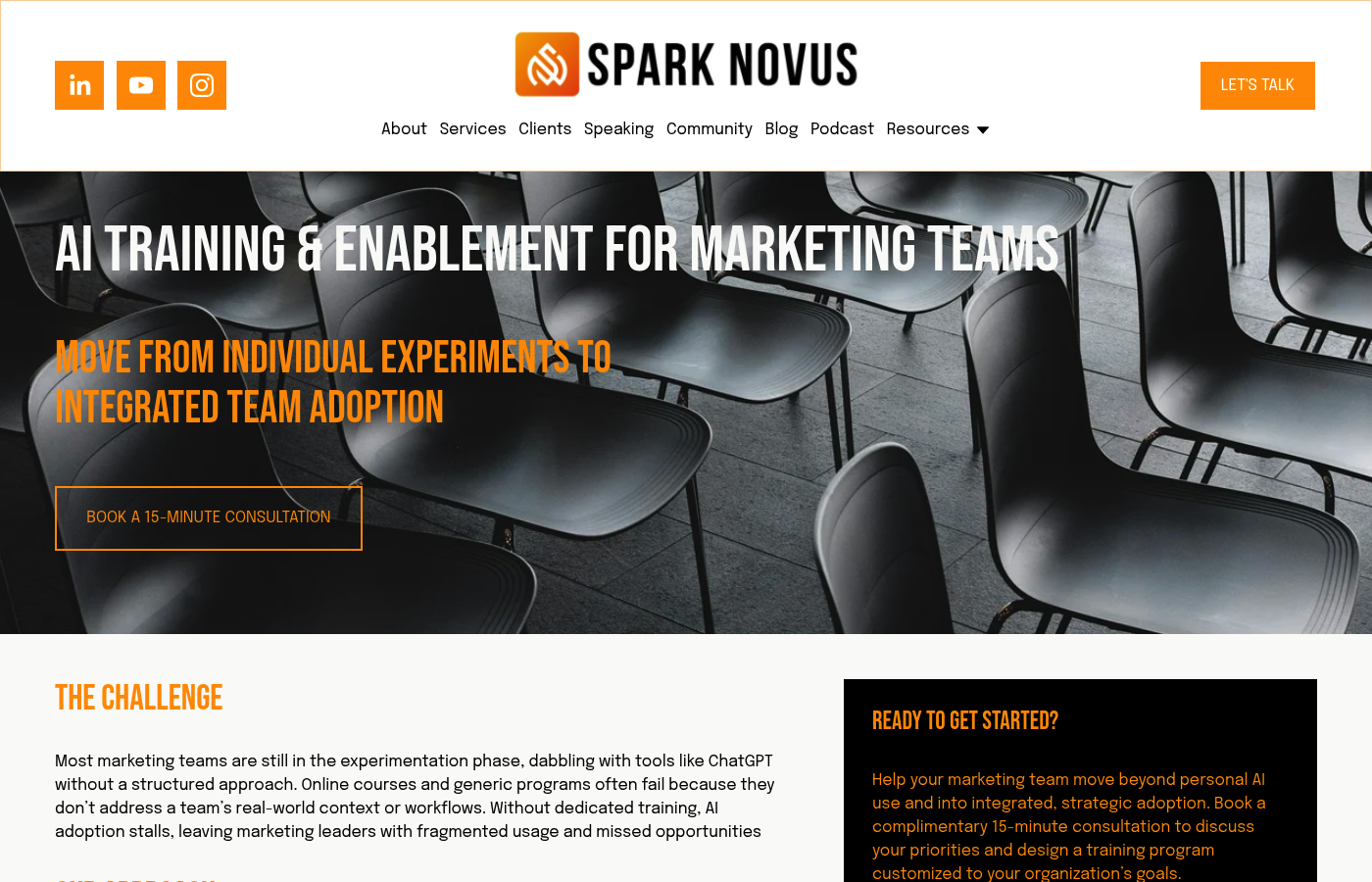
Overview: A marketing AI consultancy organized around four things it names openly: strategy, execution, training and community, aimed at enabling marketing teams rather than delivering campaigns for them.
The inclusion of execution alongside training is the distinguishing feature. Programs that teach without ever shipping anything tend to evaporate, and this one keeps a delivery component attached.
Core services:
- AI training and enablement programs for marketing teams
- Strategy work defining where AI fits the existing operation
- Execution support so the training lands on real work
- An ongoing community component beyond the engagement
Industries served: Marketing organizations, brand teams, mid-market and enterprise
Pricing: Nothing published. Programs are scoped per organization.
Pros: pairs training with actual execution rather than teaching in the abstract, four clearly named service pillars, ongoing community after the program ends, marketing-specific rather than generic AI consulting
Cons: no published rate, oriented to marketing rather than to design craft specifically, and the breadth means depth varies by pillar
Notable clients or work: Its published work centers on marketing organizations adopting AI across strategy and delivery.
Where it beats the alternatives: Keeping the training attached to work that ships.
Final verdict: A strong pick when the team in question is marketing rather than studio design.
House of GAI
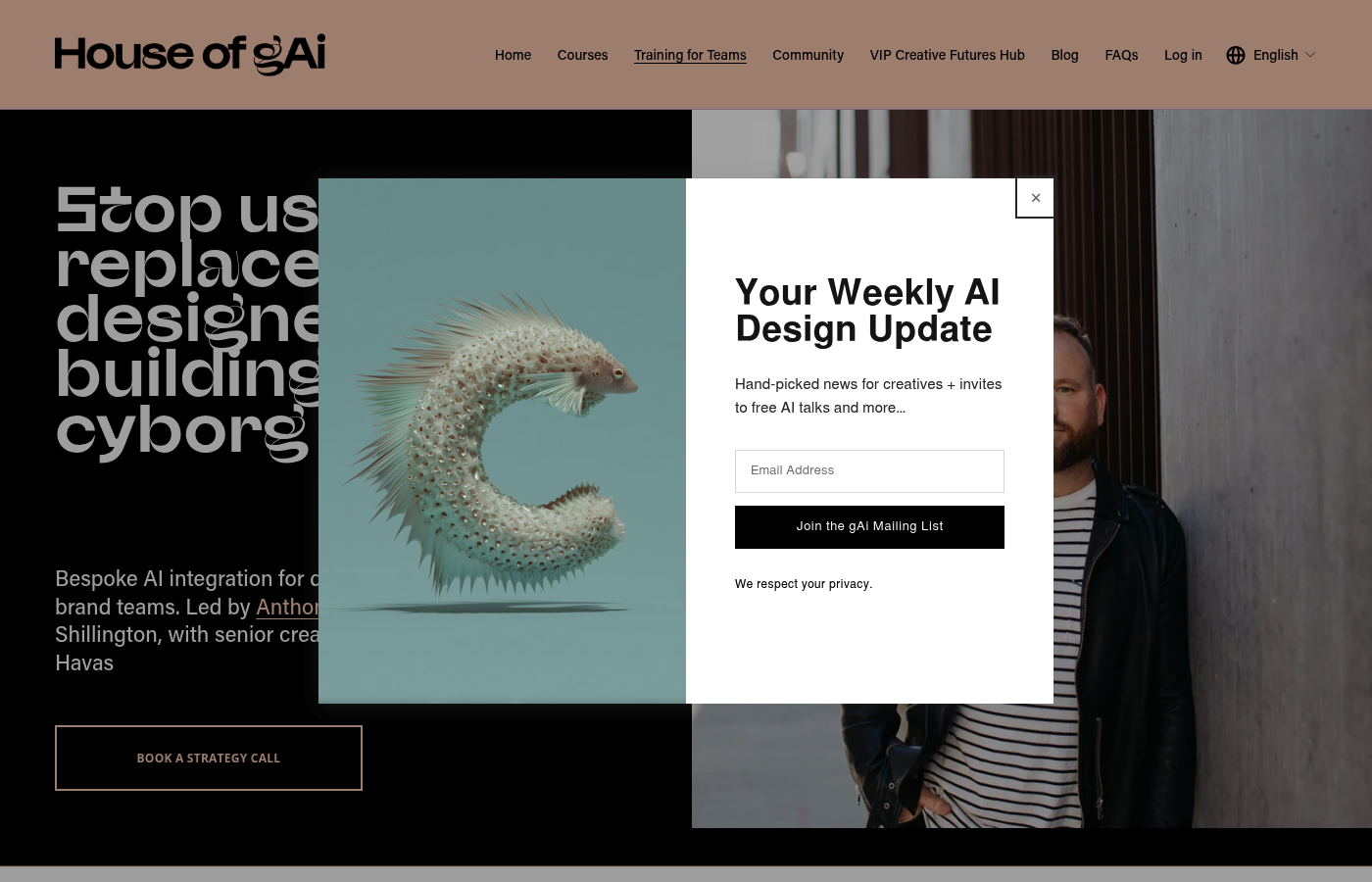
Overview: An AI training practice aimed specifically at design agencies and in-house creative teams, with a stated position that AI should extend designers rather than displace them.
Its own framing is memorable and clarifies the offer immediately: stop using AI to replace your designers, and start building what it calls a cyborg studio.
Core services:
- AI training programs built for design agencies
- Enablement for in-house creative teams
- Practical workflow integration for designers rather than marketers
Industries served: Design agencies, in-house creative studios, brand teams
Pricing: Not published. Training is scoped to the studio.
Pros: genuinely design-specific rather than marketing-adjacent, a clear philosophical position you can agree or disagree with before buying, serves agencies and in-house teams alike
Cons: nothing published on price, a narrow focus that will not suit a broader organizational mandate, and a small practice with the capacity limits that implies
Notable clients or work: Shows engagements with design agencies and in-house studios rather than general business teams.
Its strongest suit: Being aimed at designers rather than at everyone who touches a brand.
Final verdict: The closest fit on this page if the team you are training is a design studio.
G3NR8
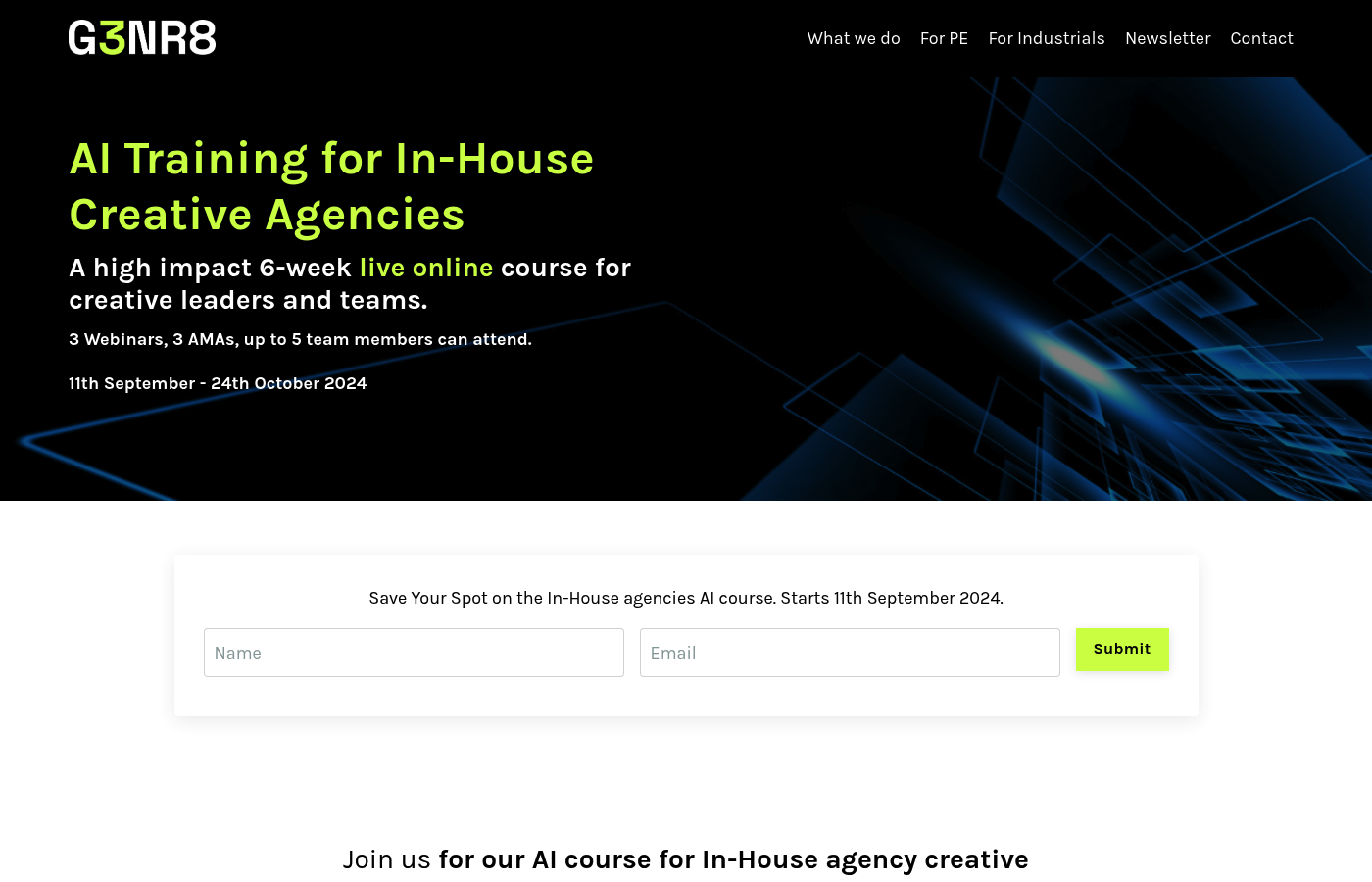
Overview: A structured AI training course for in-house creative agencies, delivered as a six-week live online program for creative and marketing brand leaders and their teams.
The fixed format is the appeal. A defined course with a start and an end is far easier to get approved than an open-ended consulting engagement, and easier to judge afterwards.
Core services:
- A six-week live online AI course for creative teams
- Programs aimed at brand leaders alongside their teams
- Training designed around in-house agency structures
Industries served: In-house creative agencies, brand and marketing teams
Pricing: Not published. The course is quoted per cohort.
Pros: a defined six-week shape rather than an open engagement, live rather than recorded, includes leaders and teams together, easy to evaluate against a budget cycle
Cons: no published price, a fixed course cannot flex to an unusual workflow, and six weeks of live sessions is a real time commitment across a team
Notable clients or work: Runs cohorts drawn from in-house creative and brand functions.
Why buyers shortlist it: A course with a defined end date survives procurement more easily than a retainer.
Final verdict: The most straightforward thing to buy here, if the format fits.
Creative AI Academy
Overview: An enterprise-oriented AI training provider running structured programs for organizations that need to bring a large number of people to a common standard rather than upskill one studio.
Scale is the differentiator here, and it is a genuine one. Training forty people across three offices is a materially different problem from running a workshop for eight.
Core services:
- Enterprise AI training programs delivered at organizational scale
- Structured curricula rather than bespoke workshops
- Programs spanning creative and adjacent functions
Industries served: Enterprises, large marketing organizations, multi-team businesses
Pricing: Not published. Enterprise programs are quoted per organization.
Pros: built for training at scale rather than one team, structured curriculum brings consistency across offices, enterprise procurement experience
Cons: no published rate, a standardized curriculum is less tailored to a specific studio's workflow, and enterprise orientation makes it heavy for a team of ten
Notable clients or work: Publishes enterprise AI training programs.
Best angle: Getting a large, scattered organization onto one standard.
Final verdict: The right shape at enterprise scale and considerable overkill below it.
AI strategy, audits and workflow consulting
The four firms below start with analysis rather than teaching. Choose from here when you are not yet sure AI belongs in your process at all, or where, and expect the answer to differ sharply from what the AI-native build shops would tell you.
Ardent Creative
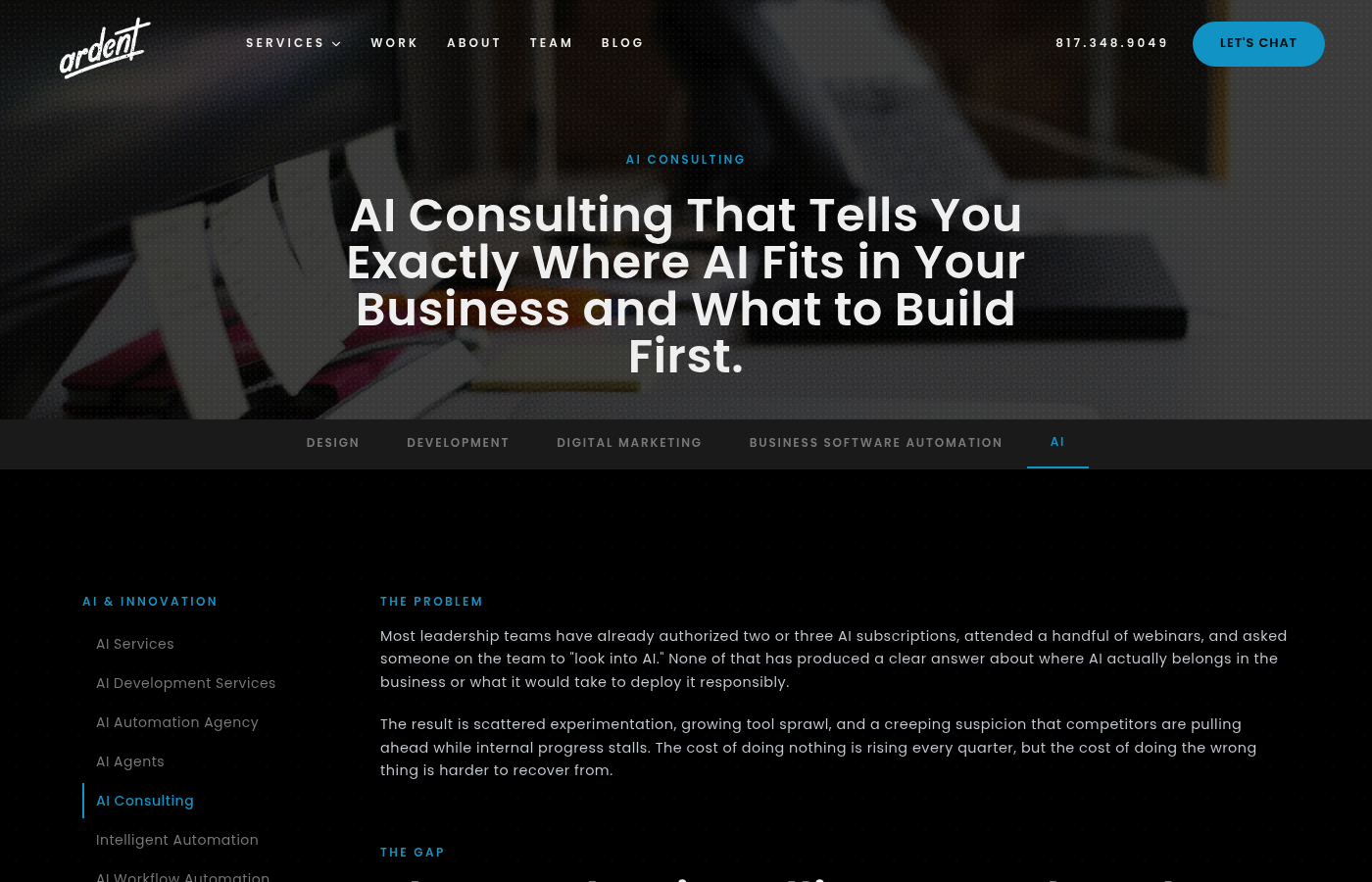
Overview: An AI consulting practice built around strategy, audits and roadmaps, whose stated starting point is an honest assessment of which workflows are genuinely worth automating and which tools fit the operation you already run.
That framing is more useful than it sounds. Most AI disappointment traces back to automating something that was never the bottleneck, and an audit that says "not this" earns its fee.
Core services:
- Workflow audits identifying real automation candidates
- Tool selection matched to the existing operation
- Roadmaps sequencing initiatives rather than launching all at once
Industries served: Creative and marketing organizations, mid-market businesses
Pricing: Not published. Audits and roadmaps are scoped individually.
Pros: starts with assessment rather than assuming the answer is more AI, explicit about tools fitting the current stack, sequenced roadmaps rather than a big bang
Cons: no rate published, analysis-led engagements produce documents before they produce change, and a roadmap still needs someone to execute it
Notable clients or work: Publishes AI strategy, audit and roadmap engagements.
Where it fits: Teams who suspect they are about to automate the wrong thing.
Final verdict: The sensible first engagement when the direction is genuinely unclear.
Phos AI Labs
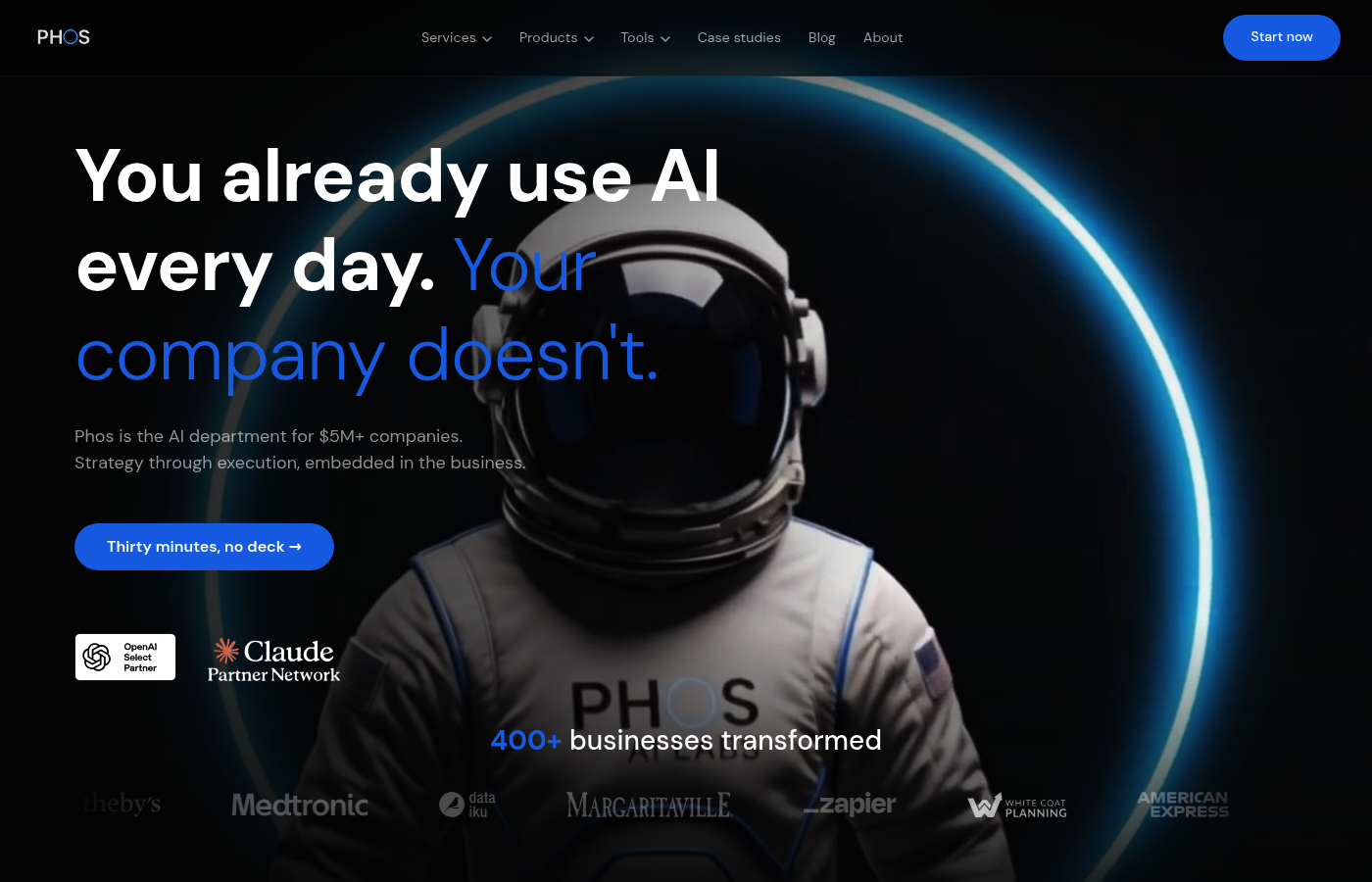
Overview: An AI consultancy aimed at mid-market firms, describing itself as the leading option for that segment, and building training around each role's actual work rather than around the tools.
Its most concrete promise is a playbook the team keeps after the engagement ends, which addresses the standard failure mode where knowledge leaves with the consultant.
Core services:
- Role-based AI training built around each person's real tasks
- A retained playbook documenting the agreed way of working
- AI consulting oriented to mid-market operations
Industries served: Mid-market firms, agencies, professional services
Pricing: Not published. Engagements are quoted per firm.
Pros: role-specific rather than one generic curriculum, leaves a documented playbook behind, mid-market focus means realistic scope, publishes client testimonials by name and company
Cons: no published rate, the "leading" claim is its own description rather than an independent ranking, and mid-market framing may not stretch to enterprise governance needs
Notable clients or work: Publishes named client testimonials, including from the founder of a no-code development agency.
Why it made this list: The retained playbook is the clearest answer here to what you keep afterwards.
Final verdict: Good value for a mid-market team that wants the knowledge to stay.
Punchcut
Overview: A design and innovation consultancy working on AI inside products and interfaces, which is a different problem from AI inside your production process and worth separating carefully.
Punchcut describes itself as a leading design and innovation firm, and its relevance here is for teams whose AI question is about what they are building rather than how they build it.
Core services:
- Design and innovation consulting on AI-enabled products
- Interface and experience design for AI features
- Strategic work on where AI belongs in a product
Industries served: Product organizations, enterprises, technology companies
Pricing: Not published. Consulting engagements are scoped per project.
Pros: genuine depth in AI product and interface design, strategic rather than tool-focused, established consulting practice
Cons: no published rate, it addresses AI in the product rather than AI in the creative workflow, and that distinction catches buyers out regularly
Notable clients or work: Publishes design and innovation consulting work on AI-enabled products.
Where it wins: When the AI question is about what you ship, not how you make it.
Final verdict: Excellent for AI product design, and the wrong purchase for studio enablement.
Carissa Newton
Overview: An independent AI marketing consultant working directly with teams on strategy and adoption, with no agency layer between the buyer and the person doing the work.
Working with one consultant trades bench depth for directness, and for a single team's adoption program that is frequently the better half of the bargain.
Core services:
- AI marketing strategy and consulting delivered directly
- Adoption guidance for marketing and brand teams
- Hands-on work with the team rather than through account management
Industries served: Marketing teams, brand organizations, mid-market businesses
Pricing: Not published. ⚠ Dollar figures on the site describe client outcomes such as a company sale, not consulting fees.
Pros: you work with the consultant rather than a delivery team, operator background across marketing organizations, continuity guaranteed by there being one person
Cons: nothing published on fees, one consultant means a hard ceiling on how much can run at once, and the marketing orientation leaves design craft less covered
Notable clients or work: Publishes marketing leadership experience across restaurant, lending and technology organizations.
Where it fits: One team, one program, one person accountable for it.
Final verdict: A reasonable direct option for a marketing team, with the limits of any solo practice.
How we chose these nine
The test was whether a firm sells capability transfer to a creative or marketing team. That excluded a large number of general AI consultancies whose work is data engineering, and an equally large number of design agencies whose AI story is that they use it themselves.
Reading each firm's own site removed two more that looked right in search results. One turned out to be a performance advertising agency rather than a consultancy. ⚠ Another is a talent business whose own logo describes it as part of a staffing group we already cover elsewhere, which would have meant ranking the same corporate group twice under two names.
Pricing produced nothing usable. Not one of the eight consultancies publishes a rate, so every cell in that column reads Quoted and we invented no bands. ⚠ Where a page showed a dollar figure, we checked what it referred to: one consultant's largest number describes a client's company sale rather than a fee.
Two firms describe themselves in superlative terms on their own sites. We have reported those as their own claims rather than repeating them as findings, because no independent ranking supports either.
What AI consulting for creative teams costs
Not one of these consultancies puts a number on its site, so what follows describes how engagements are priced and what the market rate has to cover.
| Engagement | How it is priced | What drives the number |
|---|---|---|
| Workflow audit | Fixed project fee | Team size and number of workflows examined |
| Training course | Per cohort or per seat | Length, whether live or recorded, seniority mix |
| Enterprise program | Per organization | Headcount, office count, curriculum customization |
| Ongoing advisory | Monthly retainer | Days per month and access between sessions |
| Product design consulting | Project or retainer | Scope of the product surface involved |
The benchmark worth holding is what consulting costs generally. Federal employment and wage data puts management consulting services at 175,137 US establishments employing 840,251 people at an average annual pay of $135,918 in 2024. A consultancy has to cover that cost plus overhead, which is why day rates in this category rarely start below four figures.
Ask for a day rate even when the proposal is a fixed fee. Across every shape of AI adoption consulting it is the only number that makes a six-week course comparable to a workflow audit, and a firm that will not give you one is telling you something.
Who owns what your team makes with AI
Governance rarely carries legal weight, but here it does, and most adoption programs still treat the point as a footnote.
The US Copyright Office addressed it directly in Part 2 of the report, published in January 2025 after reviewing more than 10,000 public comments. Its conclusion is that generative AI outputs can be protected by copyright only where a human author has determined sufficient expressive elements, and that the mere provision of prompts is not enough.
The Office was equally clear about what does not disqualify a work. Using AI to assist creation, or including AI-generated material inside a larger human-authored work, does not bar copyrightability. A human-authored work perceptible in an AI output, or creative human arrangement and modification of that output, can carry protection.
Register of Copyrights Shira Perlmutter framed the reasoning around the centrality of human creativity, noting that extending protection to material whose expressive elements are determined by a machine would undermine rather than further the constitutional goals of copyright.
For a creative team the practical consequence is concrete. Assets your designers meaningfully shaped are protectable; assets someone generated from a prompt and shipped unchanged may not be.
Any consultancy here should be able to explain how its recommended workflow keeps human authorship in the loop, and how you would evidence that later. A firm with no answer is selling tooling rather than governance, and the gap shows up at the moment you try to enforce a mark. Our note on generative AI and creative work covers the same ground for discovery.
Questions to ask before you engage one
Four questions do most of the filtering, and none of them is about price.
Ask what you keep when the engagement ends, and listen for something concrete like a documented playbook rather than a promise of confidence. Ask whether training is role-specific, since a single curriculum for brand designers, motion designers and copywriters will underserve all three. Ask which workflows they expect to recommend against automating, because a consultant who says none has not done this before. And ask how they handle the copyright question above.
The last one is the sharpest filter available. Teams that want the capability inside their own agency rather than bought in should also look at how agency partners structure this, since agencies face the same adoption problem one layer up and have usually solved parts of it already.
FAQ
What does an AI consulting agency for creative teams actually deliver?
Capability rather than assets. A typical engagement combines a workflow audit, tool selection, role-specific training and a governance policy, ending with your team working differently rather than with a folder of finished work.
The measurable outcomes are usually cycle time on defined tasks, consistency across people doing the same job, and a documented standard that survives staff turnover. If a proposal promises none of those, it is closer to a workshop than a consulting engagement.
How much does AI consulting for creative teams cost?
None of the eight consultancies here publishes a rate, which is normal for the category and unhelpful for shortlisting. Fees are driven by team size, program length, and whether the work is a fixed course or an ongoing advisory arrangement.
Ask for a day rate regardless of how the proposal is structured, since it is the only figure that makes different engagement shapes comparable. As context, management consulting averages $135,918 a year per employee in federal data, which sets a floor under any credible rate.
Should we train our team or outsource the work?
Train when you have capable people and an inconsistent approach; outsource when you have a backlog and no capacity. The failure mode is buying training for an overloaded team, which adds coursework to a workload that was already the problem.
Many organizations end up doing both in sequence, clearing the backlog externally while a program runs internally. Sequencing it the other way round is what produces a trained team that still cannot hit its deadlines.
Can we copyright work our team makes with AI?
Sometimes, and it depends on how much your people actually shaped it. The Copyright Office concluded that protection attaches only where a person determined the expressive elements of the result, and that writing a prompt does not clear that bar on its own.
Work where a designer meaningfully arranged, modified or built upon the output can qualify, as can AI-generated material embedded inside a larger human-authored piece. Keep evidence of the human contribution as a matter of routine, because the argument is much harder to make retrospectively.
How long before an AI program shows results?
Structured AI training for creative teams runs around six weeks here, and a workflow audit is typically shorter. Visible change in how a team works usually takes a quarter, because the first weeks produce enthusiasm rather than habit.
The reliable early indicator is not speed but consistency: several designers independently reaching for the same approach on the same kind of task. If that has not happened by the end of the program, the training did not transfer. Design leadership matters more than tooling here, which is the argument our piece on why designers matter makes at length.
One subscription and your hiring problems solved


FAQ


Awesomic is a revolutionary app that matches companies with vetted professionals across 30+ skill sets, from design and development to marketing and product. Based in San Francisco with a global core team, we offer a faster and more flexible alternative to traditional hiring through a subscription-based model. Awesomic delivers high-quality talent on demand, without the delays of recruiting.
We function as a subscription-based service that matches you to top-tier, vetted talent. Submit a project in just a few clicks and start receiving deliverables in as little as 24 hours. Scale your Awesomic plan up or down as your business needs change.
Every Awesomic subscription comes with unlimited revisions. You receive daily progress updates via the app, and you can provide feedback or request iterations as needed. If your project requires a different approach, you can request a talent rematch at any time, at no extra cost. You can also add teammates to collaborate and streamline feedback
A talent marketplace is a platform that utilizes data and intelligent matching algorithms to connect professionals with projects based on their skills, experience, and availability. While often used internally by large companies, Awesomic applies this model at scale, matching vetted global talent to your most critical business needs.
Hiring is time-consuming, expensive, and risky. Awesomic eliminates that problem. We rigorously vet all talent for technical ability, communication, and soft skills, ensuring only senior-level professionals work on your projects. You skip the job posts, interviews, and delays, and get straight to results.
No, Awesomic goes beyond design. While many clients utilize us for branding, UI/UX design, or motion graphics, we also provide vetted talent in no-code web development, product design, marketing, and more. Think of us as an extension of your team. A flexible, high-performing creative partner from planning to execution, whether you're building awesome products or scaling your team.
You can talk directly with your matched talent via the Awesomic app, connect via Slack, email, or schedule video calls. No matter the plan, you’ll receive daily updates in the app for every active task. You can also tag us in for any issues through our in-app customer chat.


