




9 Best Fractional Design Lead Options in 2026


Key takeaways:
- A fractional design lead is bought for judgment, not throughput. If what you actually lack is someone to make design decisions and hold a standard, no amount of extra design capacity fixes it.
- Two of the eight leadership providers publish real rates: $16,000 a month for a team-facing advisory retainer, and $20,000 to $45,000 a month for executive-level engagements. The rest quote privately.
- The Department of Labor defines an executive as someone whose primary duty is management and who regularly directs two or more employees. Ask whether your fractional lead will actually have anyone to direct.
- Awesomic is on this list and is not a fractional design lead. We supply design capacity, which solves a different problem, and knowing which one you have is the whole decision.
A fractional design lead is a senior design decision-maker you engage part-time, usually one to three days a week, instead of hiring a design director or VP outright. They set direction, run critique, make the calls nobody else in the room is qualified to make, and leave your team better than they found it.
The model exists because design leadership is expensive, scarce and lumpy. A twelve-person product company genuinely needs someone answering design questions, and genuinely cannot justify a $300,000 executive to answer them.
This list runs from executive-level fractional CDOs down to independent operators, and it includes one entry that is deliberately not a fractional design lead at all. That entry is us, and the reason it is here is explained plainly below rather than buried.
Everything about the other eight came from their own websites, checked in September 2026.
Leadership and capacity are different purchases
The whole category turns on this distinction, and getting it wrong is expensive in both directions.
Capacity is the problem when work is queued up and nobody is making it. You know what needs designing, you have opinions about what good looks like, and you simply need more hands. A subscription, an agency or a contractor solves this.
Leadership is the problem when work is being made and nobody is sure it is right. Designs ship because someone has to decide, engineering pushes back and wins by default, and quality drifts without anyone being able to say exactly when. Hands do not solve this. Judgment does.
Most companies believe they have a capacity problem because capacity problems are visible on a Jira board. Leadership problems show up as vague dissatisfaction, which is much harder to requisition budget for.
A useful test: if you handed your team three more designers tomorrow, would the output get better or just larger? If the honest answer is larger, you need a fractional head of design rather than more hands. Taste is the thing being bought, and our note on the importance of taste is really about who gets to exercise it.
The 9 best fractional design lead options
The table groups the nine by the altitude they operate at, because a fractional CDO advising a board and a fractional lead running weekly critique are both real products that cost very different amounts.
| Option | Altitude | Best for | Typical commitment | Pricing (from) | Rating |
|---|---|---|---|---|---|
| Awesomic | Capacity, not leadership | Teams who need work made, not directed | Monthly subscription | $1,490/month | ★★★★★ |
| Chameleon Collective | Executive | A fractional head of design at board level | One to three days a week | $20,000/month | ★★★★★ |
| Designing for Analytics | Director, team-facing | Supporting an existing team's quality | Monthly advisory retainer | $16,000/month | ★★★★★ |
| Todd Bracher Studio | Executive | Design as enterprise value | Two to three days a week | Quoted | ★★★★☆ |
| Outwitly | Lead to director | UX and service design leadership | Flexible engagements | Quoted | ★★★★☆ |
| Common Ideas | Lead, facilitation-led | Teams needing direction and workshops | Flexible engagements | Quoted | ★★★★☆ |
| Gev Design | Lead, startup-facing | Early teams wanting design and product | Ongoing arrangement | Quoted | ★★★★☆ |
| Founders Who UX | Director, UX-specific | Startups without UX leadership | Fractional design director basis | Quoted | ★★★☆☆ |
| Dragan Babić | Independent operator | Working directly with one senior person | Direct arrangement | Quoted | ★★★☆☆ |
Ratings reflect fit for fractional leadership specifically. Two of these providers also sell project and staffing work, which is priced separately and bought for different reasons.
Design capacity rather than design leadership
One entry sits in this group, and it is here because most people searching for a fractional design lead are misdiagnosing what they need.
Awesomic
Best for: Teams who need work made, not directed
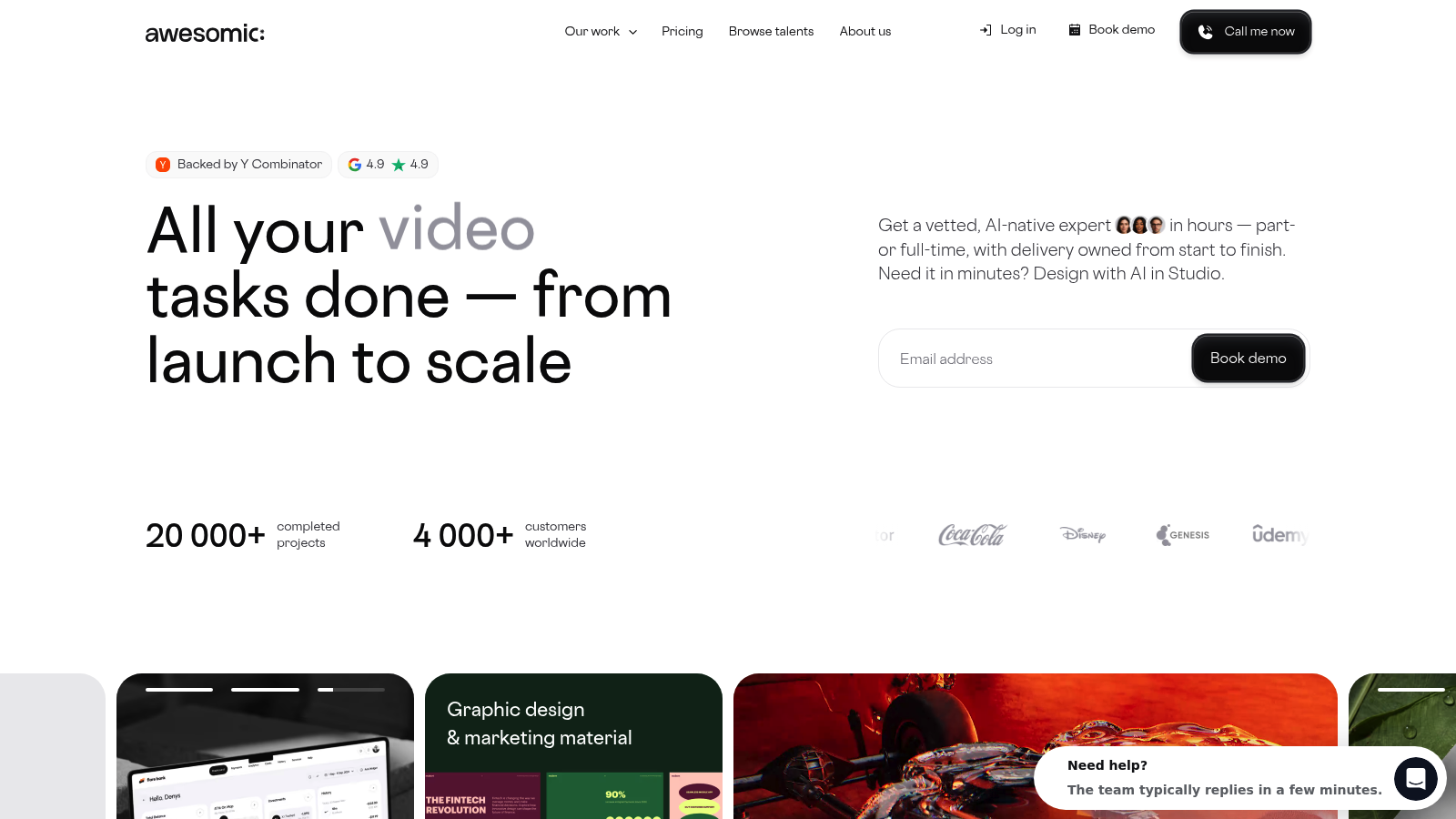
Overview: We should be direct about this before anything else: Awesomic is not a fractional design lead. We do not supply design executives, we do not run your critique, and nobody we match you with will sit in your leadership meetings.
What we do supply is the design work itself, on a monthly subscription, with a matched designer picking up briefs and a project manager keeping delivery moving. That is a capacity product.
We are on this list because a large share of people searching this term describe the same underlying situation: a backlog, a founder approving designs at midnight, and a suspicion that hiring a director would fix it. Sometimes it would. Often what is missing is simply the person to do the work, and a lead with nobody to lead is an expensive way to discover that.
Mercoa, a Y Combinator S21 company whose embedded API lets vertical SaaS platforms offer bill payments, is a fair illustration. Its scope with us covered the integration system, the API surface and the landing page, which is design capability supplied on demand rather than a design executive installed.
Core services:
- A matched designer working your briefs on a monthly plan
- Product, interface, brand and web design from one subscription
- A Dedicated Talent arrangement putting a project manager beside a designer working full time
- Delivery managed on our side rather than added to your workload
- Swap the designer without running a search
Industries served: SaaS, fintech, developer tools, marketplaces, startups
Pricing: All-in-One costs $2,995 each month, and the narrower Graphic Pack scope costs $1,490. Above both sits Dedicated Talent, quoted rather than listed, and beneath them an AI Designer tier at $200. Commit by the quarter and a fifth comes off.
Pros: published rates against a category that almost never quotes openly, no search and no notice period, capacity available in about a day, stop between months, costs a fraction of any genuine leadership retainer
Cons: we do not provide design leadership, strategy or org design, so if the gap is judgment rather than hands, one of the eight below is the correct purchase and we will tell you so
Getting going: Sign up, get matched, and start filing briefs in the app. There is no search process and no contract to negotiate, which is precisely the difference between this and the rest of the page.
Why it belongs among fractional design lead options: Because the honest answer for many buyers is that they need the work done rather than someone to decide how, and nobody selling leadership retainers has an incentive to say so.
Final verdict: The right call when the backlog is the problem. If quality and direction are the problem, keep reading.

Fractional design executives
The three providers below operate at director or C-level, embedded in leadership rather than in the design team. This is the expensive end, and a fractional design director here is bought to change how a company makes decisions, which is why the buyers tend to sit on enterprise teams rather than in startups.
Chameleon Collective
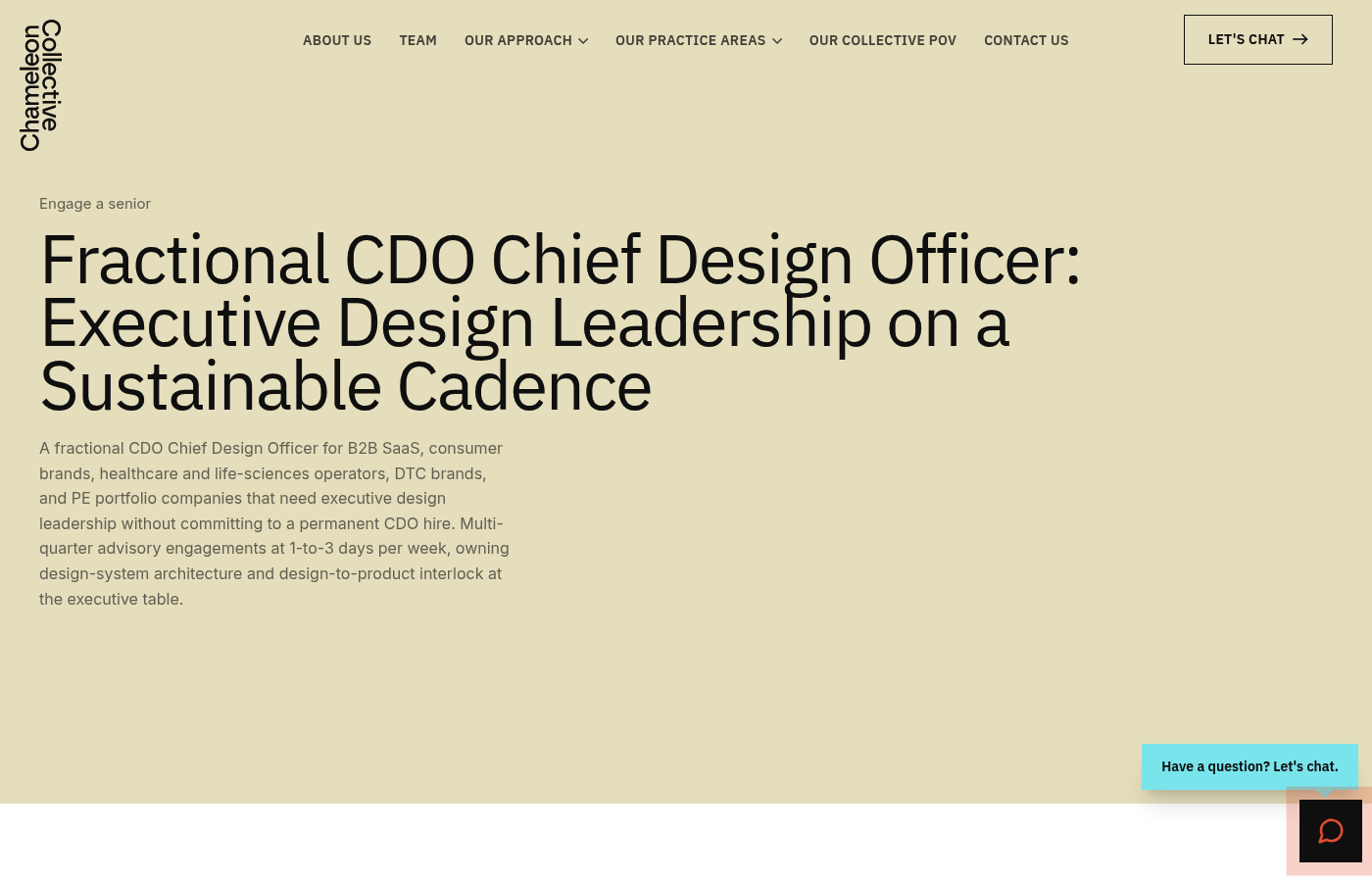
Overview: A collective placing fractional Chief Design Officers and senior design leaders into companies that need brand and design represented where decisions get made, rather than executed after them.
Chameleon is also the most financially transparent provider in this category by a wide margin, publishing not only its own range but the alternatives it competes against.
Core services:
- Fractional Chief Design Officer and part-time design leadership
- Brand identity system architecture at an organizational level
- Coaching for in-house design leaders alongside the engagement
Industries served: Growth-stage companies, enterprises, brand-led businesses
Pricing: Most engagements land between $20,000 and $45,000 a month. The bottom of that range buys roughly one day a week of ongoing design advisory; the top buys three days a week across several workstreams at once. A fixed monthly retainer is quoted after a scoping conversation.
Pros: publishes a genuine monthly range in a category that hides it, states plainly what each end of the range buys, coaching for your existing leaders is included in scope, senior bench
Cons: the entry rate is more than most companies under fifty people can carry, it is a collective rather than one named person, and the brand orientation makes it stronger on identity than on product interface work
Notable clients or work: Publishes fractional executive placements across brand, marketing and design functions.
Where it beats the alternatives: Comparing itself openly against a full-time hire and a project engagement, so you can do the arithmetic before the call.
Final verdict: The most credible executive option here, at a price that assumes you are past product-market fit.
Designing for Analytics
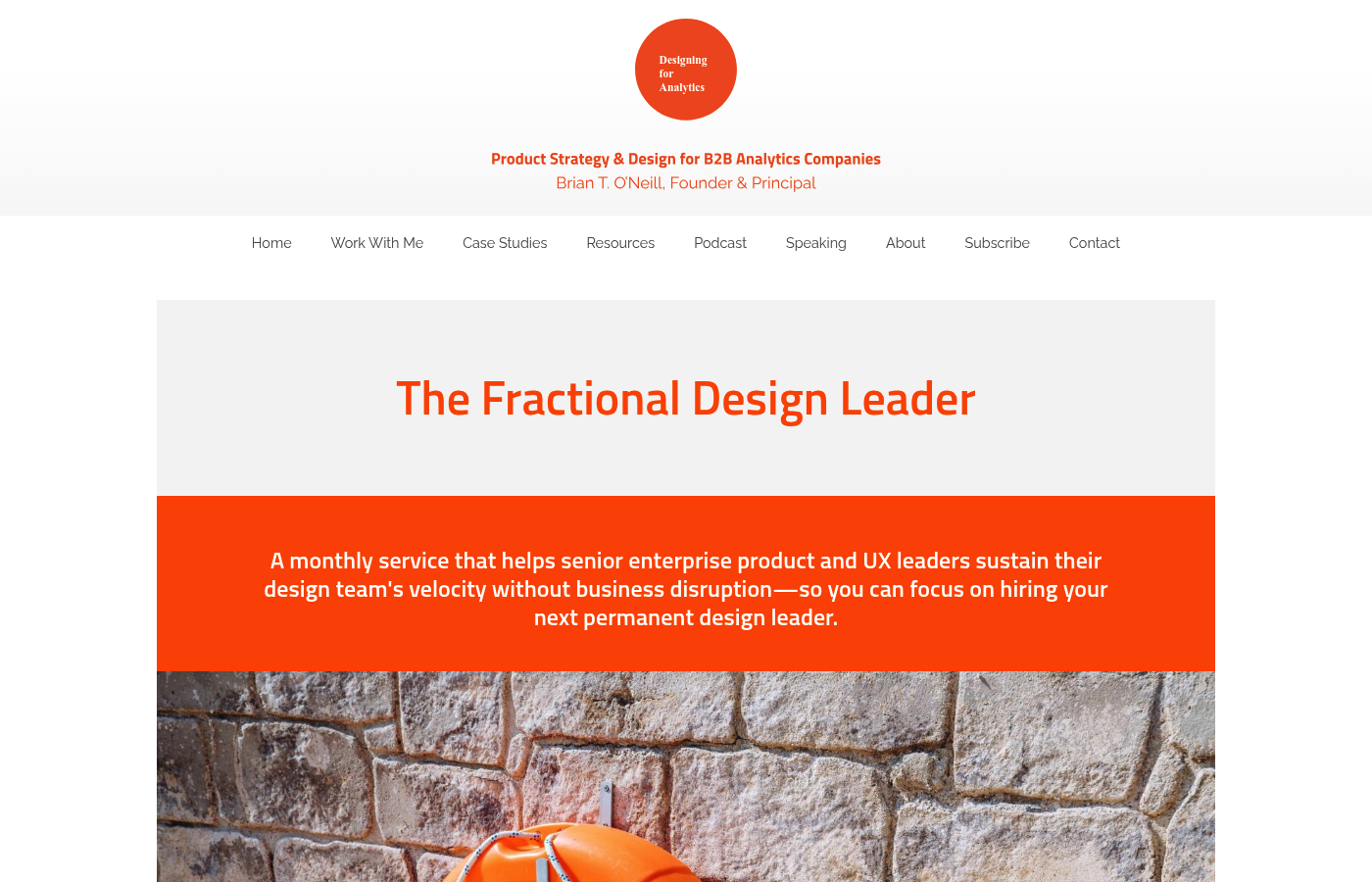
Overview: A monthly advisory retainer from Brian T. O'Neill aimed at senior enterprise product and UX leaders who already have a design team and need its output to hold quality while they hire.
The service points at the team rather than the boardroom, which is a genuinely different product from the executive placements above and priced accordingly.
Core services:
- Monthly fractional advisory retainer for a leader and their team
- Direct access on weekdays through a dedicated channel
- Help navigating friction with engineering and product leadership
Industries served: Enterprise product organizations, data and analytics teams
Pricing: $16,000 a month as a base price, payable by card online, covering access for up to five staff members plus the leader. A refund of up to the full amount is offered if the engagement does not work out.
Pros: a published rate you can act on without a sales call, covers a whole team rather than one person, an explicit money-back position, describes itself as fractional rather than interim and means it
Cons: aimed at leaders who already have a team, so it is a poor fit for a company with no designers, it is one individual with finite availability, and strategy for executive management is excluded from the standard service
Notable clients or work: Publishes advisory work with enterprise product and UX leadership teams.
Why it made this list: Because it is one of only two leadership providers on this page that lets you see the price before you speak to anyone.
Final verdict: Excellent when you have a team whose quality is slipping and a hire already in motion.
Todd Bracher Studio

Overview: A fractional Chief Design Officer service built on the argument that design usually sits downstream of strategy, and that the fix is a design executive embedded in the leadership team rather than briefed by it.
Its own framing is unusually clear about the intended outcome, which it describes as momentum rather than dependence, meaning the engagement should build internal capability instead of becoming permanent.
Core services:
- Fractional Chief Design Officer embedded with leadership
- Work directly with founders, chief executives, operating partners and boards
- Building internal design capability rather than replacing it
Industries served: Private equity portfolio companies, growth-stage businesses, established organizations
Pricing: No rate is published. Engagements typically run two to three days a week and are scoped individually.
Pros: genuinely operates at board and investor level, explicit about ending rather than entrenching, clear intended commitment stated up front, strong fit for portfolio-level design mandates
Cons: nothing published on price, a two to three day commitment is substantial, and the strategic altitude means less hands-on help with day-to-day design quality
Notable clients or work: Publishes design leadership work with growth-stage and private equity backed businesses.
Its strongest suit: Getting design into the conversation before the strategy is already fixed.
Final verdict: The right shape when the problem is organizational rather than departmental.
Fractional leads through a firm or independently
The five below operate at design lead or director level, working with the team rather than the board. This is where most companies under a hundred people should be looking, and it is also the point at which some decide an outside team is simpler, which is the case our roundup of interactive design agencies sets out.
Outwitly
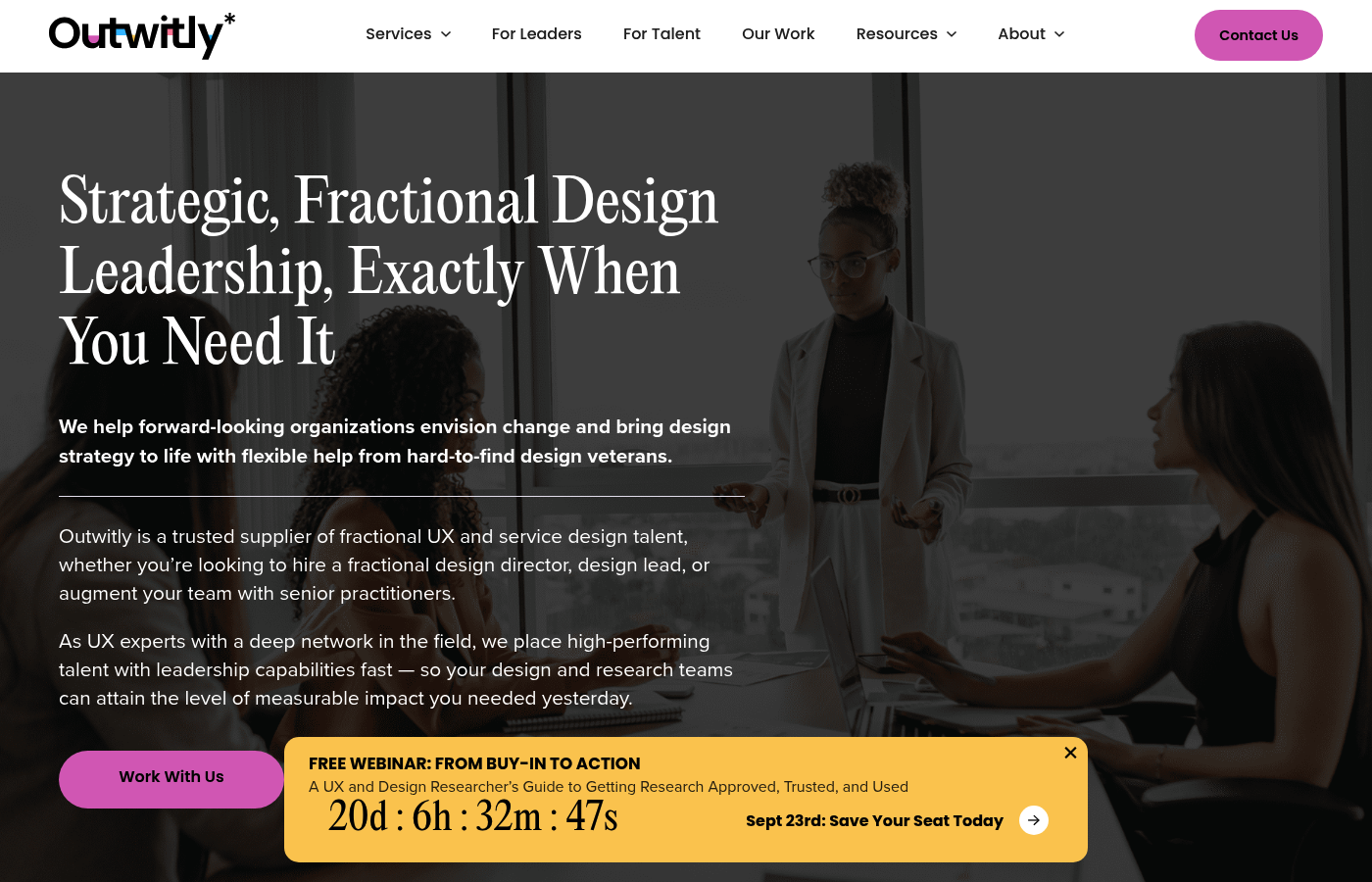
Overview: A supplier of fractional UX and service design talent spanning fractional design leads through to seasoned design directors, so the seniority can be matched to the gap rather than assumed.
Service design is its distinguishing specialism, which matters if your problem crosses channels and departments rather than sitting inside a single product interface.
Core services:
- Fractional design leads and directors placed flexibly
- UX and service design leadership
- Expert-led support scaled to the engagement
Industries served: Public sector, healthcare, service-led organizations
Pricing: Not published. Engagements are scoped around seniority and time commitment.
Pros: a real range of seniority rather than one fixed level, genuine service design depth, flexible commitment, a firm behind the individual
Cons: no published rate, the service design focus is broader than pure product UX, and placement through a firm means less certainty about exactly who you get
Notable clients or work: Publishes UX and service design leadership across public and private organizations.
Where it fits: Problems that span several touchpoints rather than one screen.
Final verdict: A sensible first call when the seniority you need is genuinely unclear.
Common Ideas
Overview: Fractional design leadership combined with expert facilitation, positioned for teams that need someone to set direction and also to run the sessions where direction gets agreed.
The facilitation element is what separates it. Plenty of teams have a direction problem that is really an alignment problem, and workshops are the tool for that rather than a design review.
Core services:
- Fractional design leadership on flexible terms
- Workshop design and expert facilitation
- Guidance for teams without senior design experience in-house
Industries served: Product teams, scale-ups, organizations building a design function
Pricing: Not published. Arrangements are agreed per engagement.
Pros: facilitation skill is rarer than design leadership and often the actual need, publishes its own thinking on the model openly, flexible engagement shapes
Cons: no rate published, a small operation with the capacity limits that implies, and facilitation-led leadership suits alignment problems more than craft problems
Notable clients or work: Publishes fractional design leadership and facilitation engagements.
Best angle: Teams that keep having the same argument and cannot resolve it.
Final verdict: Strong when the direction exists but nobody has agreed it out loud.
Gev Design
Overview: A fractional design and product arrangement built for startups, bundling ongoing requests with workshops and standing weekly meetings rather than selling advisory hours alone.
Gev positions itself explicitly against carrying a large team, office overhead and a heavy retainer, which is the calculation most seed-stage founders are actually running.
Core services:
- Fractional design and product direction for early companies
- Ongoing requests alongside the leadership input
- Workshops and standing weekly sessions with the team
Industries served: Startups, early-stage product companies
Pricing: Not published. The arrangement is agreed directly.
Pros: combines direction with actual delivery, weekly cadence built into the model, priced against startup constraints, product thinking alongside design
Cons: no published figure, blending leadership with execution can dilute both, and startup focus means less experience of larger organizational problems
Notable clients or work: Publishes product and design work for startups, including early platform launches.
Where it wins: Founders who need judgment and hands from the same person.
Final verdict: A pragmatic fit before you have a design team to lead.
Founders Who UX
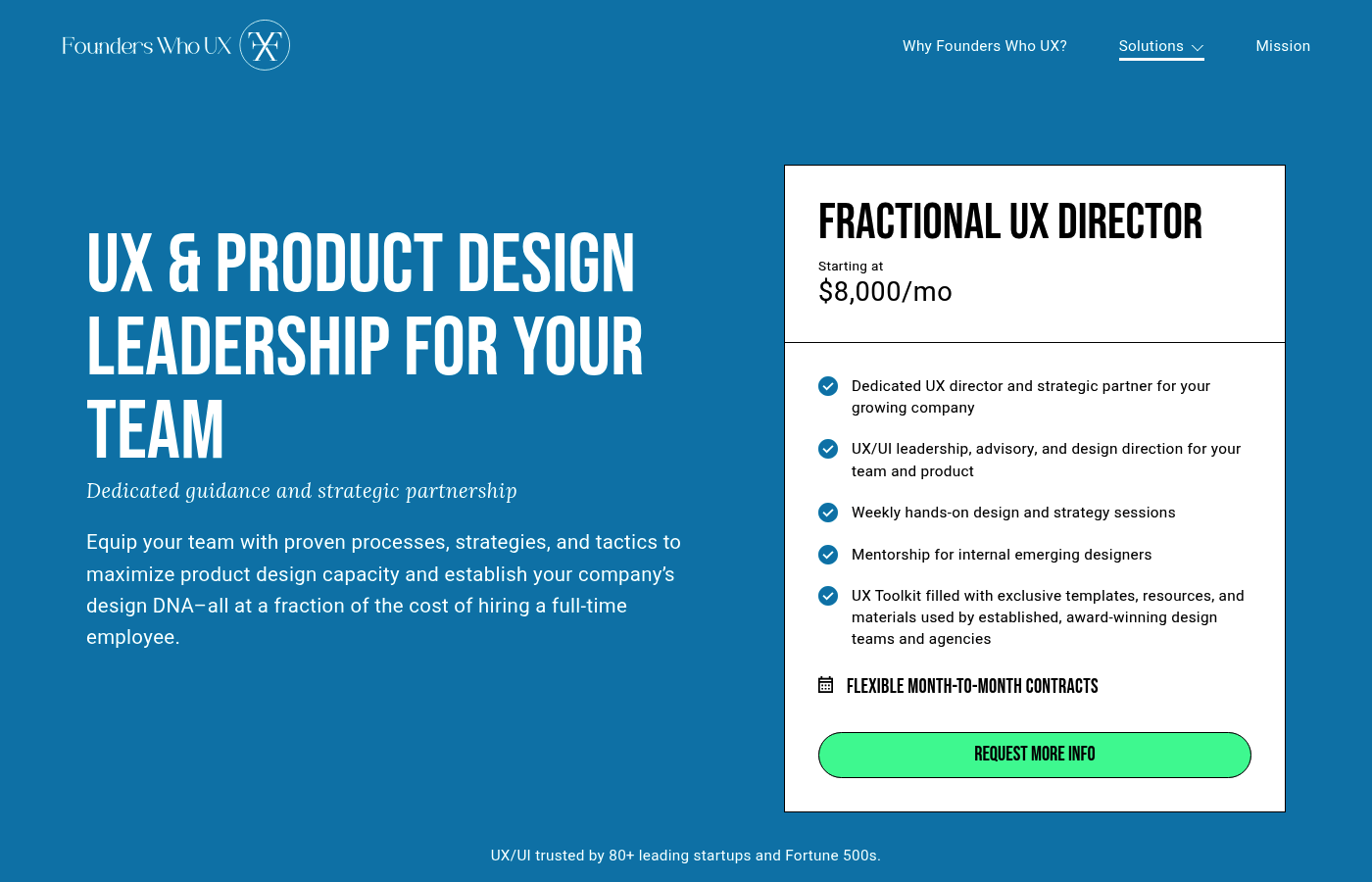
Overview: A fractional UX director service for startups that have shipped a product without any senior UX involvement and are starting to feel the consequences.
The scope is deliberately narrow, covering UX direction rather than brand, marketing or organizational design, which makes it easy to assess whether it matches your gap.
Core services:
- Fractional UX direction for startup teams
- Design oversight where no senior UX exists
- Guidance for founders making interface decisions
Industries served: Early-stage startups, founder-led product teams
Pricing: Not published. Terms are set per arrangement.
Pros: a clearly bounded offer that is easy to evaluate, aimed squarely at startups, UX-specific rather than generalist
Cons: no rate published, the narrow scope excludes brand and organizational work, and startup-stage focus limits its usefulness at scale
Notable clients or work: Publishes fractional UX direction for early-stage product companies.
Why buyers shortlist it: The scope is small enough to judge honestly before committing.
Final verdict: Worth a look for a startup whose interface decisions currently have no owner.
Dragan Babić
Overview: An independent design leader offering fractional leadership directly, with no firm, no account layer and no bench between you and the person doing the work.
Buying from an individual is a genuine trade rather than a lesser option. You get consistency and directness; you also get one calendar and one set of blind spots.
Core services:
- Fractional design leadership provided directly
- Design direction and team guidance
- Ongoing arrangements set between you and the individual
Industries served: Product companies, agencies, small design teams
Pricing: Not published. Terms are agreed one to one.
Pros: you deal with the person doing the work, no account management overhead, continuity is guaranteed because there is nobody to hand off to
Cons: no rate published, a single individual is a single point of failure, availability is finite, and there is no bench when the scope grows
Notable clients or work: Publishes independent design leadership work.
Where it fits: Teams who would rather have one senior person than an arrangement.
Final verdict: Straightforward and personal, with the ceiling that implies.
How we chose these nine
The filter was whether a provider actually sells design leadership on a part-time basis. That excluded a surprising number of firms whose blogs rank for this term while their services pages sell only project work or staffing.
⚠ It also excluded one well-known UX agency whose site describes design services rather than fractional leadership, and whose headline dollar figure turned out to be a client outcome rather than a rate. A learning platform's users earning more money is not a price.
Each remaining provider was read on its own pages. Two of the eight publish a monthly figure and six do not, which is a better ratio than this category usually manages and still means most of the table reads Quoted.
We also kept one entry that is not a fractional design lead at all, because omitting it would have been more misleading than including it with a label attached. Our own case study library shows what that capacity work looks like in practice, which is plainly not the same thing as leadership.
What fractional design leadership costs
Published rates cluster into three bands, and the band you need follows from the altitude of the problem rather than the size of your company.
| Level | Monthly cost | What it buys | Right when |
|---|---|---|---|
| Design capacity | $1,490 to $2,995 | Work made, not directed | The backlog is the problem |
| Team-facing advisory | $16,000 | A director supporting an existing team | Quality is slipping while you hire |
| Executive, one day a week | $20,000 | Design represented in leadership | Design keeps losing arguments |
| Executive, three days a week | $45,000 | Multi-stream organizational design work | Brand, product and team all need it |
| Quoted engagements | Not published | Scoped per arrangement | You will ask, and you should |
One provider publishes the comparison the rest avoid, putting a full-time design executive at $400,000 to $700,000 a year all-in once base, equity and benefits are counted, and project-based engagements at $100,000 to $500,000 apiece. Against those, a $20,000 monthly retainer is roughly a third of an executive hire.
Hiring is also slower than the arithmetic suggests. Federal job openings data recorded 7.27 million open positions across the US economy in July 2026, with the openings rate in professional and business services at 4.8%, down from 5.1% a month earlier.
A cooling market shortens searches without making senior design leaders easy to find, and the months you spend looking are months the problem persists. Teams bridging that gap often lean on faster hiring alternatives while the search runs.
The question nobody asks about direct reports
There is a definitional problem at the heart of this category, and it decides whether a fractional lead can do anything useful once they arrive.
The Department of Labor's executive exemption test defines an executive as an employee whose primary duty is managing the enterprise or a recognized department, and who customarily and regularly directs the work of two or more other full-time employees or their equivalent. It is written for overtime classification, not for consultants, but the underlying idea travels.
If your fractional design lead has nobody to direct, they are not leading a function. They are advising you, which is a valuable and entirely different service, and it should be priced and scoped as advice.
This matters because the two get conflated constantly. A company with three designers and no senior person genuinely needs a lead. A company with zero designers that hires a fractional lead has bought a consultant and given them a title, and will be disappointed at month four when nothing has shipped.
Ask the provider directly: who will this person direct, what decisions can they make without you, and what happens between their days on site? A provider that answers those crisply is selling leadership. One that deflects is selling advice with a leadership label on the invoice.
Questions to ask before you engage one
The pricing conversation is the least useful part of the process, and four other questions will tell you more.
Ask what happens on the days they are not there, because a lead who is the only decision-maker becomes a bottleneck four days a week. Ask what they intend to leave behind, since the best engagements build a standard and a rhythm the team keeps after the retainer ends. Ask how they will work with engineering and product leadership, which is where most design leadership actually fails. And ask for a specific example of a decision they reversed.
That last question is the most revealing one on the list. Anyone who has genuinely led a design function has overruled a popular direction and can describe what it cost them. Someone who has only advised will answer in generalities. Teams also find that mapping the current experience first, using something like a customer journey map, makes the first month of any engagement considerably more productive.
FAQ
What does a fractional design lead actually do?
They set design direction, run critique, hold a quality standard and make the decisions a team cannot make for itself, typically one to three days a week. The work is judgment rather than production, so measuring them by output delivered is the wrong test.
A good engagement also changes how the team operates after it ends, leaving behind a review rhythm, a standard and usually a hiring profile for the permanent role.
How much does a fractional design leader cost?
Two of the eight leadership providers publish figures. A team-facing advisory retainer runs $16,000 a month for a leader and up to five staff, and executive engagements run $20,000 to $45,000 a month depending on whether you are buying one day a week or three.
The rest quote privately. As a benchmark, a full-time design executive costs $400,000 to $700,000 a year all-in on one provider's own published comparison, which puts a one-day-a-week retainer at roughly a third of that.
Do I need a fractional design lead or more designers?
Ask whether three more designers would make the output better or just larger. If larger, the gap is judgment and you want a lead; if better, you have a capacity problem and a subscription or agency solves it more cheaply.
The expensive mistake runs in both directions. Hiring leadership for a capacity problem produces an expensive person with nothing to direct, while adding hands to a leadership problem produces more work of the same uncertain quality.
How is fractional different from interim or consulting?
Interim work is full-time for a fixed period, usually covering a vacancy until someone permanent starts. Fractional is genuinely part-time and ongoing, structured around the assumption that you do not need the role full-time at all.
Consulting sits alongside both and produces recommendations rather than decisions. The practical difference is authority: a fractional lead makes calls inside your organization, while a consultant advises the people who do. Confirm which you are buying before the first invoice.
When should the engagement end?
When the standard holds without them, which most good providers will tell you is the goal rather than something you have to negotiate. One provider on this list states plainly that it is aiming for momentum rather than dependence.
In practice the end point is usually a permanent hire the fractional lead helped define and often helped interview. If a provider has no view on when they should leave, treat that as a commercial position rather than a professional one. Seasonal planning matters here too, and our guide to the summer slowdown covers how teams phase this kind of work.
One subscription and your hiring problems solved


FAQ


Awesomic is a revolutionary app that matches companies with vetted professionals across 30+ skill sets, from design and development to marketing and product. Based in San Francisco with a global core team, we offer a faster and more flexible alternative to traditional hiring through a subscription-based model. Awesomic delivers high-quality talent on demand, without the delays of recruiting.
We function as a subscription-based service that matches you to top-tier, vetted talent. Submit a project in just a few clicks and start receiving deliverables in as little as 24 hours. Scale your Awesomic plan up or down as your business needs change.
Every Awesomic subscription comes with unlimited revisions. You receive daily progress updates via the app, and you can provide feedback or request iterations as needed. If your project requires a different approach, you can request a talent rematch at any time, at no extra cost. You can also add teammates to collaborate and streamline feedback
A talent marketplace is a platform that utilizes data and intelligent matching algorithms to connect professionals with projects based on their skills, experience, and availability. While often used internally by large companies, Awesomic applies this model at scale, matching vetted global talent to your most critical business needs.
Hiring is time-consuming, expensive, and risky. Awesomic eliminates that problem. We rigorously vet all talent for technical ability, communication, and soft skills, ensuring only senior-level professionals work on your projects. You skip the job posts, interviews, and delays, and get straight to results.
No, Awesomic goes beyond design. While many clients utilize us for branding, UI/UX design, or motion graphics, we also provide vetted talent in no-code web development, product design, marketing, and more. Think of us as an extension of your team. A flexible, high-performing creative partner from planning to execution, whether you're building awesome products or scaling your team.
You can talk directly with your matched talent via the Awesomic app, connect via Slack, email, or schedule video calls. No matter the plan, you’ll receive daily updates in the app for every active task. You can also tag us in for any issues through our in-app customer chat.


