




9 Best Ways to Hire Fractional Design Talent in 2026

Key takeaways:
- Fractional design talent means a designer working a defined slice of time for you, not a freelancer per project and not an employee. The difference is continuity.
- The market splits three ways: curated fractional networks, open talent marketplaces, and subscription services that supply the capacity without you managing anyone.
- Only two of the nine options here publish a rate. Everything else is quoted, so compare on model rather than on price.
- Classification is a real risk. The IRS applies a three-part common-law test to decide contractor versus employee, and getting it wrong is your exposure, not the designer's.
Fractional design talent is a senior designer working a set portion of their week on your product, month after month, without joining your payroll. It sits between a freelancer you brief per project and a full-time hire you recruit, insure and manage.
Companies hire fractional designers because they need more design than a freelancer provides and less than a full-time salary buys. That gap is genuinely large, and it is why the category has grown into three distinct shapes rather than one.
This piece covers where to hire fractional designer capacity and how the nine routes differ. Awesomic is first because our subscription is one of those routes, and we describe the others factually from their own sites, read in September 2026.
One clarification on scope. This is about fractional design capacity, meaning people who make the work, rather than fractional design leadership, meaning someone who directs it; those are separate purchases and we cover the leadership side on its own. Fractional design services cover product, brand and marketing design, and the discipline you need changes which route fits; a company looking for a graphic designer has different options from one looking for a product design lead.
What "fractional" actually means, and what it does not
Fractional is a commitment shape, not a seniority level. You are buying a recurring share of someone's capacity, typically one or two days a week, with the expectation that they stay long enough to learn your product.
That distinguishes it from two neighbors. Freelance is project-shaped: you brief, they deliver, the relationship may or may not continue. Contract or contract-to-hire is employment-shaped: full-time hours, a defined end date, usually through a staffing firm.
The practical test is whether the person accumulates context. A freelancer who has done six projects for you over two years is, in every way that matters, fractional. A "fractional designer" who rotates off after one sprint is a freelancer with better marketing. Teams weighing this against the alternatives will find our comparison of freelancers, in-house and subscription covers the trade-offs in more depth than a definition can.
The 9 best routes to fractional design talent
The table groups each option by model, because that decides how much management the arrangement costs you.
| Option | Model | Best for | What you get | Pricing (from) | Rating |
|---|---|---|---|---|---|
| Awesomic | Subscription | Capacity without managing anyone | Matched designer, managed delivery | $1,490/month | ★★★★★ |
| Go Fractional | Curated network | Senior part-time operators | Vetted fractional leaders and designers | Quoted | ★★★★★ |
| Toptal | Curated network | Vetted specialists at short notice | Screened designers, hourly or part-time | Quoted | ★★★★★ |
| Chameleon Collective | Curated network | Brand designers on retainer | Fractional designers and creative leaders | Quoted | ★★★★☆ |
| Fractionus | Curated network | Straightforward fractional placement | Fractional designers across disciplines | Quoted | ★★★★☆ |
| Founders Who UX | Curated network | Startups needing UX leadership | Fractional UX direction and design | Quoted | ★★★★☆ |
| Braintrust | Talent network | Lower fees on a user-owned network | Screened talent, employer pays no markup | Quoted | ★★★★☆ |
| Pangea | Marketplace | Fast, flexible part-time hires | Vetted part-time and fractional talent | Quoted | ★★★☆☆ |
| Contra | Marketplace | Commission-free independent hiring | Independent designers, direct engagement | Free to hire | ★★★☆☆ |
Ratings reflect fit for ongoing fractional design specifically. A marketplace scoring lower here may be excellent for a one-off project, which is a different need.
Awesomic
Best for: Capacity without managing anyone
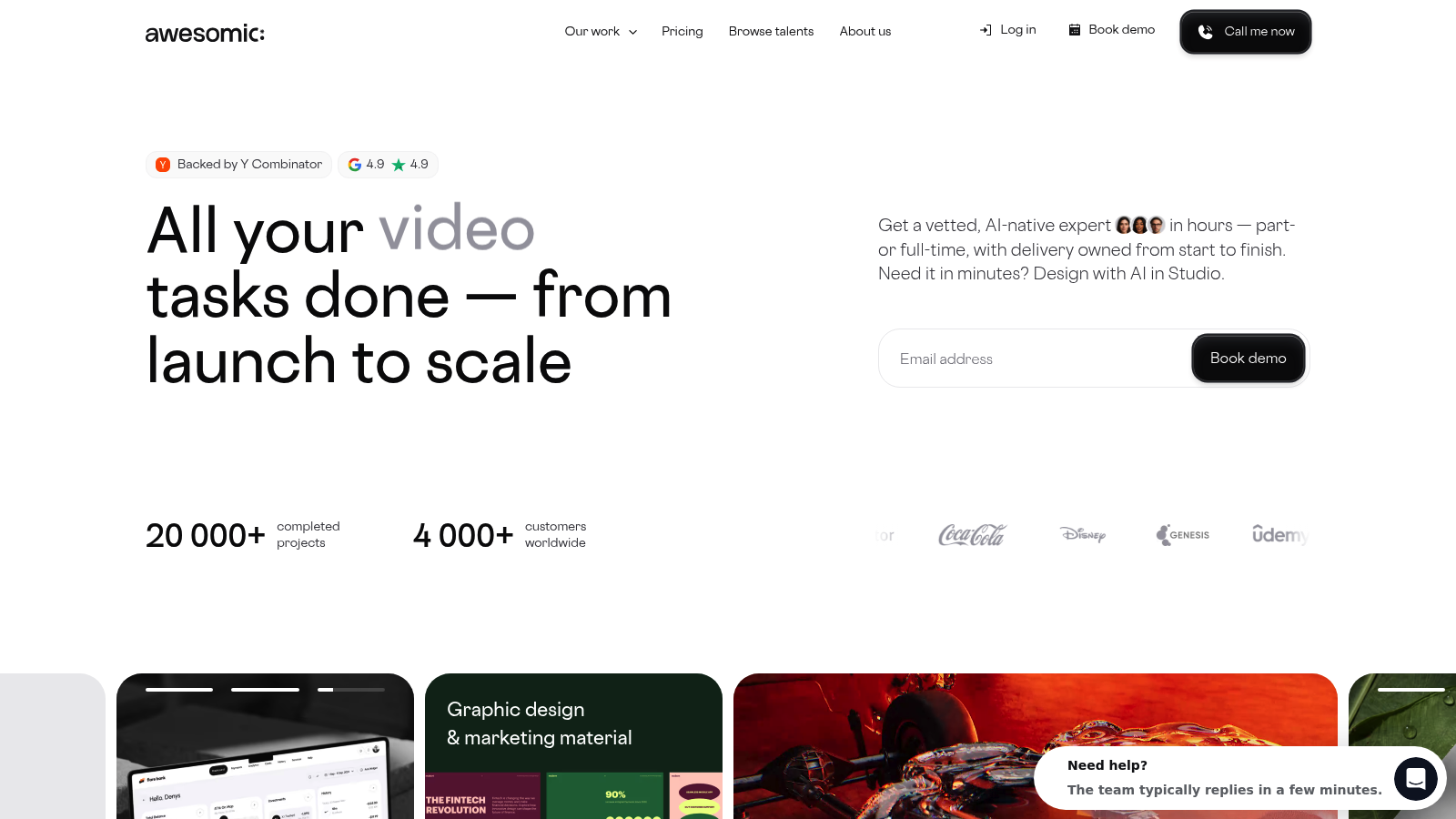
Overview: We supply the same thing fractional design promises, arranged differently. Rather than placing a contractor you then manage, we match you with a vetted designer who works your queue on a monthly subscription, with the delivery managed on our side.
The distinction is worth being precise about, because it is the main reason to choose us over the networks below. With a fractional hire you own the relationship: the scoping, the check-ins, the chasing, and the awkward conversation if it is not working. With a subscription you own the brief and we own the rest.
Our talent pool sits at the top 0.82% of applicants, and matching happens within a day rather than across a two-week search.
Finofo, a Canadian fintech whose platform lets business finance teams bank internationally, convert currencies and automate payables, took the dedicated-talent route with us: one designer working continuously on the product rather than a series of separately scoped engagements.
Core services:
- A matched, vetted designer working your queue continuously
- Product and UI/UX design, brand and marketing assets from one arrangement
- Webflow, Framer and WordPress build when the design needs shipping
- A dedicated full-time talent plus a project manager on the top tier
- Designer swap without restarting a search if the fit is wrong
- Copy and QA, once you are on All-in-One
Industries served: SaaS, fintech, healthtech, marketplaces, agencies
Pricing: Two rates are public: $1,490 monthly for Graphic Pack and $2,995 for All-in-One. Above them sits a quoted Dedicated Talent plan that pairs a full-time designer with a project manager, and below them a $200 AI Designer tier. Paying quarterly cuts 20%.
Pros: published rates in a category that mostly hides them, no management overhead, matched in about a day, swap the designer without a new search, stop between months
Cons: there is no browsable roster to pick an individual from the way a marketplace offers, and each published plan carries a single live task
Engagement model: Sign up, receive a match, and send briefs in the app with Slack beside it. No contractor agreement lands on your desk to administer.
How the arrangement starts:
- Book a demo and describe the recurring design load, not just the next project.
- Choose a tier sized to that volume.
- Get matched, normally the same working day.
- Run the first two weeks as a trial of the working relationship.
- Ask for a different designer if the fit is wrong, rather than restarting.
Why it belongs among fractional design talent options: Because most people searching for fractional design want reliable recurring capacity, and are indifferent to whether that arrives as a contractor or a service.
Final verdict: The right route when you want the output without the management. If you specifically want to hire and direct a named individual yourself, one of the networks below fits better.

Go Fractional

Overview: A curated network for hiring senior people part-time, covering design alongside other functions, and built specifically around the fractional model rather than adapted to it.
What you get:
- Access to vetted senior designers working on a part-time basis
- Fractional leaders as well as individual contributors
- A curated shortlist rather than an open search
Best for: Startups and scale-ups wanting senior part-time capability
Pricing: No published rate. Engagements are arranged between you and the individual, with terms varying by person.
Pros: built for fractional specifically, genuinely senior pool, covers leadership as well as execution
Cons: no published pricing, you manage the relationship once matched, and availability depends on individual schedules
Notable clients or work: Publishes fractional talent across design and other operating functions.
Where it fits: When you want a specific senior person, not a service.
Final verdict: One of the cleanest expressions of the fractional model on this list.
Toptal

Overview: An established talent network that screens designers heavily and matches them to hourly, part-time or full-time engagements, with a no-risk trial on each new hire.
What you get:
- Screened designers matched to your brief
- Hourly, part-time or full-time engagement options
- A trial period on each new match
Best for: Teams needing a vetted specialist at short notice
Pricing: No published rate card. ⚠ The salary figure shown on its designers page is Glassdoor's average for designers generally, quoted for comparison, not Toptal's price.
Pros: rigorous screening, fast matching, flexible engagement lengths, trial reduces the risk of a bad match
Cons: no rate transparency at all, premium pricing relative to open marketplaces, and better suited to individual specialists than a whole creative function
Notable clients or work: Works with funded startups and enterprises across design, engineering and finance talent.
Its real strength: Screening. You are paying to not interview twenty people.
Final verdict: The safe premium option when the role is specific and the deadline is close.
Chameleon Collective
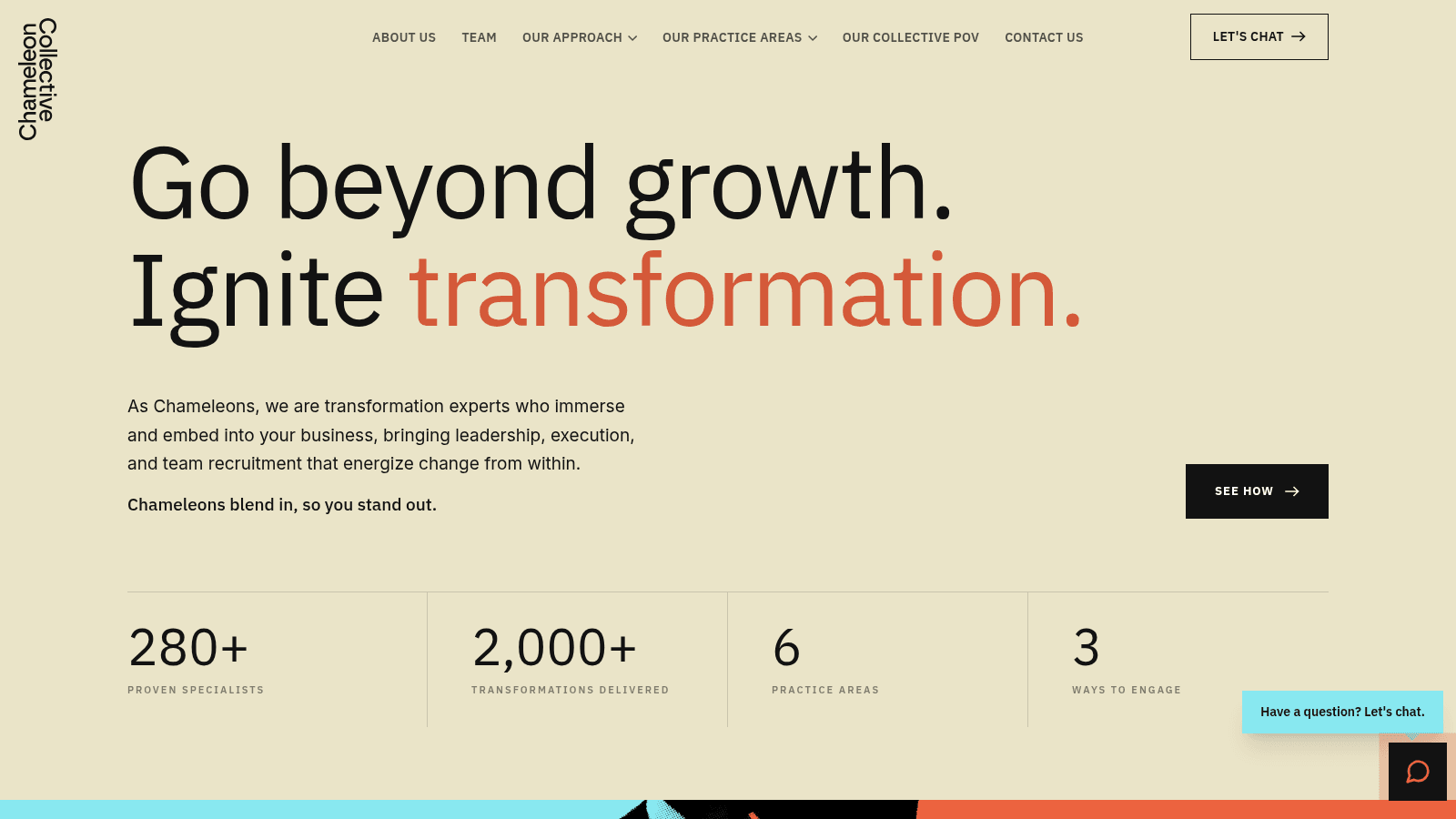
Overview: A collective placing fractional creative and brand talent on retainer, weighted toward senior people who have run functions rather than only executed within them.
What you get:
- A fractional graphic designer or brand designer on a retainer basis
- Creative leadership alongside hands-on design
- Placement into an ongoing rhythm rather than a project
Best for: Continuity from a fractional graphic designer
Pricing: No published rate for designer placement; retainers are arranged per engagement. ⚠ Its separate fractional Chief Design Officer service does publish a range, at $20,000 to $45,000 a month, but that buys executive leadership rather than a designer.
Pros: explicitly retainer-shaped rather than project-shaped, senior brand and creative bench, comfortable with leadership-level placements
Cons: no published pricing, weighted to brand and marketing over product UX, and senior placements carry senior rates
Notable clients or work: Publishes fractional creative and brand placements across consumer and B2B clients.
Why buyers shortlist it: It treats the retainer as the default, which is what fractional actually means.
Final verdict: A strong option for brand-side fractional design.
Fractionus

Overview: A platform for hiring fractional designers directly, positioned around simplicity: describe the need, get matched to a fractional designer, agree the arrangement.
What you get:
- Fractional designers across product, brand and marketing design
- Direct matching rather than a long recruitment process
- Flexible weekly commitments
Best for: Teams wanting a straightforward fractional arrangement
Pricing: No published rate. Terms are agreed per engagement.
Pros: narrowly focused on fractional hiring, low process overhead, covers several design disciplines
Cons: no published pricing, a smaller and less established network than Toptal, and you manage the relationship after matching
Notable clients or work: Publishes fractional designer placements across design disciplines.
Best angle: A first fractional hire, where process overhead is the thing you least want.
Final verdict: Worth a look for a simple, direct arrangement.
Founders Who UX

Overview: A UX-specific outfit offering fractional UX direction to growing companies, which is narrower than the general networks and correspondingly deeper in one discipline.
What you get:
- Fractional UX direction for companies without a design leader
- UX solutions aimed at growth-stage products
- Senior involvement rather than junior execution
Best for: Startups needing UX judgment, not just UX hands
Pricing: No published rate. Engagements are scoped individually.
Pros: genuinely UX-specialist, oriented to direction rather than production, suits companies with engineers but no design leadership
Cons: no published pricing, narrow scope if you also need brand or marketing design, and direction without execution capacity can create a bottleneck
Notable clients or work: Publishes UX solutions work for growing companies.
Where it wins: The company whose product decisions are being made by whoever argues hardest.
Final verdict: The most focused option here if the gap is UX leadership.
Braintrust
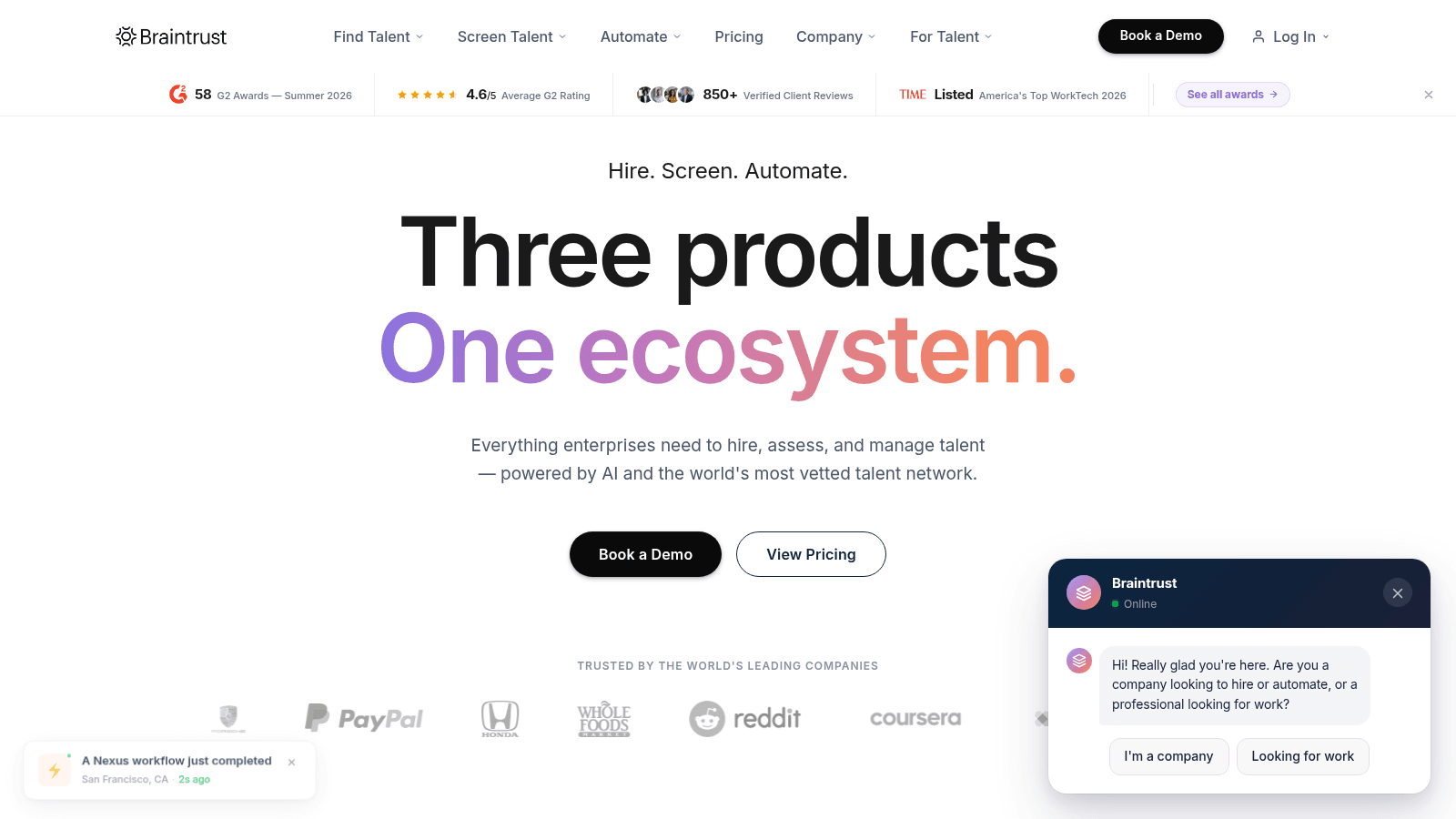
Overview: A talent network structured so that the people using it own it, with the stated effect that employers pay no markup on talent rates in the way traditional networks charge.
What you get:
- Screened designers and other knowledge workers
- Engagement without the standard agency markup
- Hiring and screening tooling around the network
Best for: Teams optimizing cost without going fully open-market
Pricing: No published rate for talent. The commercial model is that employers avoid the markup a conventional network adds.
Pros: cost structure genuinely differs from conventional networks, screened rather than open, covers design alongside technical roles
Cons: no published rates, a smaller design bench than generalist networks, and the network model is unfamiliar enough to need explaining internally
Notable clients or work: Publishes enterprise and startup hiring across knowledge-work roles.
The case for it: The same screening logic as a premium network without the same markup.
Final verdict: Worth comparing directly against Toptal on total cost.
Pangea

Overview: A marketplace for hiring vetted part-time and fractional talent quickly, oriented to startups that need someone working within days rather than weeks.
What you get:
- Vetted part-time and fractional designers
- Fast matching aimed at days rather than weeks
- Flexible weekly hours
Best for: Startups needing to hire fractional designer capacity fast
Pricing: No published rate for talent. Arrangements are agreed per hire.
Pros: speed, flexible commitment levels, oriented to startup budgets
Cons: no published pricing, vetting is lighter than a premium network, and you carry the management and quality risk
Notable clients or work: Publishes part-time and fractional hiring across startup roles.
Why it made this list: Time-to-start, which for an early-stage company is often the only variable that matters.
Final verdict: A pragmatic option when the alternative is nothing shipping this month.
Contra

Overview: A professional network for independent workers, structured commission-free, where you engage designers directly rather than through an intermediary taking a cut.
What you get:
- Direct engagement with independent designers
- Commission-free hiring, so rates are what the designer sets
- Profiles and portfolios rather than a matching service
Best for: Companies comfortable running their own search
Pricing: Free to hire through the platform. Designer rates are set individually and negotiated directly.
Pros: no platform commission, transparent direct relationships, large pool of independent designers
Cons: no vetting layer, so screening is entirely your job, quality varies widely, and there is no fallback if a designer disappears
Notable clients or work: Hosts independent designers working across product, brand and marketing design.
Its niche: Teams with the design judgment to screen well and the time to do it.
Final verdict: The cheapest route on paper, and the one that costs the most management.
How we chose these nine
Two checks shaped the list, and both come down to whether the model is genuinely fractional.
Each option had to supply recurring capacity, not one-off project work. That removed several well-known freelance marketplaces whose model is a single brief with no expectation of continuity, and it is why Contra sits at the bottom of the list rather than off it: the platform supports ongoing relationships even though nothing about it enforces one.
We also read each option's own site rather than relying on roundups, and recorded pricing only where it is published. Seven of the nine publish nothing, so those cells read Quoted. Two publish something meaningful: our own tiers, and Contra's commission-free structure.
Where a figure on a page turned out not to be a price, we left it out and said so. Toptal's designers page shows a salary benchmark drawn from Glassdoor rather than a rate of its own, and repeating it as a price would have been wrong.
We also excluded pure overflow services that supply capacity to an existing team rather than a named person, though they solve an overlapping problem; that case is covered in our note on how on-demand design supports an in-house designer.
What fractional design talent costs
Almost nothing in this category is published, so comparing quoted rates is not possible. What you can compare is the structure of the spend.
| Route | How you pay | Who manages the designer | Cost risk |
|---|---|---|---|
| Curated fractional network | Day or weekly rate, direct to the person | You do | Rate rises as seniority rises |
| Premium talent network | Hourly or part-time rate plus markup | You do | Markup is invisible in the rate |
| Open marketplace | Whatever the designer sets | You do, entirely | Screening failures cost time, not fees |
| Subscription service | Flat monthly fee | The provider does | Throughput ceiling, not rate |
| Full-time hire | Salary plus benefits and overhead | You do, permanently | The hardest commitment to reverse |
The bottom row is the benchmark the whole category is priced against. Federal employment and wage figures put the US specialized design services industry at 48,540 establishments employing about 151,114 people at an average annual wage of $90,915 in 2024.
That average is a useful anchor precisely because it is not a Bay Area product-design salary. Fractional arrangements tend to be compared against an inflated mental figure, and the honest comparison is against what design labor actually costs across the country. Our own cost and speed comparison against traditional freelancers sets out where each model wins.
The classification question nobody raises on the sales call
If you engage a fractional designer directly rather than through a service, you are making a worker-classification decision, and the exposure is yours.
The IRS assesses whether someone is an independent contractor or an employee using common-law rules across three categories.
The three are behavioral control (does the company control what the worker does and how they do it), financial control (are the business aspects of the job controlled by the payer, including how they are paid and who provides tools), and type of relationship (are there written contracts or employee-type benefits, will the relationship continue, and is the work a key aspect of the business).
Read those three together and the risk becomes obvious. A "fractional" designer who works set hours, uses your equipment, takes direction daily and has been with you for two years starts to look like something other than a contractor. That is precisely the arrangement fractional hiring tends to drift into, which is one reason some companies prefer a service relationship, where the designer is not their worker at all.
None of this is a reason to avoid fractional talent. It is a reason to write the agreement deliberately and to revisit it when a three-month arrangement becomes a three-year one.
When fractional is the right answer
Fractional works when the design need is continuous but sub-scale: real every week, not enough to justify a salary. That is the majority of companies between a first product and a design team.
Two situations defeat it. If the work is genuinely full-time, a fractional arrangement means paying a premium rate for a fraction of the coverage you need, and the designer's other clients will win the scheduling conflicts. If the work is sporadic, you are paying a retainer for months where nothing ships.
There is also the management question, which is the one most teams underestimate. A fractional designer is someone you have to brief, unblock and review, and if nobody internally owns that, the arrangement decays quietly. Companies without a design leader often find that structuring design operations matters more than which network they hired through.
Making it work once you have someone
The failure mode is not usually the designer. It is that fractional capacity gets treated like full-time capacity and then disappoints against that expectation.
Set the cadence explicitly: which days they work, how briefs arrive, when reviews happen, and what the turnaround commitment is. Then protect the context, because context is the entire value of fractional over freelance. That means one place where decisions live, not a Slack thread nobody can find in six months.
Finally, decide who is responsible for the design when the fractional person is not there. Teams hiring their first designer of any kind should read the founder's guide to hiring designers first, because the fractional decision is downstream of a staffing decision.
FAQ
What is fractional design talent?
It is a designer working a defined, recurring portion of their time for you, typically a day or two a week, without joining your payroll. The defining feature is continuity: the same person stays long enough to learn your product, which is what separates it from freelance work briefed project by project.
How much does a fractional designer cost?
Seven of the nine routes here publish no rate, so fractional design services are quoted per arrangement and vary with seniority, discipline and weekly commitment. The useful benchmark is what design capacity costs generally: federal data puts average annual pay in specialized design services at $90,915, before benefits and overhead. Subscription services are the exception that publishes, starting at $1,490 a month with us.
Is a fractional designer better than hiring a freelancer?
They are different commitments rather than different quality levels. A freelancer suits defined projects with a clear endpoint; fractional suits continuous work where accumulated context saves real time. If you find yourself re-explaining your product to the same freelancer every quarter, you already need fractional and are paying freelance prices for it.
Do I need to worry about worker classification?
Yes, if you engage someone directly. The IRS weighs behavioral control, financial control and the type of relationship to decide whether a worker is a contractor or an employee, and the liability for getting it wrong sits with the business, not the designer. Write the agreement deliberately, and revisit it if a short arrangement becomes a long one.
What is the difference between fractional design talent and a design subscription?
Fractional means you engage and manage an individual for a recurring slice of their time. A subscription means a provider supplies the capacity and manages delivery, so you brief work rather than manage a person, and our case studies show what a year of that looks like.
The output can be similar; the overhead is not. Choose fractional if you want to direct a named individual, and a subscription if you want the work done without adding a management line to your week.
One subscription and your hiring problems solved


FAQ


Awesomic is a revolutionary app that matches companies with vetted professionals across 30+ skill sets, from design and development to marketing and product. Based in San Francisco with a global core team, we offer a faster and more flexible alternative to traditional hiring through a subscription-based model. Awesomic delivers high-quality talent on demand, without the delays of recruiting.
We function as a subscription-based service that matches you to top-tier, vetted talent. Submit a project in just a few clicks and start receiving deliverables in as little as 24 hours. Scale your Awesomic plan up or down as your business needs change.
Every Awesomic subscription comes with unlimited revisions. You receive daily progress updates via the app, and you can provide feedback or request iterations as needed. If your project requires a different approach, you can request a talent rematch at any time, at no extra cost. You can also add teammates to collaborate and streamline feedback
A talent marketplace is a platform that utilizes data and intelligent matching algorithms to connect professionals with projects based on their skills, experience, and availability. While often used internally by large companies, Awesomic applies this model at scale, matching vetted global talent to your most critical business needs.
Hiring is time-consuming, expensive, and risky. Awesomic eliminates that problem. We rigorously vet all talent for technical ability, communication, and soft skills, ensuring only senior-level professionals work on your projects. You skip the job posts, interviews, and delays, and get straight to results.
No, Awesomic goes beyond design. While many clients utilize us for branding, UI/UX design, or motion graphics, we also provide vetted talent in no-code web development, product design, marketing, and more. Think of us as an extension of your team. A flexible, high-performing creative partner from planning to execution, whether you're building awesome products or scaling your team.
You can talk directly with your matched talent via the Awesomic app, connect via Slack, email, or schedule video calls. No matter the plan, you’ll receive daily updates in the app for every active task. You can also tag us in for any issues through our in-app customer chat.


