




10 Best Explainer Video Companies in USA for 2026

Key takeaways:
- Several studios ranking for "explainer video companies in USA" are not in the USA. Five candidates we checked publish addresses in Toronto, Bangalore or Sydney, and two of them rank on page one for the American keyword.
- The largest study of video engagement ever run, covering 6.9 million viewing sessions, found that shorter videos are much more engaging. Length is the cheapest lever you have.
- Federal wage data puts a staff animator's median pay at $99,800 a year before benefits, with the occupation growing only 2 percent, so most teams commission explainers rather than hire for them.
- Ask any studio for a street address before you ask for a quote. It is the fastest way to filter a shortlist, and almost nobody does it.
An explainer video is the format you reach for when your product cannot be photographed and will not be read about. Software, financial products, medical devices, anything that happens inside a server or a sealed tank: a camera is useless and a landing page full of text goes unread.
The problem is that "explainer video company in USA" is one of the least trustworthy queries in this category. The phrase appears in the page titles of studios based in Ontario and Karnataka, and the roundups ranking for it repeat those studios without checking. We went looking for American animation studios and spent most of the research time disqualifying candidates.
What follows is the list that survived. We put ourselves at the top and then spent the rest of this piece marking out which briefs belong with a specialist studio instead. On a character-led film or a broadcast campaign, one of the nine below is the better call.
Treat the video as a working asset rather than a one-off expense, an argument we make at length about design for advertising, because the studios that price well on a single film often price badly on the variants you will need six months later.
What counts as an explainer video company
The category is broader than it looks, and picking the wrong kind of supplier is the most common reason a project runs to double the estimate.
A dedicated explainer studio makes narrated 2D animation, 60 to 120 seconds, aimed at making an abstract product legible. That is the core product. Around it sit whiteboard and scribe animation, which trades polish for a sense of being walked through something; product demo animation built from real interface recordings; character animation, where the story carries more weight than the feature list; and motion graphics for social cutdowns.
Each has a different cost base. A whiteboard video and a character-driven brand film share almost no production steps, which is why a brief that just says "animated explainer" invites wildly different quotes from equally honest studios.
Decide which of those five formats applies, settle the runtime, and name the channel it plays on, all before you contact anyone. A clear brief is worth more than a longer shortlist, and it is the part most buyers skip. Our own creative brief guide walks through the questions a studio will otherwise have to guess at.
How we verified this list, and what it disqualified
Every competing roundup on this keyword republishes directory rankings without opening the sites. We did the opposite: we resolved each candidate's real domain by search, loaded it, and read the company's own contact or about page for a street address.
That single check removed more candidates than any quality judgment did.
Hatch Studios is in Toronto. Its own about page describes its founder as one of Canada's leading animation creative directors, and its client list includes The Heart and Stroke Foundation of Canada. It ranks on page one for the American keyword.
MotionGility publishes a Canadian address on Ellesmere Road in Scarborough, Ontario, while its page title reads "Best Explainer Video Company in USA." Epic Video Factory lists Dundas Street West in Toronto. Studiotale titles its homepage "Animated Explainer Videos Company in Bangalore, India." Punchy Studio, which appears in US-facing explainer searches, runs on a .com.au domain and calls itself Australia's leading visual communications agency.
Three more candidates failed for different reasons. Grumo Media publishes no location anywhere on its homepage, about page or contact page, so we could not confirm it either way and dropped it rather than guess. The Draw Shop now runs under the banner "Powered by Explainify," meaning it is no longer an independent choice. Explainly blocks automated access from three separate directions, so we could not verify its pages the way we verified everyone else's.
Most lists of the top explainer video companies in USA never run this check at all. None of this makes those studios bad, and several are excellent, so a Toronto animator may well be the right hire. But an article promising American companies should contain American companies, and a buyer who needs a US entity for procurement, contracting or time-zone reasons deserves to know before the first call.
The list runs to ten rather than the usual twelve because padding it would have meant putting a Toronto studio in a USA roundup.
The 10 best explainer video companies in USA
The table sorts by what each company is actually built to make, which predicts fit better than a star rating. Just one company on this list posts rates publicly, so treat the pricing column as a tier indicator rather than a quote.
| Company | Based in | Best for | What it makes | Pricing |
|---|---|---|---|---|
| Awesomic | San Francisco, CA | Explainers plus the design around them | Animation, motion, web, brand, video | $1,490 or $2,995 monthly |
| Sharp Eye Animation | San Francisco, CA | Custom animation with a tech sensibility | 2D and 3D animated explainers | Quote only |
| Digital Brew | Orlando, FL | Full-service animated explainer projects | 2D, 3D and live-action hybrid | Quote only |
| TruScribe | Madison, WI | Whiteboard explanation of complex ideas | Scribe and whiteboard animation | Quote only |
| Next Day Animations | Baltimore, MD and Minneapolis, MN | Mission-driven and nonprofit work | 2D explainers, illustration, voiceover | Quote only |
| IdeaRocket | Miami, FL | Corporate animation with a long catalog | 2D, 3D, whiteboard, motion graphics | Quote only |
| Nathan Love | New York, NY | Character animation with awards behind it | Character-led animation and design | Quote only |
| Trollbäck+Company | New York, NY | Brand films rather than feature tours | Brand identity in motion | Quote only |
| Killer Visual Strategies | Seattle, WA | Data-heavy stories that need visualizing | Motion, infographics, interactive | Quote only |
| Big Fish Presentations | Baton Rouge, LA | Explainers that live inside a pitch | Presentation design and video | Quote only |
Locations in that table come from each company's own site, not from a directory listing. Where a firm publishes more than one office, we named the ones it calls headquarters.
1. Awesomic
Best for: teams that need an explainer and then keep needing creative work.
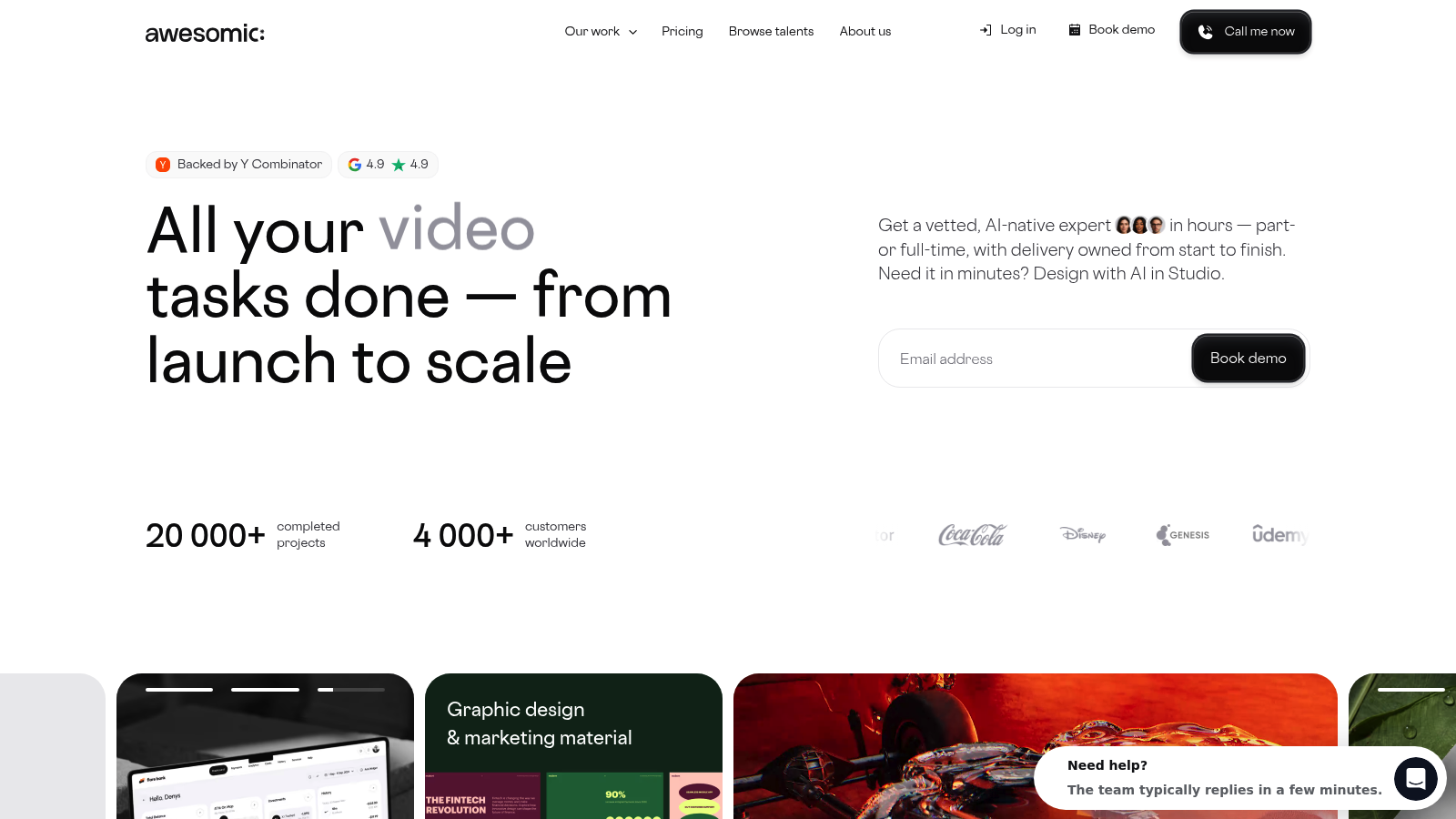
We're a design and creative subscription based in San Francisco. You describe the task, the app routes it to a pre-screened animator or designer the same day, and revisions carry no cap. Animation and motion sit alongside web, brand and product design on the same subscription, with a project manager on the dedicated tier.
The reason we lead this list is not that we out-animate a specialist character studio. It is that an explainer is almost never the only thing a company needs. The video ships and then the landing page it points at needs rebuilding, the social cutdowns need cutting, and the pitch deck needs to match.
Denario is the clearest example we can point to. The fintech company, later acquired by PandaDoc, came to us for animation to simplify how it explained its product. We built a product demo video from a script they had already written, then a full illustration set that became their visual language, social ads for three platforms, a one-pager aimed at restaurants as a new audience, and a multi-language Webflow migration. That is roughly a year of work that began as one video.
What we make: animated explainers and product demos, motion graphics and social cutdowns, illustration systems, landing pages and full sites, brand identity, pitch decks.
Pricing: two plans cover most animation needs. Graphic Pack runs $1,490 monthly, falling to $1,190 if you commit quarterly against a three-month floor. All-in-One, which folds in no-code build, copywriting and QA, costs $2,995 monthly or $2,396 on that same quarterly basis. Above them sits Dedicated Talent, scoped case by case; below them, AI Designer at $200 for self-serve landing pages.
Proof: 20,000-plus completed projects, a client base north of 4,000 companies, 4.9 ratings on Google Play and on Trustpilot, an acceptance rate of 0.82 percent among applying designers, plus Y Combinator backing and a Red Dot Award.
Where we fit: we are the right call when the explainer is the first of many things, and the wrong call when you want one broadcast-grade character film and nothing else. For that, hire a specialist below. Our case studies show which of the two situations you are in.

2. Sharp Eye Animation
Best for: technology companies that want animation with a product sensibility.
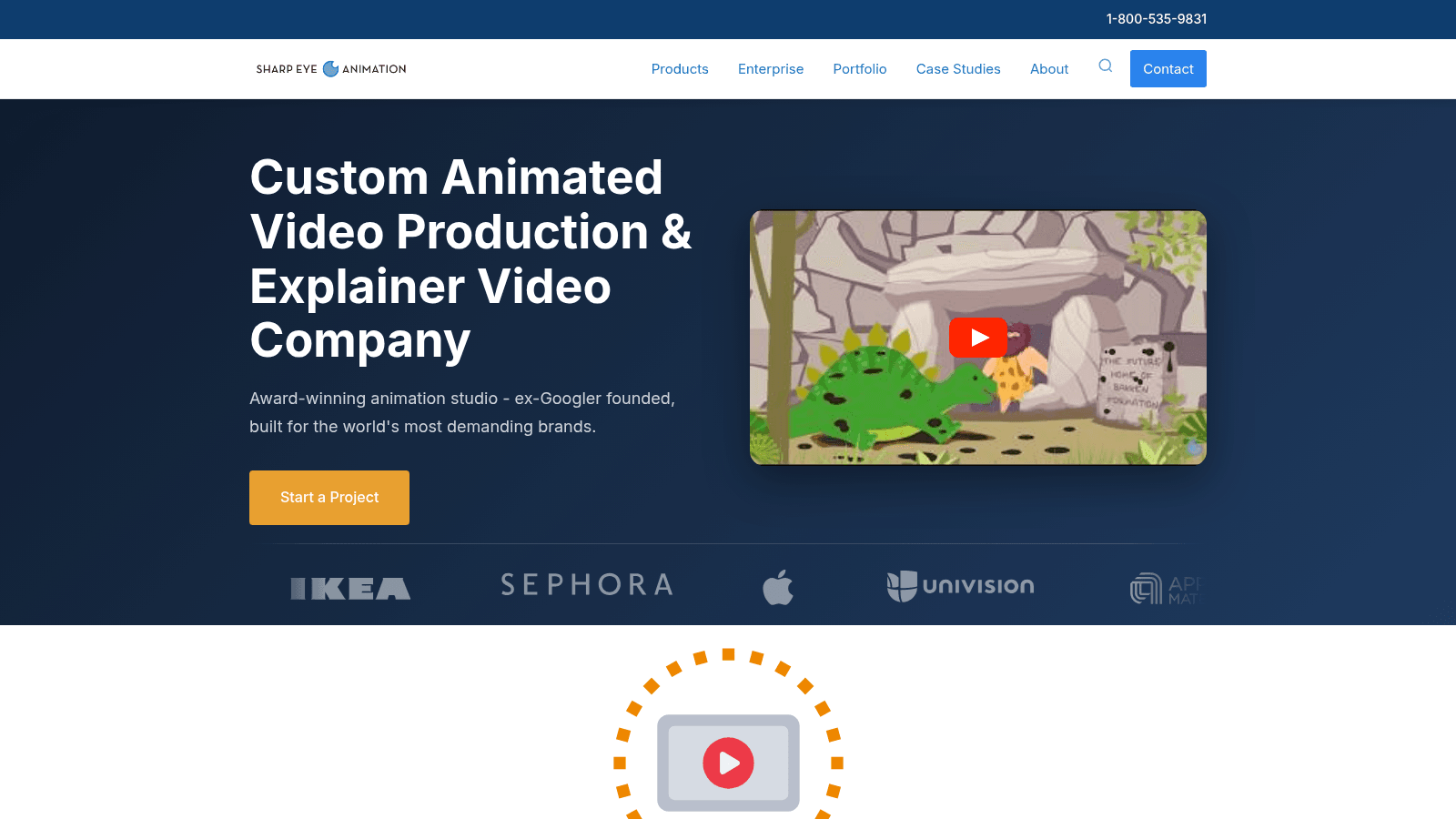
Sharp Eye describes itself on its about page as a full-service animated video production company founded by an ex-Googler, headquartered in San Francisco with a presence in Los Angeles. That origin shows in the work, which leans toward software and platform explanation rather than consumer storytelling.
It handles the full arc from script through storyboard to final animation, which suits teams that do not have a copywriter ready to hand the studio a finished script.
What it makes: 2D animated explainers, 3D animation, product videos, motion graphics.
Pricing: no published rate card. Projects are scoped individually.
Why buyers shortlist it: a genuine San Francisco address and a founder from a large technology company are an unusual combination in this category, where most studios are either coastal boutiques or offshore production shops.
3. Digital Brew
Best for: companies that want one team to own the whole video, end to end.
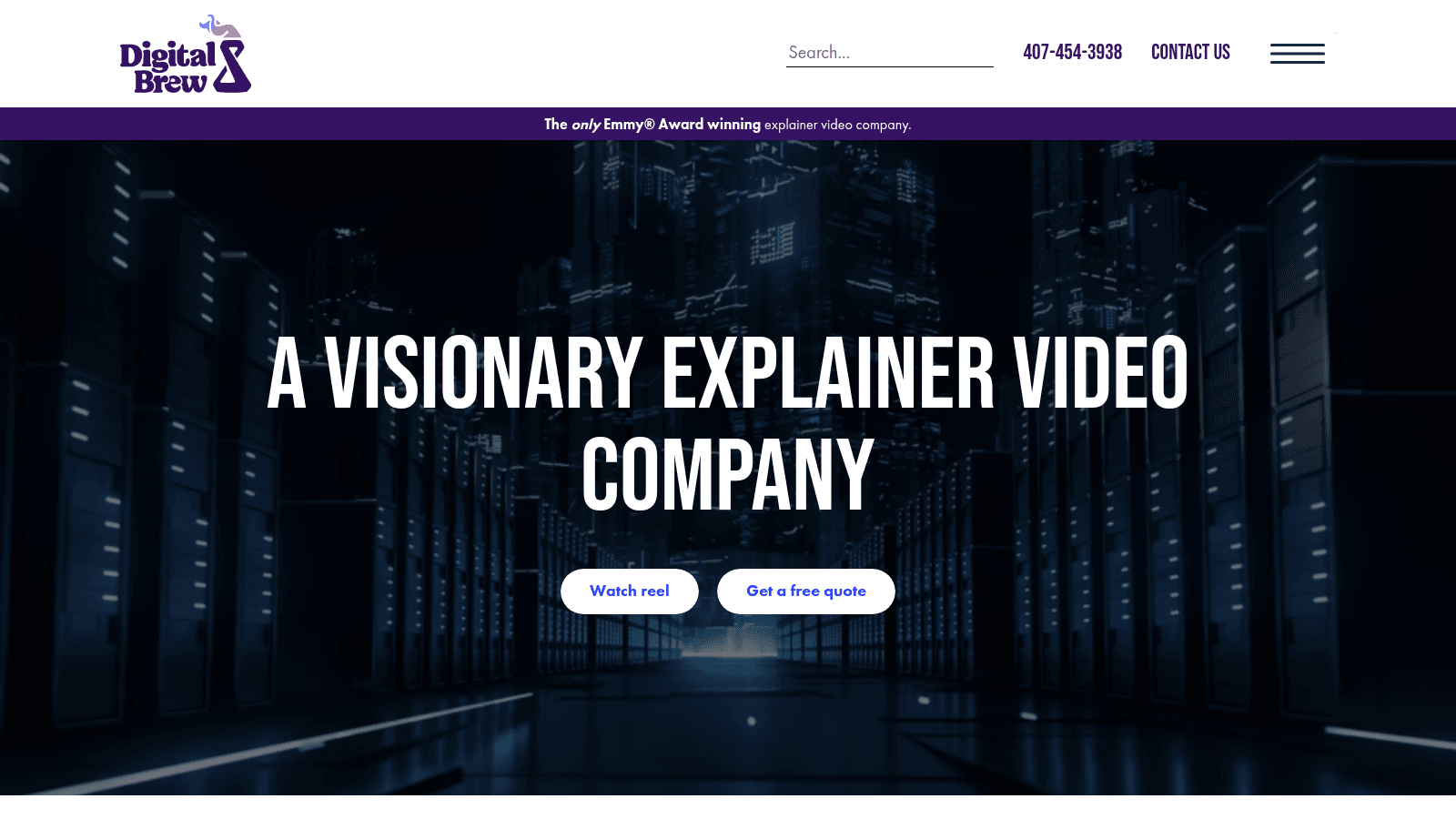
Digital Brew works out of North Magnolia Avenue in Orlando and positions itself squarely as an animated explainer video production company rather than a general creative agency. It is one of the few firms on this list whose entire homepage is about a single deliverable.
The studio blends animation with live action on the same project, which is useful when part of your story genuinely can be filmed and part of it cannot.
What it makes: 2D and 3D animated explainers, live-action hybrid video, motion graphics, character animation.
Pricing: quoted per project, with no public tiers.
Its real strength: focus. A studio that does one thing tends to have a repeatable process for it, and Digital Brew's positioning leaves little doubt about what you are buying.
4. TruScribe
Best for: dense or technical material that needs to feel like a walkthrough.
TruScribe publishes its headquarters address on Seminole Centre Court in Madison, Wisconsin, and has built its practice around whiteboard animation specifically. The company frames the format as a method rather than a style, arguing that watching a hand draw an idea holds attention differently than watching a finished graphic appear.
That makes it a narrow pick, but a strong one when the subject is genuinely complicated.
What it makes: whiteboard and scribe animation, script development, voiceover, animated training content.
Pricing: scoped per project; the site discusses cost ranges in its blog rather than publishing tiers.
Where it fits: internal training, compliance, healthcare and any subject where the audience needs to follow a chain of reasoning rather than admire a product.
5. Next Day Animations
Best for: nonprofits, agencies and mission-driven organizations on real budgets.
Next Day Animations describes its team as animators, voiceover actors and illustrators located across the United States, with offices in Baltimore and Minneapolis. It is the most explicitly distributed company on this list, and it says so plainly rather than implying a single glass headquarters.
Much of its published work is for advocacy groups, public agencies and educational organizations, which is a different discipline from product marketing.
What it makes: 2D animated explainers, illustration, scriptwriting, voiceover, translation and localization.
Why it made this list: it serves a segment that most explainer studios quietly price out, and it does so without pretending to be something it is not.
6. IdeaRocket
Best for: corporate buyers who want a deep back catalog to judge from.
IdeaRocket has been making animated business video for a long time and has an unusually large public portfolio spanning 2D, 3D, whiteboard and motion graphics. If you want to watch twenty examples before a call, this is the easiest site on the list to do that on.
One point of accuracy matters here. IdeaRocket markets itself heavily around New York, but the only postal address it publishes is a private mailbox on Northeast 191st Street in Miami, Florida. We are noting what the site says rather than characterizing where the team sits.
What it makes: 2D and 3D animation, whiteboard video, motion graphics, live-action hybrid.
Pricing: no public rate card, though the site discusses typical animation cost ranges openly.
Why buyers shortlist it: breadth of catalog and a willingness to talk about money before you are on a sales call.
7. Nathan Love
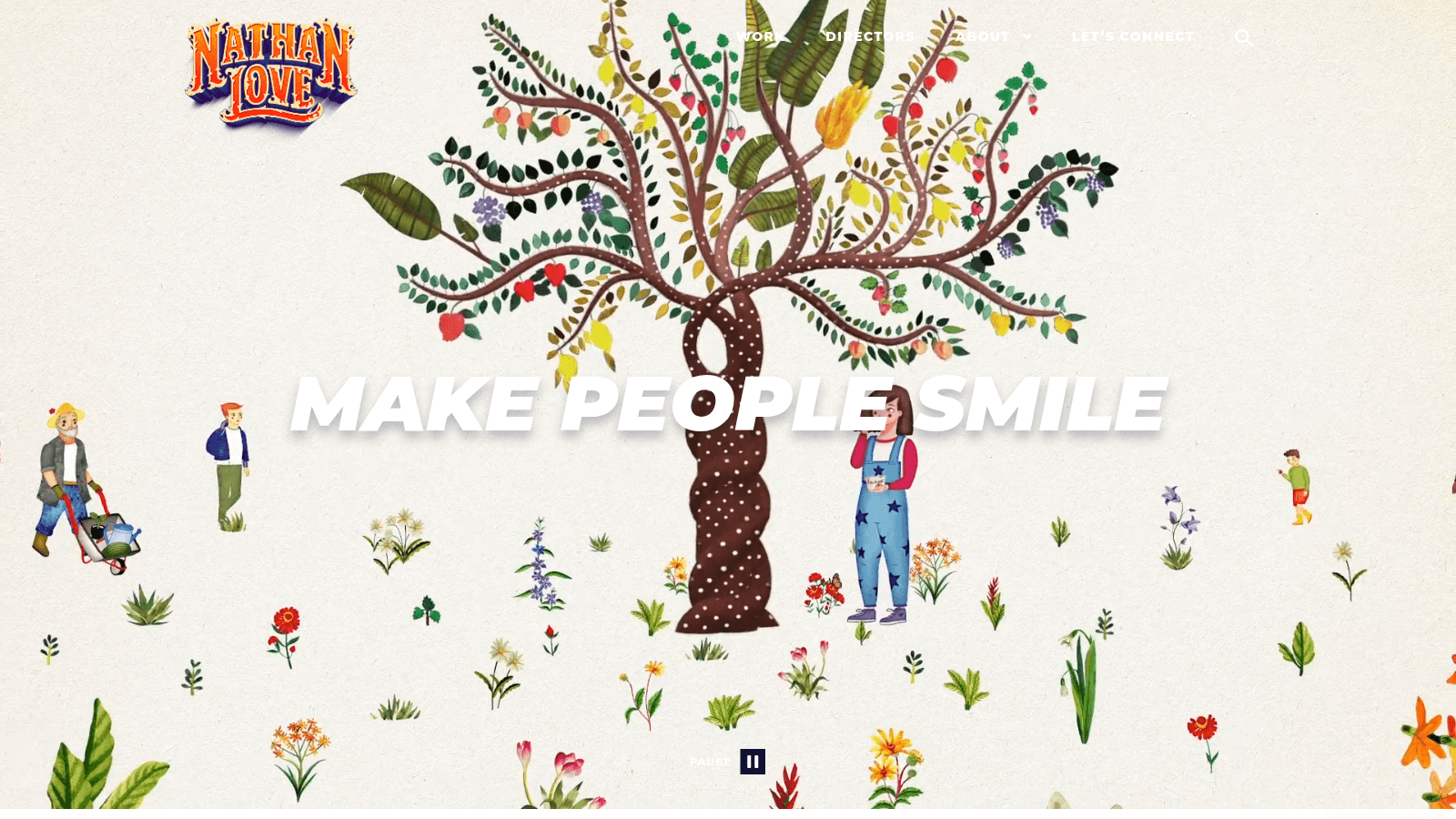
Best for: brands that want character animation with genuine craft behind it.
Nathan Love is a New York animation studio whose work sits closer to entertainment than to software explanation. Its about page lists recognition including a Shorty Awards win with silver and audience honors, finalist and merit placements at The One Show, a London International Awards shortlist and a bronze at The Global Awards.
This is not the studio for a fifteen-slide feature tour. It is the studio for a character your audience remembers.
What it makes: character animation, design and art direction, broadcast and social campaigns.
Pricing: quoted per project, at the higher end of this list.
Where it beats the alternatives: when the brief is emotional rather than instructional, craft stops being a luxury and becomes the entire point.
8. Trollbäck+Company
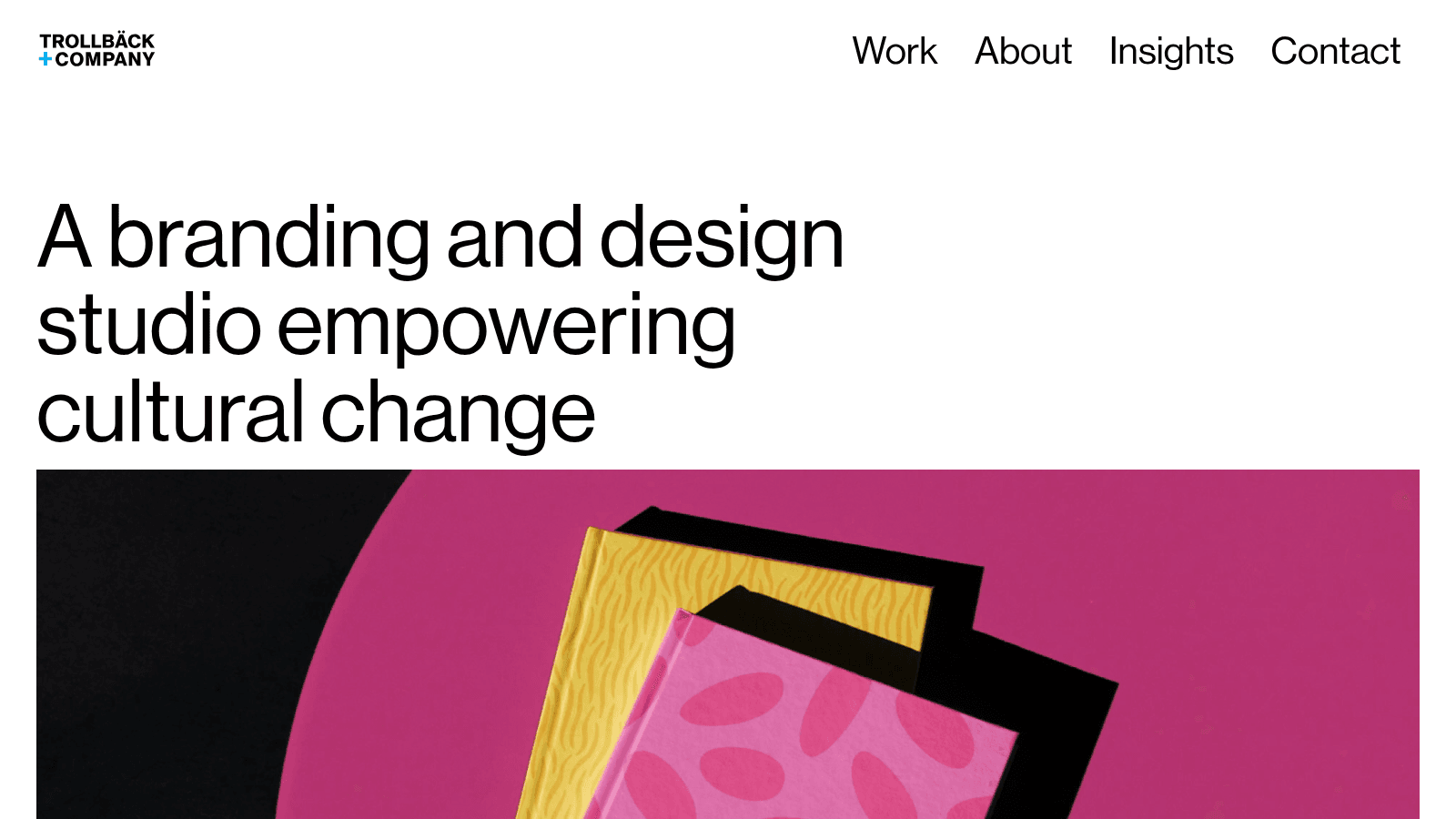
Best for: organizations translating a brand into motion, not explaining a feature.
Trollbäck+Company publishes a New York headquarters alongside an annex, plus Stockholm and Los Angeles presence. Its practice is brand identity expressed through motion, and its public work skews toward large institutions and media brands.
Include it on a shortlist only if what you actually need is a brand film. Briefing a firm like this on a product walkthrough wastes both parties' time.
What it makes: motion-led brand identity, brand films, title design, design systems for video.
Pricing: enterprise scoping, no public figures.
Its real strength: it treats motion as part of an identity system rather than as a one-off asset, which matters if the video has to sit next to a rebrand.
9. Killer Visual Strategies
Best for: research, data and reports that need to become watchable.
Formerly Killer Infographics, the Seattle firm now leads with visual communication and describes itself in content marketing terms. Its portfolio is heavy on data visualization, interactive pieces and motion built from research, including regional work such as a Puget Sound technology visualization for the Washington Technology Industry Association.
Treat it as an adjacent option rather than a pure explainer shop. If your raw material is a study or a dataset, that adjacency is exactly what you want.
What it makes: motion graphics, infographics, interactive experiences, presentation and report design.
Pricing: project-based, no public tiers.
Why it earns a place here: most explainer studios start from a script. This one starts from evidence, which is a meaningfully different process.
10. Big Fish Presentations
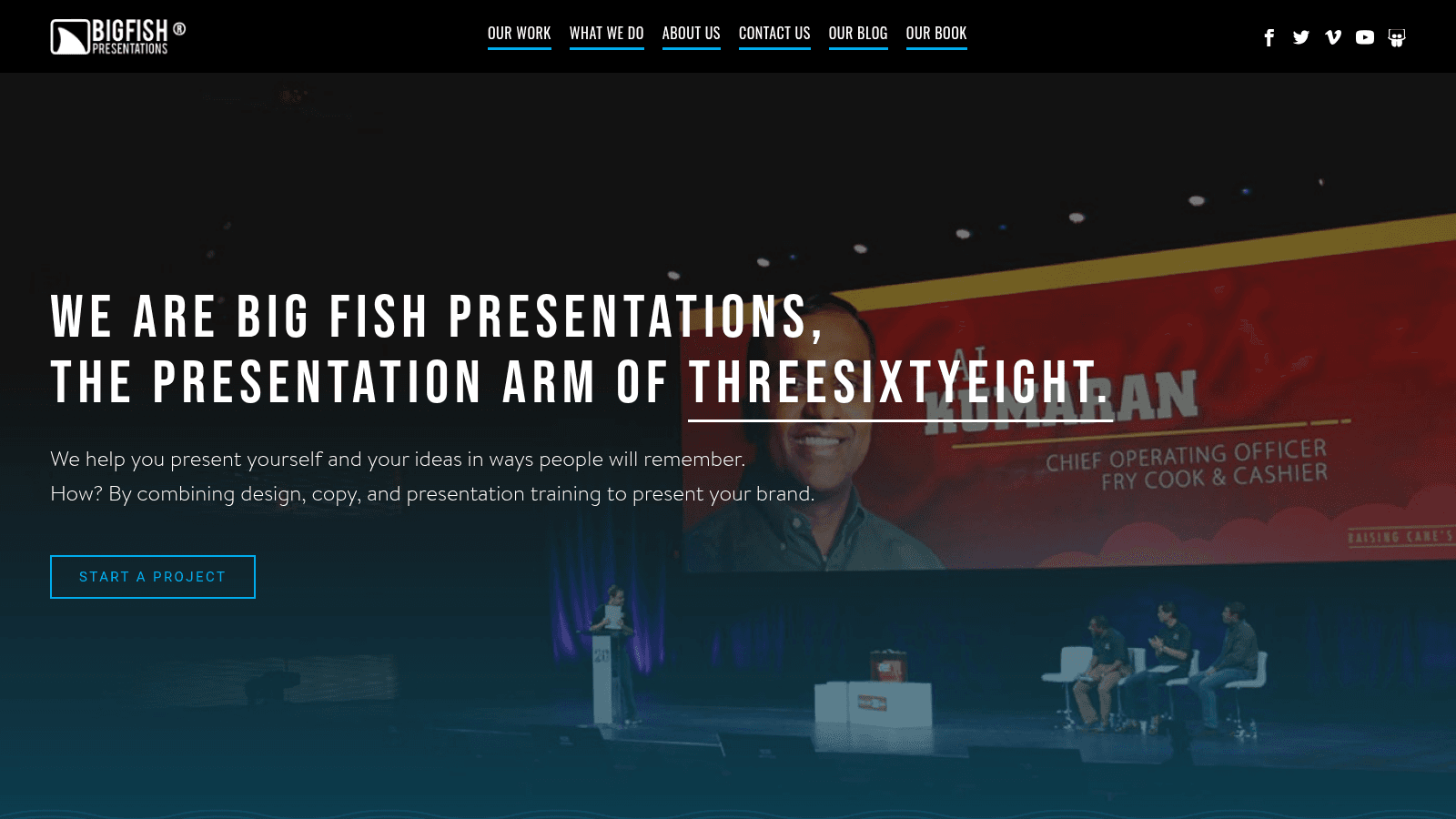
Best for: explainers that need to live inside a pitch or a keynote.
Big Fish Presentations works from South 14th Street in Baton Rouge and operates alongside ThreeSixtyEight, sharing contact details with it. Its distinctive angle is that video and presentation design are one practice, not two.
That is genuinely useful if the video's real job is to open a sales meeting or an investor pitch rather than to sit on a homepage.
What it makes: presentation design, animated and live-action video, event content.
Pricing: scoped per engagement.
Where it fits: fundraising decks, conference keynotes and sales enablement, where the animation has to match the slides that follow it.
What an explainer video costs in the US
Public rate cards are vanishingly rare here, which makes budgeting harder than it should be. The ranges below reflect what these studios describe in their own public writing about cost, and they move with length, animation style and how much script work you hand over.
| Style | Typical range | What drives the number |
|---|---|---|
| Whiteboard or scribe, 60 to 90 seconds | $3,000 to $10,000 | Illustration volume and script length |
| Standard 2D animated explainer, 60 to 90 seconds | $8,000 to $25,000 | Custom illustration versus library assets |
| Character-driven 2D with original design | $25,000 to $75,000 | Character design, rigging, animation hours |
| 3D or technical animation | $30,000 to $150,000 | Modeling and render time |
| Ongoing animation on a subscription | $1,490 to $2,995 a month | Volume and how much non-video work is included |
Two things move these numbers more than anything else. The first is whether you arrive with a finished script, because script development is often a third of the timeline. The second is revision policy, since a fixed-bid project with two included rounds and a studio charging for the third is a very different commitment from unlimited revisions.
It is worth comparing that against building the capability internally. The Bureau of Labor Statistics puts the 2024 median pay for special effects artists and animators at $99,800 a year, before benefits, software or management overhead, with the occupation projected to grow just 2 percent through 2034 and around 5,000 openings a year. For most companies producing a handful of videos annually, that math does not work, which is why commissioning remains the norm.
Recruiting is the other cost nobody budgets, since motion specialists are a thin market and the search itself takes months, a process we break down in our guide to hiring motion design talent.
How to choose between them
Start with the format, not the vendor. Once you know whether you need a whiteboard walkthrough or a character film, half the list disqualifies itself.
Then apply four filters in order:
- Ask for a street address and confirm it on the company's own site before the first call.
- Watch three finished videos in your format, not a showreel of best moments from twenty projects.
- Ask who writes the script, and what happens to the timeline if you supply your own.
- Get the revision policy in writing, including what a round is and what triggers a new charge.
On length, there is better evidence than the usual unsourced claims about attention spans. Guo, Kim and Rubin analyzed 6.9 million video-watching sessions across four edX courses and found that shorter videos are substantially more engaging, and that informal, direct delivery outperformed polished studio production. The finding comes from educational video, but the mechanism is the same one your explainer depends on.
The practical read is to cut before you polish. A tight 70-second video from a mid-tier studio will usually outperform a beautiful 3-minute one, and it costs less to make. Deciding between commissioning this and building an in-house function is the same calculation covered in our comparison of creative service models.
Making the shortlist call
Three questions settle most of these decisions faster than a procurement process will.
Is this one video or the first of several? A single flagship film belongs with a specialist studio. A steady stream of product videos, cutdowns and the design that surrounds them belongs on a retainer or a subscription, because per-project pricing punishes volume.
Does the story need craft or clarity? Nathan Love and Trollbäck sit at the craft end, TruScribe and Next Day Animations at the clarity end, and most of the list in between. Buying craft when you needed clarity is the most expensive mistake in this category.
And does it actually need to be American? If procurement, contracting or security review requires a US entity, the verification above matters a great deal. If it does not, you have a much wider field, and some of the studios we disqualified for location are genuinely strong. Once the video exists, the harder question is usually distribution, which is where planning the surrounding video edit and cutdowns pays for itself.
If you want animation to sit alongside the web, brand and social work it inevitably creates, that is what our video service is built for.
FAQs
How much does an explainer video cost in the USA?
Most American studios quote between $8,000 and $25,000 for a standard 60 to 90-second 2D animated explainer. Whiteboard animation runs lower, often $3,000 to $10,000, while character-driven or 3D work starts around $25,000 and climbs past $100,000 for technical animation. The two biggest variables are whether you supply a finished script and how many revision rounds are included. Subscription models price differently, charging monthly rather than per project, which changes the math once you need more than two videos a year.
How do I check that an explainer video company is really based in the USA?
Open the company's own contact or about page and look for a street address, not a phone number or a "serving clients nationwide" line. Directory listings and roundups routinely describe firms as American when their own sites publish addresses in Toronto, Bangalore or Sydney. If a company publishes no address at all, treat that as a missing answer rather than a neutral one. This single check disqualified five candidates while we were building this list.
How long should an explainer video be?
Between 60 and 90 seconds for most marketing uses. Research by Guo, Kim and Rubin covering 6.9 million viewing sessions found shorter videos substantially more engaging, and that holds across formats. If your script will not fit, the usual cause is trying to cover several audiences in one video rather than genuinely needing the time. Two short videos aimed at two audiences almost always outperform one long video aimed at both.
Should I hire an animation studio or use a design subscription?
Hire a studio when you need one flagship piece with a distinctive visual signature, particularly character animation or a brand film. Choose a subscription when animation is one of several ongoing needs and you also require landing pages, social cutdowns, decks and brand assets. The deciding factor is volume rather than quality: per-project pricing works against you as soon as the second and third videos appear, while a monthly model works against you if you genuinely only ever need one.
Who writes the script for an explainer video?
It varies by studio, and it is worth asking early because script development often accounts for a third of the schedule. Some companies include scriptwriting and treat it as the core of the engagement. Others expect a finished script and will quote a shorter timeline if you have one. Denario handed us a script it had already written and we produced the video from it, which compressed the project considerably. If you have strong internal writers, say so during scoping, because it should change both the price and the delivery date.
One subscription and your hiring problems solved


FAQ


Awesomic is a revolutionary app that matches companies with vetted professionals across 30+ skill sets, from design and development to marketing and product. Based in San Francisco with a global core team, we offer a faster and more flexible alternative to traditional hiring through a subscription-based model. Awesomic delivers high-quality talent on demand, without the delays of recruiting.
We function as a subscription-based service that matches you to top-tier, vetted talent. Submit a project in just a few clicks and start receiving deliverables in as little as 24 hours. Scale your Awesomic plan up or down as your business needs change.
Every Awesomic subscription comes with unlimited revisions. You receive daily progress updates via the app, and you can provide feedback or request iterations as needed. If your project requires a different approach, you can request a talent rematch at any time, at no extra cost. You can also add teammates to collaborate and streamline feedback
A talent marketplace is a platform that utilizes data and intelligent matching algorithms to connect professionals with projects based on their skills, experience, and availability. While often used internally by large companies, Awesomic applies this model at scale, matching vetted global talent to your most critical business needs.
Hiring is time-consuming, expensive, and risky. Awesomic eliminates that problem. We rigorously vet all talent for technical ability, communication, and soft skills, ensuring only senior-level professionals work on your projects. You skip the job posts, interviews, and delays, and get straight to results.
No, Awesomic goes beyond design. While many clients utilize us for branding, UI/UX design, or motion graphics, we also provide vetted talent in no-code web development, product design, marketing, and more. Think of us as an extension of your team. A flexible, high-performing creative partner from planning to execution, whether you're building awesome products or scaling your team.
You can talk directly with your matched talent via the Awesomic app, connect via Slack, email, or schedule video calls. No matter the plan, you’ll receive daily updates in the app for every active task. You can also tag us in for any issues through our in-app customer chat.


