




12 Best UX Design Subscription Services in 2026

Key takeaways:
- A UX design subscription buys you a designer on a monthly fee instead of a hire. Published rates on this list start at $1,400 a month and reach $11,999 for two full-time designers.
- Specialist product UX shops mostly do not publish prices. Seven of the twelve services here show a rate on their own site; the other five quote per engagement.
- A salary is not the cost of a designer. The Bureau of Labor Statistics puts benefits at 30.1% of what private employers pay per hour worked, on top of wages.
- Match the model to your flow. Subscriptions reward a steady queue of work; one-off projects are usually cheaper through a fixed-scope engagement.
A UX design subscription puts a product designer, or a small team, on a monthly fee and lets them work through your queue of interface tasks. You send the task, the designer picks it up, and you keep the same arrangement next month instead of scoping a new statement of work each time.
This list covers services whose actual deliverable is product and app UX: user flows, interface design, design systems, mobile screens and the ongoing iteration that follows a launch. If what you need is a marketing site or a landing page, that is a different category with different vendors, and the rates do not transfer.
We have put ourselves first because this is our category and we are transparent about that. Everything said about the other eleven comes from their own sites, verified in September 2026, and where a service does not publish a price we say so rather than guessing.
One framing note before the list. A subscription is an alternative to a salary, so the useful comparison is against what it costs to hire a UI designer rather than against a freelancer's day rate. We come back to that arithmetic in the pricing section.
What a UX design subscription actually is
The subscription model replaces two things at once: the hiring process and the per-project quote. You pay a flat monthly fee, you get an assigned designer or team, and the work moves through a queue.
Three details separate the real offers from the marketing. The first is concurrency: almost every "unlimited" plan works one task at a time, so unlimited means unlimited requests in the queue, not unlimited output. The second is who you actually get, since a plan with a named senior designer behaves very differently from a rotating pool. The third is commitment, which ranges from cancel-anytime to a two-month minimum.
Scope deserves the same scrutiny. Product UX and interface work are not the same job as visual or graphic design, and the distinction between an app designer and UI designer is the one buyers most often get wrong when they write the brief. Buy against the wrong title and you get competent work aimed at the wrong problem.
The 12 best UX design subscription services
The table below is ordered as the list runs. Pricing is the lowest published monthly rate on each vendor's own site as of September 2026; "Quoted" means the service publishes no rate at all.
| Service | Best for | Main services | Typical clients | Pricing (from) | Rating |
|---|---|---|---|---|---|
| Awesomic | Product design plus everything around it | UI/UX, web, branding, no-code, video | Startups, agencies, mid-market | $1,490/month | ★★★★★ |
| Eleken | One dedicated SaaS designer | SaaS UI/UX, redesigns, MVP design | SaaS companies | $4,599/month | ★★★★★ |
| Meticular | Lean SaaS teams wanting a flat rate | UX requests, UI design, strategy | SaaS and IT teams | $3,197/month | ★★★★☆ |
| VNTA | Design and build in one subscription | Product design, development, MVP launch | SaaS startups | $2,999/month | ★★★★☆ |
| WeGrow | B2B AI companies | Product design, design systems | B2B AI companies | $4,900/month | ★★★★☆ |
| MyDesigner | Shipping one outcome per week | Product screens, brand systems, landing pages | Early-stage teams | $1,400/month | ★★★★☆ |
| Intrface | Flat-rate unlimited UI work | UI design, product design | UK and EU product teams | £4,900/month (GBP) | ★★★★☆ |
| Cieden | Complex B2B platforms | UX strategy, research, design systems | B2B and enterprise SaaS | Quoted | ★★★★☆ |
| Adam Fard Studio | Research-led B2B overhauls | UX audits, B2B SaaS design, AI design | Mid-market software | Quoted | ★★★★☆ |
| UX Studio | Validating before you build | UX research, usability testing, UI | Product teams | Quoted | ★★★★☆ |
| Lazarev | AI and data-heavy interfaces | Product design, UX for AI platforms | Funded startups, scale-ups | Quoted | ★★★★☆ |
| MetaLab | A flagship, zero-to-one product | Product design, interface design, brand | Well-funded product teams | Quoted | ★★★★☆ |
Ratings reflect fit for ongoing subscription-style UX work specifically, not overall quality. Several of the quoted-only studios below do outstanding project work and would score differently on a list about one-off engagements.
Awesomic
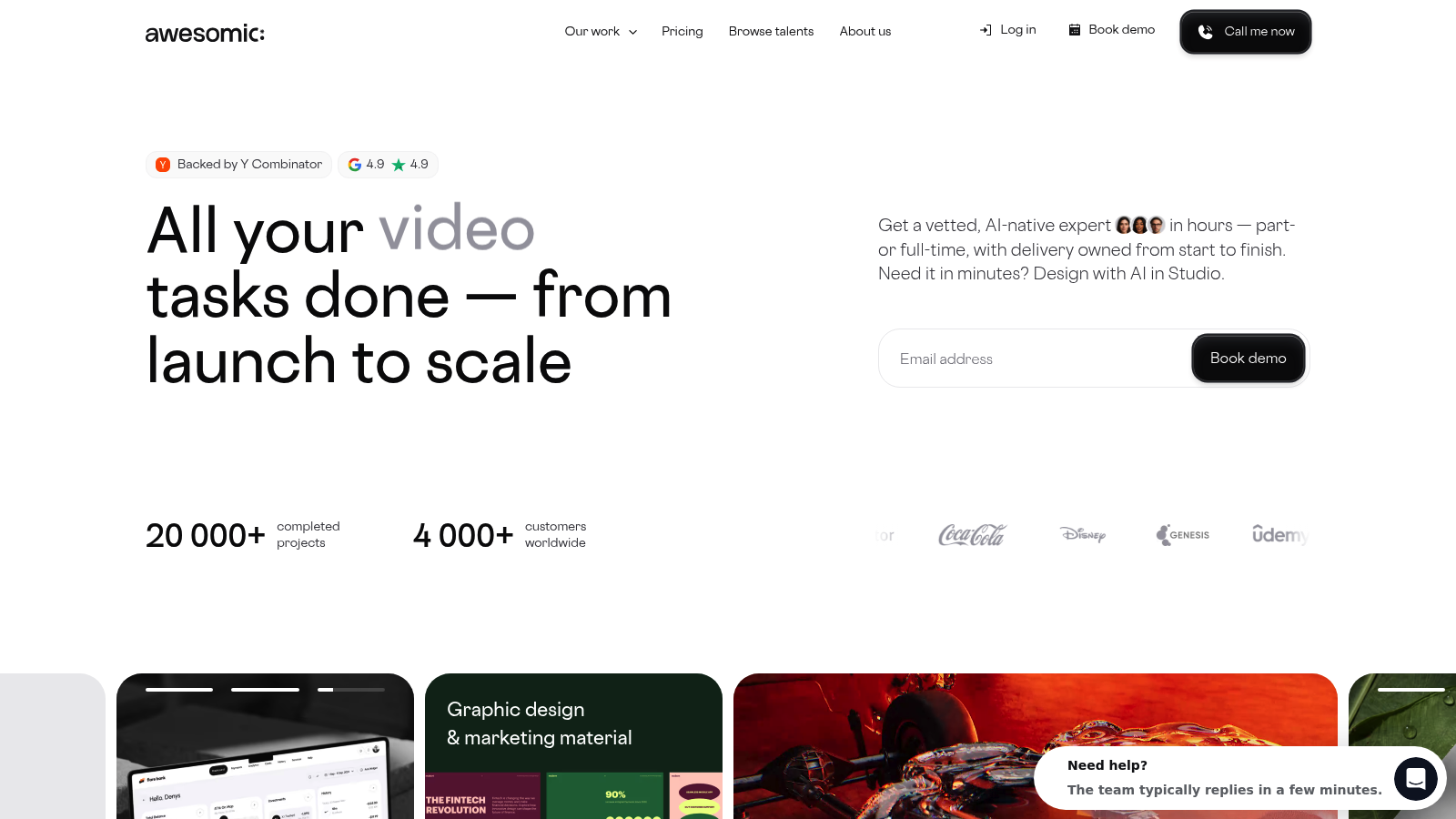
Best for: Product design plus surrounding work
Overview: We match you with a vetted designer, usually within a day, and you brief tasks the way you would brief someone on your own team. The designer stays with your product, so context carries from one task to the next instead of being re-explained each time.
The reason we sit in a UX list rather than a graphic design one is that our talent covers product and interface work end to end: user flows, UI, mobile screens, design systems and the iteration that follows a release. When a product needs a landing page or a pitch deck in the same month, that goes into the same queue rather than becoming a second vendor.
We are backed by Y Combinator and hold a 4.9 rating on both Google Play and Trustpilot, which is the closest thing to a public score this category has.
One example of what continuity looks like: we designed the UX and UI for memoryOS, a gamified memory-training app co-founded by two-time World Memory Champion Jonas von Essen. Its Kickstarter campaign raised $642,014 from 2,800 backers and, as of July 2021, was the most funded app in Kickstarter's history.
Core services:
- Product and UI/UX design, so flows, screens and states are handled by one designer
- Design systems and component libraries that keep later work consistent
- Mobile and web app design across iOS, Android and responsive web
- No-code build in Webflow, Framer and WordPress when a design needs shipping
- Branding, graphics and pitch decks, so adjacent work does not need a second vendor
- Copywriting and QA on the All-in-One plan, which closes the gap between design and release
Industries served: SaaS, fintech, healthtech, ed-tech, marketplaces
Pricing: Entry to the subscription starts at $200 a month for the AI Designer tier, then $1,490 for Graphic Pack and $2,995 for All-in-One, with a fourth Dedicated Talent tier priced on a call. Plans bill monthly with no commitment or quarterly at a 20% saving, and the published rates cover one active task at a time.
Pros: fast matching, one designer who keeps your context, breadth beyond UX, unlimited revisions, no hiring overhead
Cons: the published tiers cover one active task at a time, and the dedicated full-time option is quote-only
Engagement model: You subscribe, get matched, and brief tasks through the app with Slack alongside it. Pause or cancel between months rather than negotiating out of a contract.
How to start working with us:
- Pick a plan on the pricing page and create an account.
- Tell us what your product is and what the first task is.
- Get matched with a designer, normally inside 24 hours.
- Brief the first task and set the level of detail you want back.
- Review, request revisions, and keep the queue moving.
Why it's a good UX design subscription: You get product-level design capacity without a hire, and the same designer keeps learning your product instead of starting cold each month. The breadth means a UX subscription does not become three subscriptions the first time you need a deck.
Final verdict: The strongest fit if you want ongoing product design and expect adjacent work to appear. It is less suited to a single, one-off audit, where a fixed-scope engagement is cheaper.

Eleken
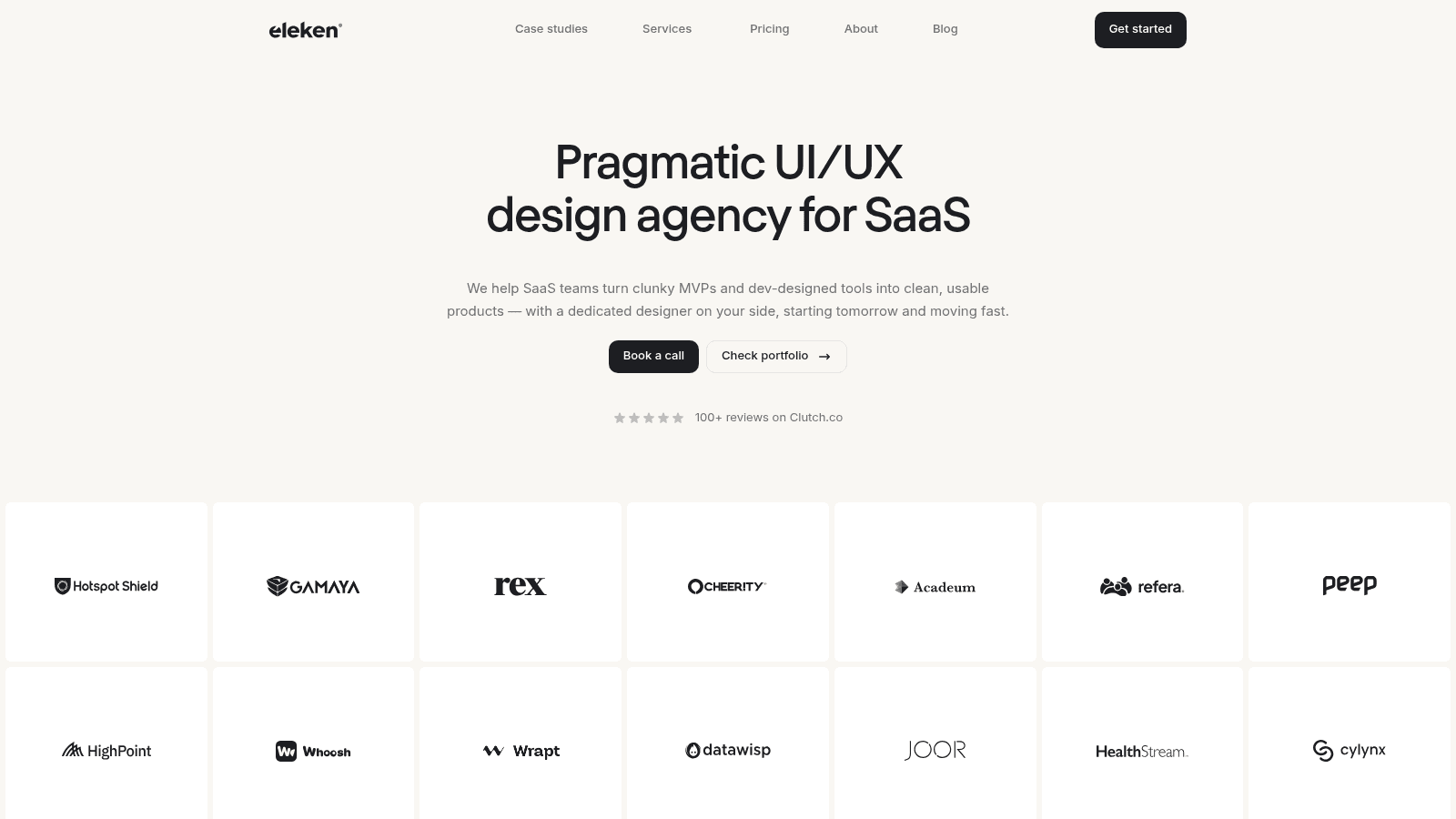
Overview: A UI/UX agency working exclusively on SaaS products, selling its time as a subscription rather than as a project. One named designer handles your backlog, and the agency's Head of Design reviews the output.
Core services:
- SaaS product redesigns, handled by a designer who stays on the product
- Design from scratch for MVPs, so a first version ships with a coherent interface
- Team extension when an in-house designer needs capacity beside them
Industries served: SaaS, fintech, healthcare
Pricing: Three tiers, priced per designer: part-time capacity is $4,599 monthly, a full-time designer is $6,599, and two full-time designers cost $11,999. A two-month minimum applies, and a three-day free trial is offered.
Pros: genuine SaaS specialism, one named designer, unlimited tasks and revisions
Cons: a $4,599 floor is steep for small teams, the two-month minimum is not true month-to-month, and there is no branding, print or video breadth
Notable clients or work: Publishes SaaS case studies across fintech and healthcare, with a Clutch rating of 4.9 from more than 100 reviews.
Where it fits: A SaaS team that knows it needs sustained UI/UX attention and wants one senior person rather than a rotating pool.
Final verdict: The clearest specialist option here, priced accordingly.
Meticular

Overview: An unlimited UX/UI subscription aimed at SaaS and IT teams, with two tiers separated mainly by turnaround speed. Requests queue up and are worked one at a time by a dedicated designer.
Core services:
- Unlimited UX requests, worked sequentially by one designer
- UI design with unlimited revisions inside the plan
- Strategy input included rather than sold as a separate discovery phase
Industries served: SaaS, IT services, B2B software
Pricing: $3,197 a month for Starter, which quotes a four-day turnaround, and $5,997 for Pro at two days. Both are advertised with no minimum commitment and the ability to pause or cancel.
Pros: clear published rates, no lock-in, strategy bundled into the fee
Cons: one task at a time on both tiers, speed is the main thing the higher tier buys, and the team is small enough that parallel capacity is limited
Notable clients or work: Positions explicitly around SaaS and IT products rather than general marketing design.
Its real strength: Predictability. You know the rate, the turnaround target and the fact that you can stop.
Final verdict: A reasonable middle option if $4,500-plus is more than you want to commit.
VNTA

Overview: A subscription studio that puts design and development on the same plan, pitched at teams who want an MVP designed, built and launched rather than handed over as files.
Core services:
- Product design carried through to working software
- Development and launch, so the design does not stop at handoff
- Post-launch fixes and improvements inside the same subscription
Industries served: SaaS startups, early-stage products
Pricing: Two monthly plans. The Design Subscription is $2,999 and covers brand, UI and product design on demand. The Product Subscription is $4,999 and adds development, so an MVP is designed, built and launched on the same fee, with daily progress updates on weekdays. A $1,200 one-week test sprint is offered as a way to try the workflow first.
Pros: design and build under one fee, a design-only plan for teams that do not need the build, a low-cost trial sprint, no long-term contract
Cons: the build-inclusive plan is expensive if you only need design, there are just two tiers so there is little room to scale down, and bundling build means you inherit their stack choices
Notable clients or work: Publishes product work under a subscription-based SaaS design and development positioning.
What it does well: Removing the gap between a design being approved and it existing in the product.
Final verdict: Worth a look when the bottleneck is engineering as much as design.
WeGrow

Overview: A design subscription aimed specifically at B2B AI companies, sold as a retainer with one dedicated workstream at the base price and more capacity scoped on a call.
Core services:
- Ongoing product design run as a retainer with a senior team
- Design systems and product surfaces for AI tooling
- Fixed-price project work when the scope is genuinely bounded
Industries served: B2B AI, developer tools, enterprise software
Pricing: From $4,900 a month for the retainer, covering one dedicated workstream, with additional capacity quoted. Fixed-scope projects start from $9,000. Pause or cancel is offered on the retainer.
Pros: narrow focus on B2B AI products, senior team on both engagement types, an honest split between retainer and project
Cons: the base retainer is a single workstream, extra capacity requires a call, and the AI focus is limiting if your product is not one
Notable clients or work: Positions around B2B AI companies and publishes work in that segment.
Who it suits: An AI company whose interface problem is explaining a model's output to a non-technical buyer.
Final verdict: A specialist bet that pays off if you are squarely in its segment.
MyDesigner
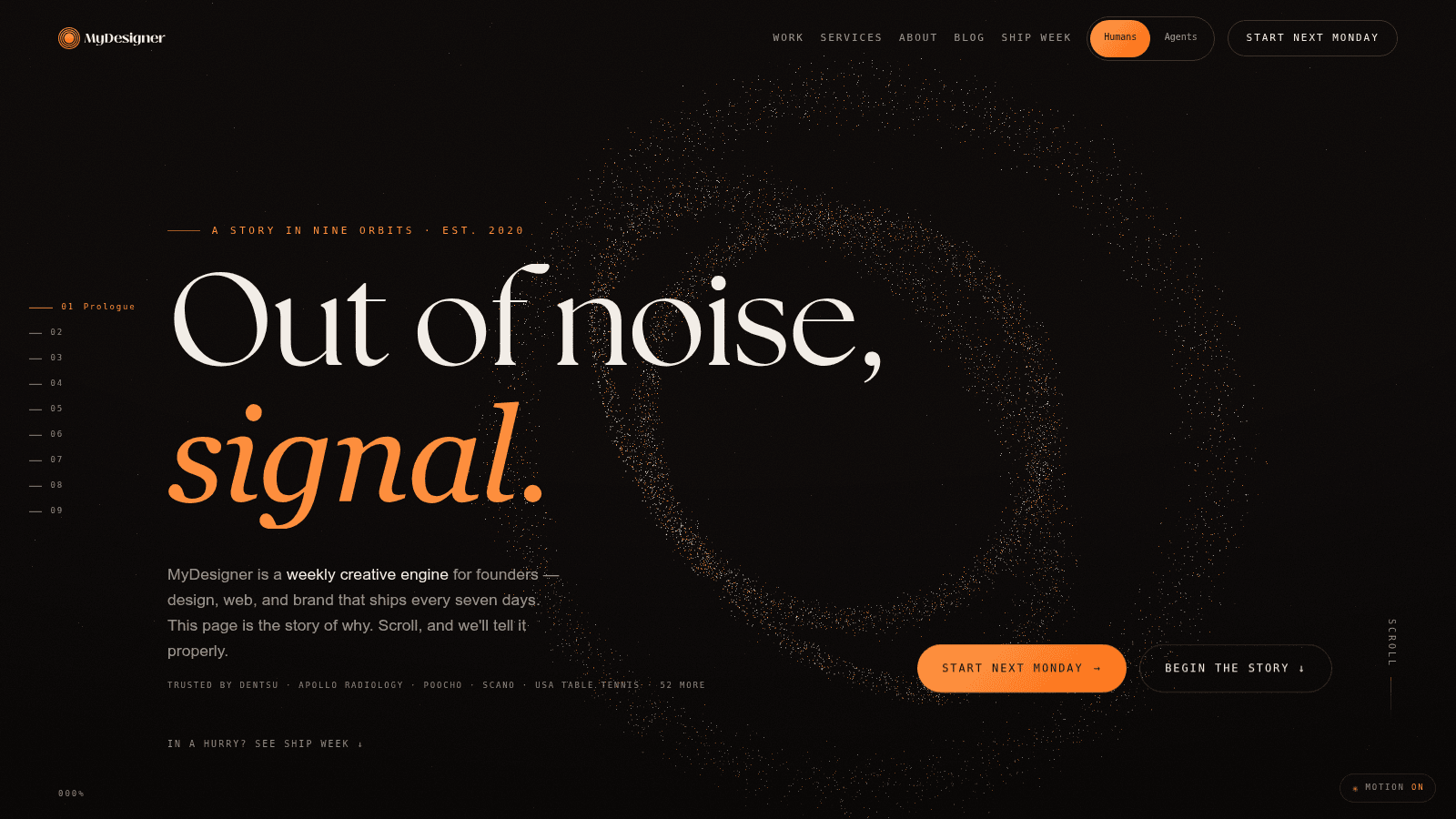
Overview: A studio that prices by the week rather than the month, on the argument that a week is the honest unit of delivery. You agree one defined outcome on Monday and it ships by Friday.
Core services:
- A defined weekly outcome, directed, designed, built and shipped
- Product screens and key flows designed for clarity
- Webflow or Framer landing pages when that is the agreed weekly outcome
Industries served: Early-stage startups, small product teams
Pricing: $1,250 as a one-time Ship Week for a single defined outcome. Ongoing arrangements are Growth Weeks at $1,400 a month or Partner Weeks at $3,800 a month, and both are offered only after a Ship Week has gone well.
Pros: the lowest entry point here, a genuine try-before-you-commit structure, unusually concrete about what one week buys
Cons: the weekly frame suits bounded outcomes more than sprawling ones, ongoing plans are gated behind the trial week, and it is a small operation
Notable clients or work: Publishes its weekly model and pricing openly rather than behind a call.
Why buyers shortlist it: It is the cheapest honest way to find out whether an outside designer can actually move your product.
Final verdict: Start here if you are not yet sure a subscription is the right shape.
Intrface
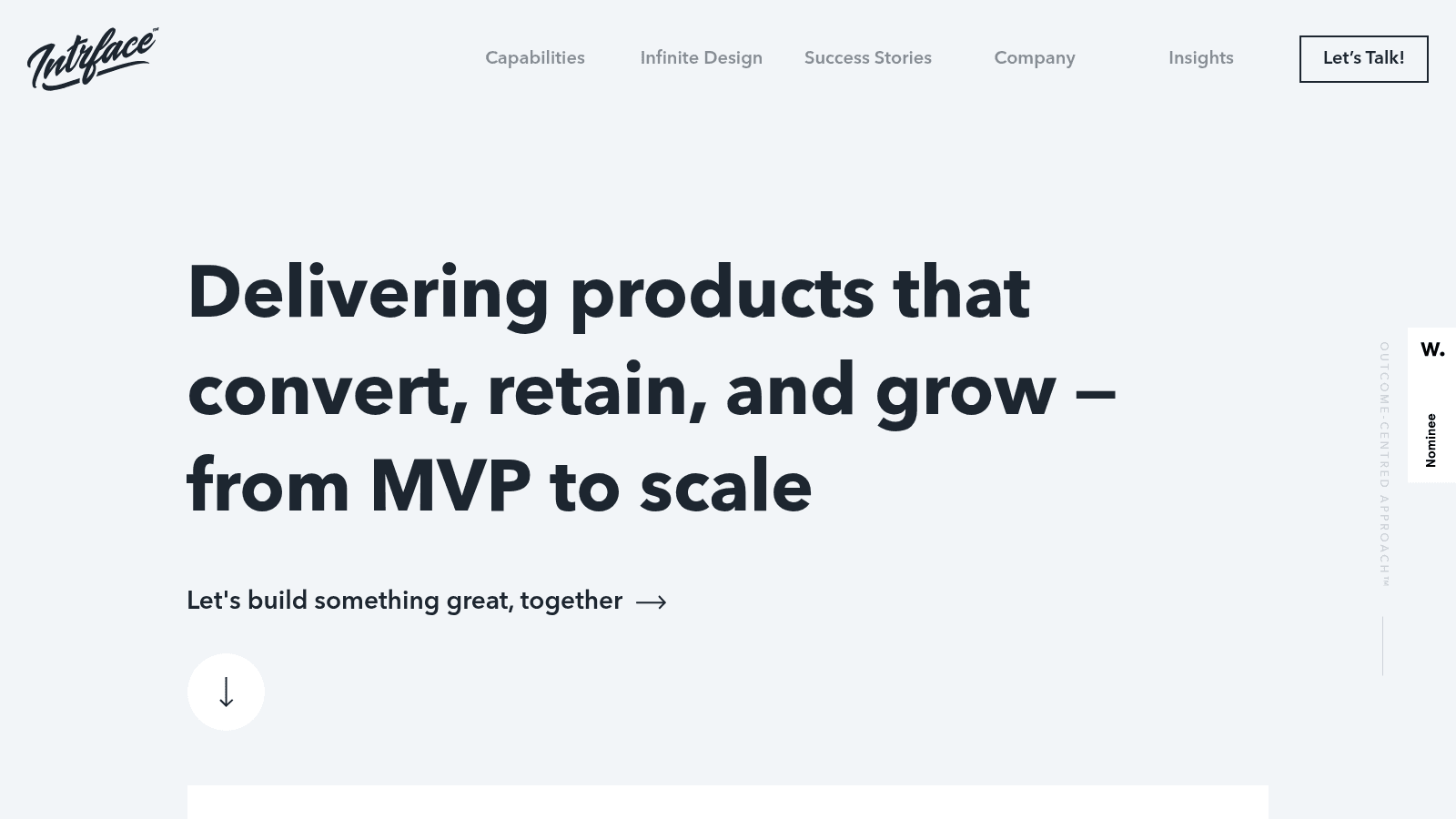
Overview: A UK studio selling unlimited UI design on a flat monthly rate under the name Infinite Design, positioned directly against employing an in-house design team.
Core services:
- Unlimited UI design requests on a single flat rate
- Product design delivered on an ongoing basis
- Design capacity intended to replace an in-house hire
Industries served: UK and European product teams, startups
Pricing: From £4,900 a month, with a £8,800 tier above it. This is the one rate on this list published in pounds rather than dollars, because the studio is UK-based and bills in GBP.
Pros: a genuinely flat rate, unlimited requests, positioned clearly against hiring
Cons: pricing in pounds adds conversion risk for US buyers, UK working hours mean limited overlap with US West Coast teams, and the flat rate is high for a small queue
Notable clients or work: Publishes its flat-rate model and comparison against in-house hiring openly.
Where it fits: A UK or European team that wants one predictable line item instead of a salary.
Final verdict: Strong if you are in its timezone, awkward if you are not.
Cieden
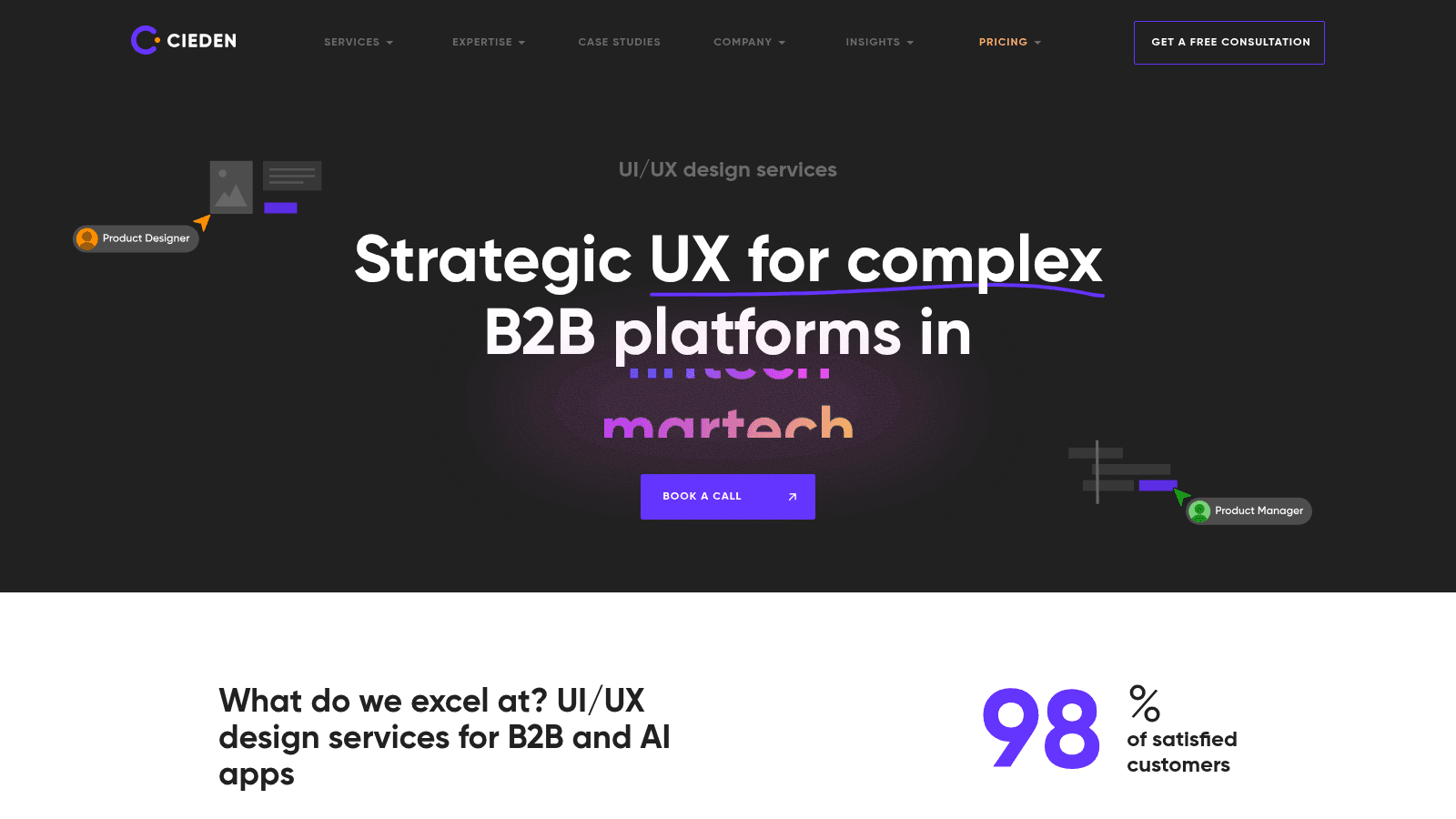
Overview: A strategic UX agency built around complex B2B platforms, offering dedicated design teams and team extension rather than a fixed subscription tier.
Core services:
- UX strategy and research for products with complicated workflows
- Design systems carried through to developer handoff
- Dedicated design teams or an embedded product designer
Industries served: B2B SaaS, healthcare, fintech, martech
Pricing: No public pricing. Engagements are scoped individually, so expect a discovery conversation before you see a number.
Pros: genuine depth on complex workflows, handoff taken seriously, a team-extension model closer to a subscription than most agencies
Cons: no published rate, onboarding is slower than a fixed-tier plan, and the team is Ukraine-based, so US West Coast overlap is limited
Notable clients or work: Publishes testimonials from Apollo.io, Foqal and Factually Health.
Its real strength: Products where the hard part is the logic, not the visual surface.
Final verdict: Best when the UX problem is genuinely complicated rather than merely unfinished.
Adam Fard Studio
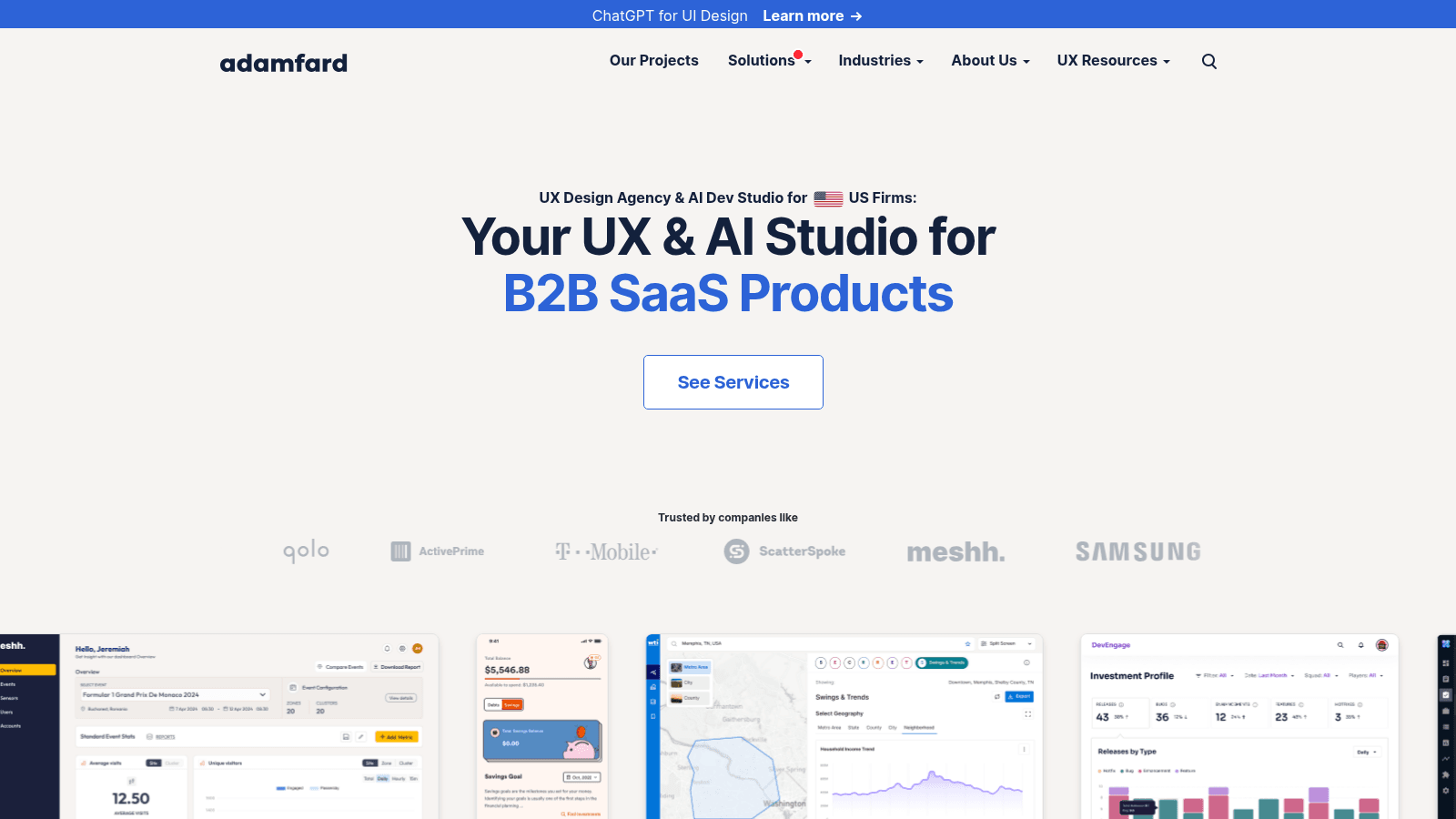
Overview: A UX and AI design studio working with B2B SaaS products, with a research-led method aimed at enterprise software that has grown awkward over time.
Core services:
- UX audits that identify what is actually costing you conversions
- B2B SaaS product design informed by research rather than preference
- AI product design and design systems
Industries served: B2B SaaS, enterprise software, AI products
Pricing: No public pricing. Work is scoped per engagement.
Pros: research-led rather than execution-only, clear B2B focus, publishes named case studies
Cons: no published rate, a smaller team limits parallel capacity, and less public social proof than the larger studios
Notable clients or work: Case studies on its own site name th!nkpricing, Marginal Unit, Sciforma and One2Team.
What it does well: Diagnosing why an established B2B product is hard to use before redrawing it.
Final verdict: A good fit for an overhaul with a real research component.
UX Studio
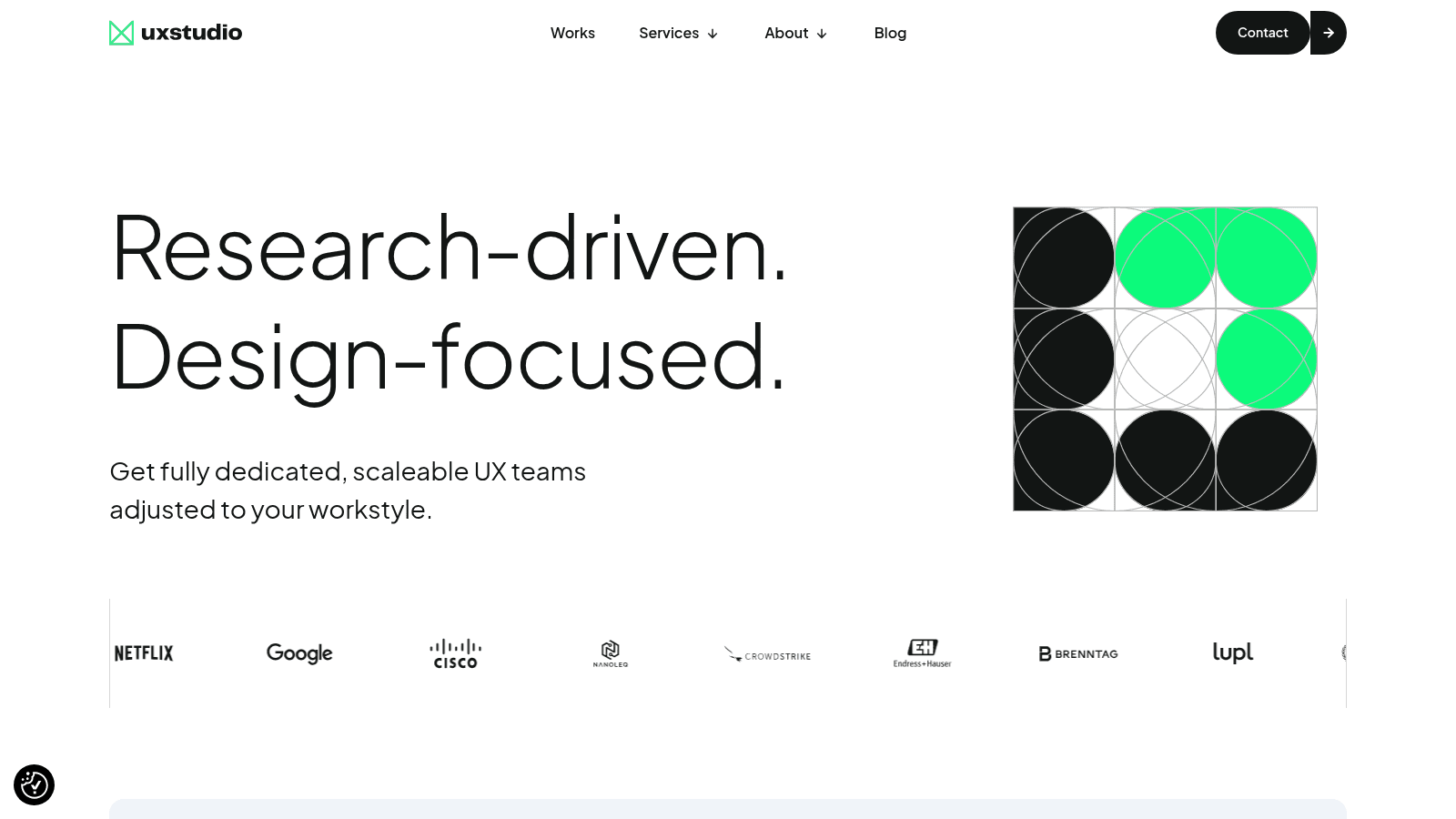
Overview: A research-first UX agency that provides dedicated, scalable UX teams and embedded designers, with validation built into the front of the process.
Core services:
- UX research and validation before a direction is committed to
- Product and UI design delivered by an embedded team
- Usability testing and design systems
Industries served: Product teams, enterprise software, consumer apps
Pricing: No public pricing. Teams are scoped and quoted.
Pros: research and testing are core rather than upsells, scalable embedded teams, strong methodological grounding
Cons: research-first sequencing is slower to produce visible UI, no published rate, and the team is Europe-based
Notable clients or work: Its homepage shows a logo carousel including Samsung, Google and Cisco, which is marketing placement rather than confirmed case studies.
Why it earns a place here: It is the option that will tell you your idea is wrong before you build it.
Final verdict: Choose it when the risk of designing the wrong thing outweighs speed.
Lazarev

Overview: A San Francisco product design agency founded in 2015, working on AI, data and B2B platforms, and structuring engagements as multi-month programs rather than monthly tiers.
Core services:
- Product design for AI and data-heavy interfaces
- UX for complex B2B platforms with multiple stakeholders
- Product storytelling and onboarding design
Industries served: AI, SaaS, fintech, ed-tech, ecommerce
Pricing: No public pricing. Engagements are structured as multi-month programs and quoted.
Pros: genuine specialism in AI interfaces, US-based with a published San Francisco presence, outcome-focused framing
Cons: no published rate, multi-month structure is heavier than a cancel-anytime plan, and it says plainly it is not the cheapest option
Notable clients or work: Publishes portfolio outcomes across AI, SaaS and ed-tech products.
Who it suits: Teams whose interface has to make a model's behavior legible to a buyer.
Final verdict: A serious option for AI products, priced as a program rather than a subscription.
MetaLab
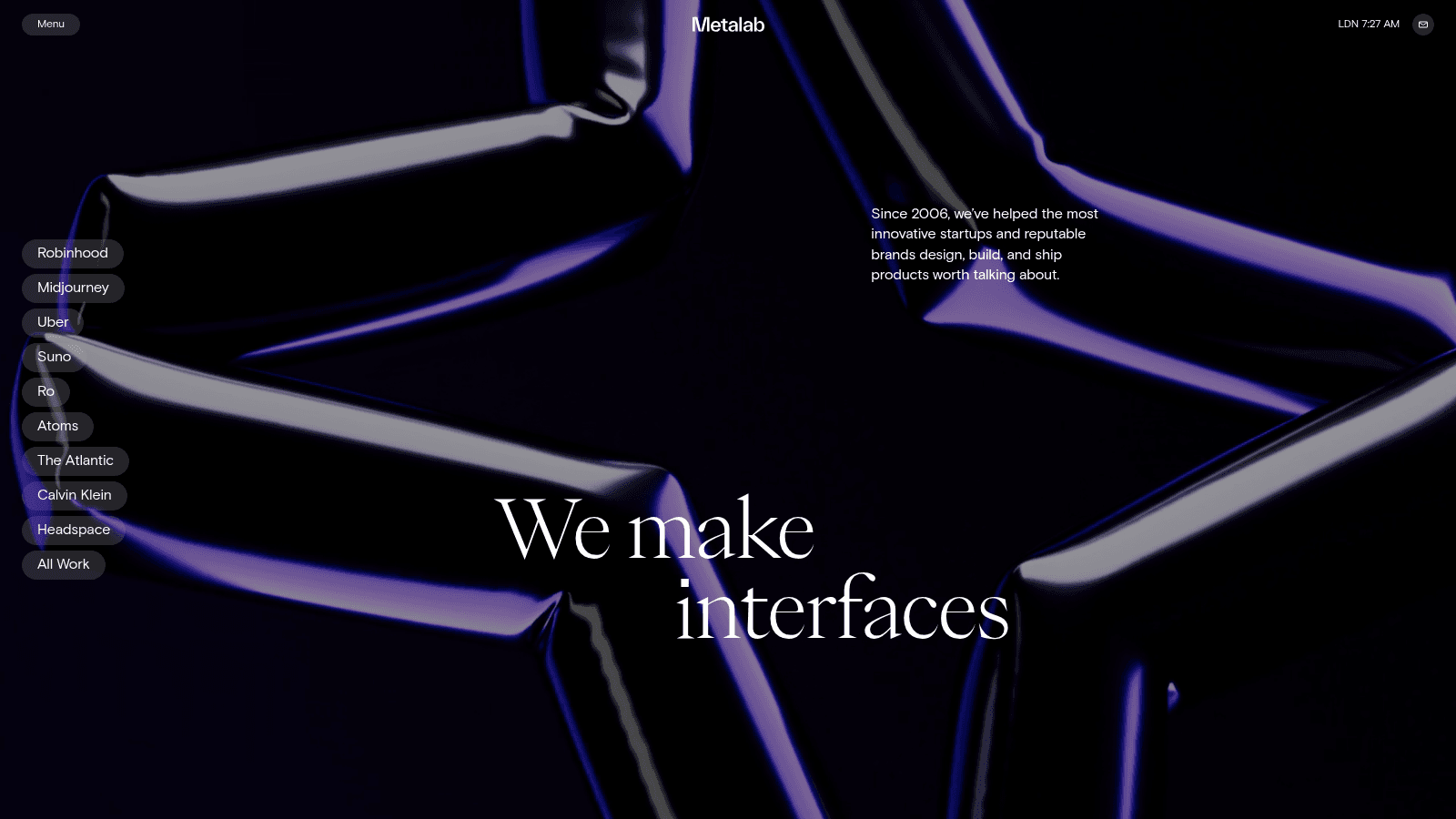
Overview: A product design studio whose own site names Slack and Google among the companies it has helped design and ship products for, working on flagship work for well-funded teams.
Core services:
- Product and interface design for zero-to-one launches
- Brand and design systems built alongside the product
- AI product design
Industries served: Consumer apps, fintech, AI, media
Pricing: No public pricing, and work is project-scoped rather than monthly.
Pros: an exceptional track record, strong brand and product capability together, senior teams
Cons: project-based rather than an ongoing subscription, premium positioning, and heavier than needed for incremental work
Notable clients or work: Names Robinhood, Midjourney, Uber, Suno and Headspace on its own site.
Where it beats the alternatives: A launch where the interface itself is the product's main argument.
Final verdict: Included for completeness at the top of the market, though it is not a subscription in the strict sense.
How we chose these twelve
Every service here had to clear four checks, and a few well-known names did not.
First, the deliverable had to be product UX, not general graphic design. Second, we read each vendor's own homepage and pricing page in September 2026 rather than trusting a directory listing, which is how we found that one candidate had repositioned itself as a software development partner and no longer belonged.
Third, any price quoted here appears on the vendor's own site; where nothing is published we wrote "quoted" instead of repeating a number from a third-party roundup. Fourth, we included studios that are project-based rather than subscription-based only where they are a genuine alternative, and we labeled them as such.
We also looked at whether a vendor designs from evidence of real use. A team that can work from UX scenarios rather than from a feature list will make better calls on your behalf when a brief is thin, which is most of the time.
The pricing check matters more than it sounds. Two of the candidates we assessed had figures circulating in comparison articles that appear nowhere on the vendors' own sites, and in both cases the numbers on the page turned out to be client funding totals rather than prices. Anything you read here you can verify yourself in a browser.
What to look for in a UX design subscription
The published rate is the least interesting part of the comparison. These five things decide whether the arrangement works.
- Concurrency, meaning how many of your tasks are genuinely worked at the same time
- Whether you get a named designer who keeps context, or whoever is free that day
- The real turnaround target, stated in days, for both first drafts and revisions
- Whether design systems and developer handoff are included or billed separately
- What happens when you need to stop, including notice periods and minimums
Ask for the turnaround commitment in writing, because it is the number most often quoted loosely in sales conversations and most often disputed later. It also helps to know which UI/UX tools a vendor works in before you sign, since a team that lives in a different toolchain from your engineers will cost you time at every handoff.
How much a UX design subscription costs
Published rates in this category cluster into three bands, and the band you need depends on how much design work you genuinely have, not on the size of your company.
| Model | Typical monthly cost | What you get | Best when |
|---|---|---|---|
| Weekly or entry subscription | $1,250 to $1,500 | One defined outcome at a time | Design needs are occasional but real |
| Mid-tier product subscription | $1,490 to $3,200 | An assigned designer, one active task | A steady queue of interface work |
| Dedicated designer subscription | $4,599 to $6,599 | A named part-time or full-time designer | Design is on the critical path |
| Multi-designer or build-inclusive | $9,000 to $11,999 | A team, or design plus development | A roadmap, not a backlog |
| Quoted engagements | Not published | Scoped programs, often multi-month | Research-heavy or flagship work |
Set those figures against the cost of employing someone. The federal Employer Costs for Employee Compensation series puts total compensation for private industry workers at $46.60 per hour worked in March 2026, of which benefits are $14.01, or 30.1% on top of wages. For the role itself, the Bureau of Labor Statistics reports a median wage of $104,000 for web and digital interface designers in May 2025, with about 13,600 openings a year across the occupation.
Put those two together and a single in-house designer costs meaningfully north of $135,000 a year before a desk, a laptop or a recruiter fee. That is the number a subscription competes against, and it is why the mid-tier plans look different once you stop comparing them to a freelancer's day rate.
The comparison is not purely financial either. Hiring takes months, and the same federal data counts about 13,600 openings a year in this occupation, so you are competing for the person as well as paying for them. Teams that would rather skip that entirely tend to hire a product designer on subscription and revisit the headcount question later.
Who should buy one, and who should not
A subscription rewards a steady flow of work. If you have a roadmap with interface implications every week, the model does what it promises: capacity without a hire, and context that compounds.
Online retail is the clearest example of that pattern. E-commerce subscription UX design tends to pay for itself because storefronts generate work continuously: product pages, checkout steps, promotional templates and seasonal refreshes all recur whether or not anyone has budgeted for them.
If your design needs are lumpy, the model works against you. You pay in the quiet months and queue in the busy ones.
A designer on Reddit made the point more bluntly than most vendor pages will, noting that subscriptions are "great if you've got a steady flow of design needs" but that for requests that are "more random or project-based, freelancers might still be better." That is one practitioner's view rather than data, and it matches what the pricing structures imply.
There is a third case worth naming. If you need a single, bounded piece of work, such as an audit or one flow redrawn, a fixed-scope engagement from one of the quoted studios above will almost always cost less than two months of a subscription. Some of the best product design agencies for startups sell exactly that shape of work, and there is no reason to buy a monthly plan to get it.
Teams that eventually want someone permanent often use a subscription as the bridge. It covers the work while the search runs, and it tends to clarify the job description, because you learn what you actually brief week to week before you commit to a headcount.
Making the decision
Start with your queue, not the vendor list. Write down the design tasks you genuinely expect in the next eight weeks. If the list is short and self-contained, buy a project. If it keeps going, a subscription is the cheaper structure and the only question is which band you need.
Testing comes next, before any commitment. Three services here offer a low-cost way in: a three-day trial, a $1,200 sprint and a $1,250 Ship Week. Any of them will tell you more about a working relationship than a portfolio will.
Finally, be honest about the interface problem you have. If the product is merely unfinished, most of this list can help. If nobody knows what users are actually doing, you want research capability, and a plan built for volume will not supply it.
That distinction is the single biggest reason these engagements disappoint, and it is worth an hour of thought before you spend $4,000 a month. When the work centers on an AI-heavy interface rather than a conventional one, the shortlist narrows again, and the AI product design agencies worth talking to are a partly different set.
FAQ
What is a UX design subscription?
It is a flat monthly fee that places a product designer, or a small design team, on your queue of interface tasks instead of you hiring someone or scoping each project separately. Most plans include unlimited requests and revisions, but work one task at a time. The model is best understood as buying capacity rather than buying a deliverable.
How much does a UI UX design subscription cost?
Published monthly rates among the services here run from $1,400 up to $11,999 for two full-time designers. The most common band for a dedicated designer sits between $3,197 and $6,599.
One service also sells a $1,250 one-off week, which is the cheapest way in but is not a monthly rate. Five of the twelve publish no rate and quote per engagement. Compare any of these against an in-house hire: the federal median of $104,000 for this occupation, plus the 30.1% benefits load in the same federal series, puts the true cost near $135,000 a year.
Is a subscription UX design service worth it for startups?
It is worth it when design work is continuous and you are not ready to commit to a salary. The benefits of a UX design subscription for startups are mostly about timing: you get a designer in days rather than months, you can stop when the roadmap quiets down, and you avoid recruiting costs entirely. If your design needs arrive once a quarter, a fixed-scope project is cheaper.
Can a design subscription handle e-commerce UX work?
Yes, and e-commerce subscription UX design is a common use case, since storefronts generate exactly the steady stream of work the model suits: product pages, checkout flows, promotional templates and seasonal updates. Check that the vendor has actually shipped commerce interfaces rather than only SaaS dashboards, because conversion-sensitive retail work rewards specific experience.
What is the difference between unlimited requests and unlimited output?
Unlimited requests means you can put as many tasks in the queue as you like. Unlimited output would mean they are all worked at once, and essentially no vendor offers that at these prices. Almost every plan here works one task at a time, so your real throughput is set by concurrency and turnaround speed, not by the word unlimited. Ask how many active tasks a plan includes before you compare rates.
One subscription and your hiring problems solved

FAQ


Awesomic is a revolutionary app that matches companies with vetted professionals across 30+ skill sets, from design and development to marketing and product. Based in San Francisco with a global core team, we offer a faster and more flexible alternative to traditional hiring through a subscription-based model. Awesomic delivers high-quality talent on demand, without the delays of recruiting.
We function as a subscription-based service that matches you to top-tier, vetted talent. Submit a project in just a few clicks and start receiving deliverables in as little as 24 hours. Scale your Awesomic plan up or down as your business needs change.
Every Awesomic subscription comes with unlimited revisions. You receive daily progress updates via the app, and you can provide feedback or request iterations as needed. If your project requires a different approach, you can request a talent rematch at any time, at no extra cost. You can also add teammates to collaborate and streamline feedback
A talent marketplace is a platform that utilizes data and intelligent matching algorithms to connect professionals with projects based on their skills, experience, and availability. While often used internally by large companies, Awesomic applies this model at scale, matching vetted global talent to your most critical business needs.
Hiring is time-consuming, expensive, and risky. Awesomic eliminates that problem. We rigorously vet all talent for technical ability, communication, and soft skills, ensuring only senior-level professionals work on your projects. You skip the job posts, interviews, and delays, and get straight to results.
No, Awesomic goes beyond design. While many clients utilize us for branding, UI/UX design, or motion graphics, we also provide vetted talent in no-code web development, product design, marketing, and more. Think of us as an extension of your team. A flexible, high-performing creative partner from planning to execution, whether you're building awesome products or scaling your team.
You can talk directly with your matched talent via the Awesomic app, connect via Slack, email, or schedule video calls. No matter the plan, you’ll receive daily updates in the app for every active task. You can also tag us in for any issues through our in-app customer chat.


