




11 Best Motion Design Agencies for Tech Companies in 2026

Key takeaways:
- Tech companies buy three different things called motion design: brand film, in-product interface motion, and campaign or social animation. Studios that excel at one are often weak at another.
- Motion triggered by scrolling or interaction has to be switchable off under WCAG, because parallax and similar effects can cause dizziness, nausea and headaches in people with vestibular disorders.
- Federal labor data counts 20,052 US graphic design establishments employing about 55,000 people, and the elite motion studios are a small subset clustered in Los Angeles, New York and Chicago.
- Ask any studio whether it delivers Lottie or coded output as well as video files. If the motion is going into your product, a rendered MP4 is the wrong deliverable.
Motion is the part of a tech brand that most often gets bought twice. A studio makes a beautiful launch film, and six months later somebody realizes the product's own transitions, loading states and onboarding animations look nothing like it, because those were built by engineers with no motion spec to work from.
The studios below span that whole range, from broadcast-grade brand film to interface motion that ships inside software. They are genuinely different businesses.
We put ourselves at the top, with one caveat stated plainly: for a flagship brand film with a name director, hire one of the ten studios below instead.
The three things tech companies call motion design
Getting this distinction right before you brief anyone saves the most money in this category.
Brand film and title-grade motion is the cinematic end: launch films, conference opens, sizzle reels, high-craft animation. It is expensive because it is bespoke, and it is bought per project. Imaginary Forces, Sarofsky and Gentleman Scholar work here.
Product and interface motion is what happens inside the software: transitions, micro-interactions, loading and empty states, onboarding sequences. The deliverable is not a video at all. It is a specification plus Lottie files or coded animation an engineer can implement, along with rules about timing and easing that keep the product coherent.
Campaign and social animation is volume work: ad variants, app store previews, feature announcements, social cutdowns. Success here is throughput and consistency rather than any single spectacular frame.
Studios rarely span all three, and the pricing models are incompatible. A studio geared for one brand film a quarter cannot economically produce forty social variants a month, and a volume shop will not deliver a title sequence. The broader field is mapped in our roundup of motion design agencies, which is not scoped to technology buyers.
Timing, easing and duration rules belong in a documented design system rather than in one designer's head, which is what keeps motion consistent after that designer moves on.
The accessibility rule most motion work ignores
This is the section missing from nearly every motion design roundup, and it has teeth if your product serves enterprise or public-sector buyers.
The W3C's Web Content Accessibility Guidelines include Success Criterion 2.3.3, Animation from Interactions. Its requirement is short: motion animation triggered by interaction can be disabled, unless the animation is essential to the functionality or the information being conveyed.
The reason is medical rather than aesthetic. W3C's own explanation notes that when scrolling a page causes elements to move beyond the movement inherent in scrolling, it can trigger vestibular disorders, and that reactions include dizziness, nausea and headaches. Parallax scrolling is named specifically as a common non-essential offender.
The mechanism for compliance is the `prefers-reduced-motion` CSS media query, which carries the setting a user has already chosen at the operating system level. A site that respects it turns off the page-flipping transition, the parallax layer and the scroll-driven animation for those users, while leaving the experience intact for everyone else.
Two practical consequences follow. First, a motion studio delivering interface work should be asking about reduced-motion behavior in the brief, not discovering it at QA. Second, if you are selling into government, education, healthcare or large enterprise, accessibility conformance is often a procurement gate, and scroll-jacking your marketing site can turn into a genuine commercial problem rather than a design debate.
Ask any studio on a shortlist what its reduced-motion fallback looks like. The answer tells you quickly whether it has shipped motion into real products or only into video files.
The 11 best motion design agencies for tech companies
Studios are grouped by which of the three motion jobs they genuinely own. Every location was read off the studio's own website.
| Studio | Owns | Known for | Based in | Pricing |
|---|---|---|---|---|
| Awesomic | Product and campaign motion | Motion alongside the design around it | San Francisco, CA | From $1,490 monthly |
| Imaginary Forces | Brand film | Title sequences and brand storytelling | Los Angeles, CA | Quote only |
| Sarofsky | Brand film | Design-led film and broadcast work | Chicago, IL | Quote only |
| Hornet | Brand film and campaign | Character-driven animation and direction | New York, NY | Quote only |
| Gentleman Scholar | Brand film and campaign | Craft-heavy creative production | Los Angeles, CA | Quote only |
| Territory Studio | Interface motion | Screen graphics and speculative interfaces | London, with SF and NY | Quote only |
| State Design | Brand and product motion | Design systems expressed in motion | Los Angeles, CA | Quote only |
| Not To Scale | Brand film and campaign | Film and animation across markets | New York, NY and London | Quote only |
| Golden Wolf | Campaign animation | Bold character work for youth brands | New York, NY and London | Quote only |
| Laundry | Brand and campaign motion | Motion-led brand expression | Los Angeles, CA | Quote only |
| Vucko | Brand and product motion | Technology-focused motion design | Toronto, Canada | Quote only |
Several of these studios operate in more than one city. Where a studio names a headquarters, that is the row's location.
1. Awesomic
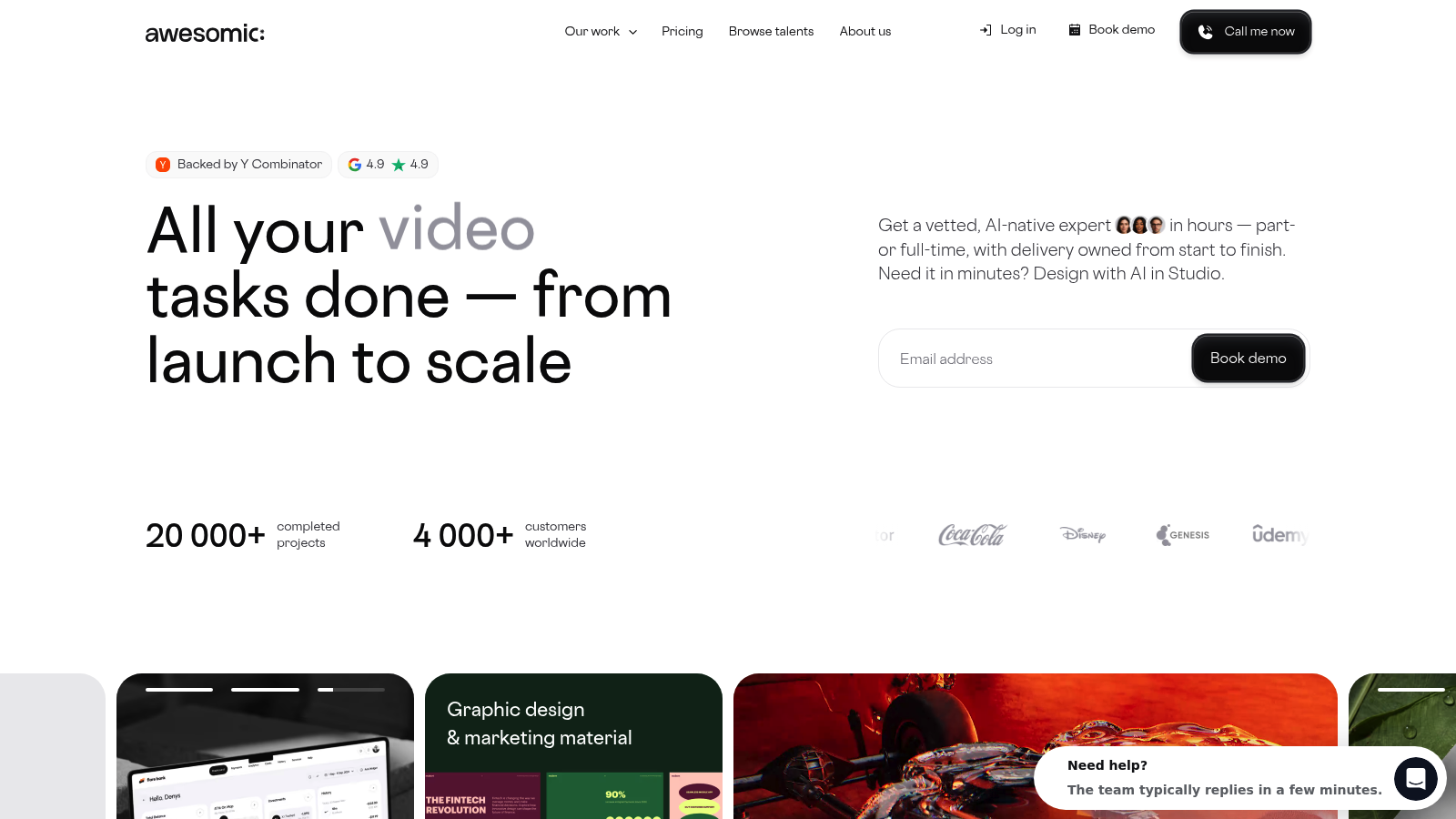
Owns: product and campaign motion, plus the design it has to match.
Most motion problems at tech companies are not craft problems. They are continuity problems: the animation exists, the product has changed, and nobody has capacity to update it before the next release.
Awesomic runs as a monthly subscription rather than a per-project studio. Briefs go into the app, a matched specialist begins within hours, and revisions run without a ceiling. Motion sits alongside UI, web, brand and illustration on the same plan, so a transition, the screen it belongs to and the marketing page that shows it off can be one workstream.
Kinship shows the model at its most embedded. The community platform, built for long-form conversation rather than feed scrolling, needed its web app screens revamped, new screens designed and its website rebuilt, with animation running through the interface work. Rather than commission that as a project, Kinship took our dedicated full-time talent plan, which puts one specialist on the account for as long as the work lasts, without a hiring cycle.
That is the trade. You get continuity and range rather than a single spectacular deliverable.
Services: interface and micro-interaction motion, animated explainers and product demos, social and ad animation, illustration systems, UI and web design, brand identity.
Pricing: All-in-One runs $2,995 monthly and folds in no-code build, copywriting and QA; the lighter Graphic Pack plan is $1,490. Quarterly billing across a three-month term brings them to $1,190 and $2,396 respectively. Dedicated Talent, a full-time specialist with a dedicated PM, is quoted on request.
Proof: past 20,000 projects for past 4,000 client companies, 4.9 on Google Play and Trustpilot alike, 0.82 percent of applicants accepted onto the talent roster, and Y Combinator behind us.
Honest limits: for a broadcast-grade brand film with a named director and a six-figure budget, hire a studio below. We are built for the motion a product generates continuously, not for one flagship piece a year. Our video service shows where that line falls.

2. Imaginary Forces

Owns: brand film at the highest craft level.
Imaginary Forces works from South Westgate Avenue in Los Angeles, with a practice built on title sequences and brand storytelling that extends into commercial and technology work. It is one of the longest-established names in the discipline, and its title work is the reference point much of the category is measured against.
Engage it when the film is the centerpiece of a launch rather than an accompaniment to it.
Services: title design, brand films, commercial direction, creative strategy.
Where it fits: flagship moments where craft is the message, budgeted accordingly.
3. Sarofsky

Owns: design-led film and broadcast work.
Sarofsky operates from West Fulton Street in Chicago and describes its work simply as beautifully made. The studio is known for feature title work alongside commercial and brand projects, with design thinking leading production rather than following it.
Being outside the Los Angeles and New York clusters is worth noting, since it often shows up in cost and in access to senior people.
Services: title design, brand and commercial film, design and animation, live action.
Why buyers shortlist it: feature-grade craft from a studio small enough that principals stay on the project.
4. Hornet

Owns: character-driven animation and directorial work.
Hornet works from Broadway in New York and represents a roster of directors across animation and mixed media, which makes it closer to a production company than a design studio in how it operates.
That structure matters practically: you are often selecting a director as much as a studio, and the range across the roster is wide.
Services: animation direction, brand and campaign films, character design, mixed media.
Its real strength: directorial range, so one relationship can cover very different creative briefs.
5. Gentleman Scholar

Owns: craft-heavy creative production across formats.
Gentleman Scholar, which presents as Scholar, works from Clearwater Street in Los Angeles with a New York presence, describing itself as a creative production company rather than a motion studio specifically.
That breadth suits campaigns where animation, live action and design need to sit in one coherent piece.
Services: animation and design, live action production, creative development, campaign content.
Where it beats the alternatives: hybrid work that would otherwise be split across an animation studio and a production company.
6. Territory Studio

Owns: interface and screen motion.
Territory Studio is best known for the fictional interfaces in major films, and it has carried that discipline into real product and brand work, operating from London with presence in San Francisco, New York and Barcelona.
For a technology company, that background is unusually relevant: designing screen graphics that must communicate state and data quickly is exactly the problem a complex product interface poses.
Services: screen and interface graphics, brand motion, data visualization in motion, film and game UI.
Why it earns a place here: almost no other studio has this depth in motion that has to read as functional rather than decorative.
7. State Design

Owns: motion as an extension of a design system.
State works from Centinela Avenue in Los Angeles and positions its work around human craft, spanning brand identity and motion rather than treating them separately.
That combination is useful when motion needs to be systematized, with rules other people can apply, rather than delivered as a set of finished files.
Services: brand identity, motion design, art direction, design systems.
Where it fits: brands that need motion guidelines as much as motion assets.
8. Not To Scale

Owns: film and animation across several markets.
Not To Scale runs from Howard Street in New York alongside London, Barcelona and Los Angeles, working across animation and live action with a director-led model.
The multi-market structure suits campaigns that need to run in several territories without re-briefing a new studio in each.
Services: animation and film production, director representation, campaign content, design.
Its real strength: international coverage from one relationship, which is rarer at this craft level than it sounds.
9. Golden Wolf

Owns: bold character animation for consumer-facing brands.
Golden Wolf operates from Rivington Street in New York and London, with a distinctly energetic style that has found a home with gaming, entertainment and youth-facing brands.
It is a deliberately narrow recommendation. If your product is enterprise software, this is probably the wrong register, and that is a matter of fit rather than quality.
Services: character animation, brand campaigns, music and entertainment content, illustration.
Where it fits: consumer technology and gaming, where personality matters more than restraint.
10. Laundry

Owns: motion-led brand expression.
Laundry is a Los Angeles studio built around motion design as the primary way a brand shows up, rather than as decoration applied afterward.
That framing suits companies rebranding, where the identity needs to work in motion from the start instead of being adapted later.
Services: motion design, brand identity in motion, commercial and campaign work, art direction.
Why buyers shortlist it: motion-first thinking produces identities that hold together on screen, which is where most brands now live.
11. Vucko

Owns: technology-focused motion and design.
Vucko is a Toronto studio whose work leans toward technology and product brands, at a scale where senior people stay involved throughout.
For a technology company that wants craft without a Los Angeles cost base, a strong smaller studio is often the better value, and this is one.
Services: motion design, brand animation, art direction, product motion.
Where it beats the alternatives: mid-sized budgets that would buy junior attention at a larger studio.
What motion design costs
Motion pricing swings more wildly than almost any creative category, because a fifteen-second animation can occupy two people or twenty. Read the bands below as the tier each studio plays in.
These figures reflect the studios named above, which sit at the senior end of the discipline. A general animation or explainer shop will quote materially less for a superficially similar deliverable, often less than half, and that gap is a difference in craft ceiling and overhead rather than a discount worth chasing on its own.
| Type of work | Typical range | What drives the number |
|---|---|---|
| Interface motion spec plus Lottie files | $5,000 to $25,000 | Number of states, handoff format |
| Animated product explainer, 60 to 90 seconds | $15,000 to $60,000 | Custom illustration and character work |
| Brand film or title-grade piece | $60,000 to $300,000 | Direction, bespoke animation, sound |
| Social and ad animation at volume | $2,000 to $10,000 a month | Number of variants and formats |
| Motion on a design subscription | From $1,490 a month | Volume plus how much design sits alongside |
Cutdowns and versioning are a separate line worth pricing early, since video editing services are charged very differently from origination. The single biggest cost driver, though, is whether assets are bespoke or systematized. A studio building a reusable motion system charges more up front and far less for the fortieth asset, while a studio treating each piece as a one-off charges roughly the same every time.
For context on the underlying market, federal data counts 20,052 graphic design establishments in the United States employing about 55,000 people, at an average annual wage of $93,078, with California, Florida, New York, Texas and Illinois holding the largest concentrations. Elite motion studios are a small slice of that, which is why the top of this market is priced the way it is.
Briefing motion so it does not get expensive
Motion projects overrun for predictable reasons, and most of them are settled before animation starts:
- Name the deliverable format precisely. Video files, Lottie, coded animation and source projects are different products with different prices.
- Lock the script and storyboard before animation begins, because changes after that point are the expensive ones.
- Specify where it plays, including aspect ratios and whether it needs to work with sound off.
- State your reduced-motion behavior up front, so accessibility is designed in rather than retrofitted.
- Pin down the number of included revision rounds, and the definition of one.
- Ask who owns the source files and the music license after delivery.
Step two carries the most money. Storyboard changes cost hours; changes after animation has begun cost days, and changes after sound design cost weeks. Step four is the one almost nobody includes, and it is the difference between shipping motion into an enterprise product and rebuilding it under procurement pressure. Micro-interaction patterns and where they earn their keep are covered in our look at emerging UI and UX trends.
Choosing the right studio
Match the studio to the job rather than the reel. A flagship brand film belongs with Imaginary Forces, Sarofsky, Hornet or Gentleman Scholar. Interface and screen motion belongs with Territory Studio, State or Vucko. Volume campaign work suits a retainer or a subscription, since scoping each asset separately means the fortieth costs what the first did.
Then check the handoff. The most common failure in tech motion is not quality, it is a deliverable engineering cannot use, and that is a conversation to have in week one rather than at QA. If you also need the surrounding interface work, our take on web app interface design shows how motion and UI decisions tend to arrive together.
Finally, be honest about volume. Companies that need motion every sprint are poorly served by studios built for quarterly projects, and the reverse is equally true. Where motion meets your marketing site rather than your product, our web design service is the closer fit.
FAQs
How much do motion design agencies charge tech companies?
An interface motion specification with Lottie files typically runs $5,000 to $25,000, an animated product explainer $15,000 to $60,000, and a brand film with directorial input $60,000 to $300,000. Volume social and ad animation is usually retained at $2,000 to $10,000 a month, while motion delivered on a design subscription starts at $1,490 a month. The largest variable is whether the studio builds a reusable system or treats each asset as bespoke, which shows up sharply once you are past the tenth deliverable.
What is the difference between motion design for a product and for a campaign?
Product motion ships inside the software: transitions, micro-interactions, loading and empty states. Its deliverable is a specification plus Lottie or coded animation an engineer can implement, and it has to account for performance and accessibility. Campaign motion is finished media, exported as video for ads, social and the website. The skills overlap but the constraints do not, and studios strong at cinematic campaign work frequently have no experience shipping motion into a live product.
Does motion design need to meet accessibility requirements?
Yes, and it is more specific than most teams expect. WCAG Success Criterion 2.3.3 requires that motion animation triggered by interaction can be disabled unless it is essential, because scroll-driven movement and parallax can trigger vestibular disorders, with reactions including dizziness, nausea and headaches. The practical mechanism is the `prefers-reduced-motion` media query, which respects a setting the user has already chosen at the OS level. For products sold into government, healthcare, education or large enterprise, this often sits inside a procurement checklist rather than a design preference.
Should we hire a motion studio or use a design subscription?
Hire a studio for a flagship piece where craft is the point and the budget reflects it, particularly brand films, title-grade work or anything needing a named director. Choose a subscription when motion is continuous: product animations that change with each release, social variants, ad creative and feature announcements. The deciding factor is frequency, since per-project pricing charges roughly the same for the fortieth asset as the first, while a monthly model does not reward you for stopping.
What deliverables should we ask a motion designer for?
Ask for the format your team can actually use. For marketing, that is video in the aspect ratios and codecs each channel needs, plus a version that reads with sound off. For product work, that is a motion specification covering timing and easing, plus Lottie files or coded animation, not a rendered MP4. In both cases request the source project files and written confirmation of music and stock licensing, since those licenses are usually limited by duration and media type and will not automatically cover a later campaign.
One subscription and your hiring problems solved

FAQ


Awesomic is a revolutionary app that matches companies with vetted professionals across 30+ skill sets, from design and development to marketing and product. Based in San Francisco with a global core team, we offer a faster and more flexible alternative to traditional hiring through a subscription-based model. Awesomic delivers high-quality talent on demand, without the delays of recruiting.
We function as a subscription-based service that matches you to top-tier, vetted talent. Submit a project in just a few clicks and start receiving deliverables in as little as 24 hours. Scale your Awesomic plan up or down as your business needs change.
Every Awesomic subscription comes with unlimited revisions. You receive daily progress updates via the app, and you can provide feedback or request iterations as needed. If your project requires a different approach, you can request a talent rematch at any time, at no extra cost. You can also add teammates to collaborate and streamline feedback
A talent marketplace is a platform that utilizes data and intelligent matching algorithms to connect professionals with projects based on their skills, experience, and availability. While often used internally by large companies, Awesomic applies this model at scale, matching vetted global talent to your most critical business needs.
Hiring is time-consuming, expensive, and risky. Awesomic eliminates that problem. We rigorously vet all talent for technical ability, communication, and soft skills, ensuring only senior-level professionals work on your projects. You skip the job posts, interviews, and delays, and get straight to results.
No, Awesomic goes beyond design. While many clients utilize us for branding, UI/UX design, or motion graphics, we also provide vetted talent in no-code web development, product design, marketing, and more. Think of us as an extension of your team. A flexible, high-performing creative partner from planning to execution, whether you're building awesome products or scaling your team.
You can talk directly with your matched talent via the Awesomic app, connect via Slack, email, or schedule video calls. No matter the plan, you’ll receive daily updates in the app for every active task. You can also tag us in for any issues through our in-app customer chat.


