




11 Best Video Agencies for Tech Startups in 2026

Key takeaways:
- Two very different businesses answer to the phrase "video agency for tech startups": studios whose whole client list is software, and general production companies that take software work between other jobs. Both can be right, and the pitch sounds identical.
- Post-production capacity in the United States is tiny and concentrated. Federal wage data counts 4,037 postproduction establishments nationwide, and California holds 1,527 of them, so a shop far from that cluster is often subcontracting your edit.
- Registering a launch film with the Copyright Office within 90 days of publishing it is what preserves your right to statutory damages. Miss the window and your remedies against anyone who lifts it shrink sharply.
- Founders on Reddit put a real number on the polished launch video: one reports paying $10,000 for the splash film alone. Budget before you shortlist.
Every founder who has watched a competitor's launch film has had the same two thoughts in sequence. The first is that it looks incredible. The second is that it cannot possibly have cost what we can spend.
The second thought is usually correct, and it is the most useful thing to establish before you talk to anybody. Video is the one marketing asset where the gap between a good result and a great one is mostly money, not taste.
What follows is a shortlist built by opening each firm's own site rather than copying an existing roundup, which is how three well-reviewed candidates got cut before they reached this page. Our own argument for why video earns its place early sits behind the shortlist rather than inside it.
The two kinds of video agency a tech startup meets
The firms that rank for this search are not competing with each other. They are two separate categories wearing the same label, and picking the wrong one is the most common expensive mistake here.
Tech-native studios build almost exclusively for software companies. Their reels are product interfaces, dashboards and founder interviews. They know what a demo day deadline is, they can read a product roadmap, and they will not need three calls to understand what your API does. The trade is range: many of them cannot mount a genuine live-action shoot with a crew.
Generalist production companies come at it from the other direction. They have the crews, the gear, the location experience and the craft depth, and they shoot software brands alongside consumer, healthcare and entertainment clients. The trade is context. You will spend the first week explaining your category.
The differences show up in the first two weeks of a project rather than in the pitch, which is why they are worth reading before you brief anyone.
| Tech-native studio | Generalist production company | |
|---|---|---|
| Ramp-up on your category | Days | Two to three weeks |
| Live-action crew capability | Often limited or subcontracted | In-house and deep |
| Typical turnaround | Two to three weeks | Six to ten weeks |
| Strongest output | Explainers, demos, ad cuts | Brand films, location shoots |
| Weakest point | Craft ceiling on flagship work | Category fluency and speed |
Neither column is better. A Series B company making one flagship brand film should be talking to a generalist with real production chops. A seed-stage company that needs a demo video, three ad cutdowns and a hiring clip this quarter should be talking to a tech-native studio, or to a subscription that treats video as continuous output rather than a project, which is the shape our own video service takes.
Why the effortless launch video is a funded one
There is a widely upvoted thread in r/ycombinator asking how YC startups produce such good launch videos. The most useful answer came from someone who runs one of the agencies that makes them, and it was refreshingly blunt: those companies have funding, they are willing to invest, and they are willing to pay for the video. Another commenter in the same Reddit thread reports that a friend who went through the program paid $10,000 for the splash video alone, with more spent across the rest of the site.
Treat that as anecdotal, because it is, but treat the shape of it as real. The reason a category-defining launch film looks unreachable is rarely that the studio behind it knows a secret. It is that somebody wrote a five-figure check and gave the work six weeks.
That is not an argument against making video. It is an argument for deciding, before your first agency call, which of the two things you are buying: one expensive artifact, or a continuous supply of adequate ones. Very few startups can afford both in the same quarter, and the ones that try usually end up with a beautiful film and an empty content calendar behind it.
Founders who have been through an accelerator tend to weight reliability over reel quality once they have made this trade a few times, a pattern our note on why YC companies choose us digs into.
The 11 best video agencies for tech startups
Every firm below was assessed from its own website, not from a directory listing, and the location shown is the one that company publishes about itself. Three candidates that appear on competing lists were removed during that check: one turned out to be a brand identity studio in Belgrade rather than a video company, and two others sell primarily to corporate, events and entertainment buyers with no software work on display.
We have put ourselves first, with the limit stated plainly in our own entry rather than buried.
1. Awesomic
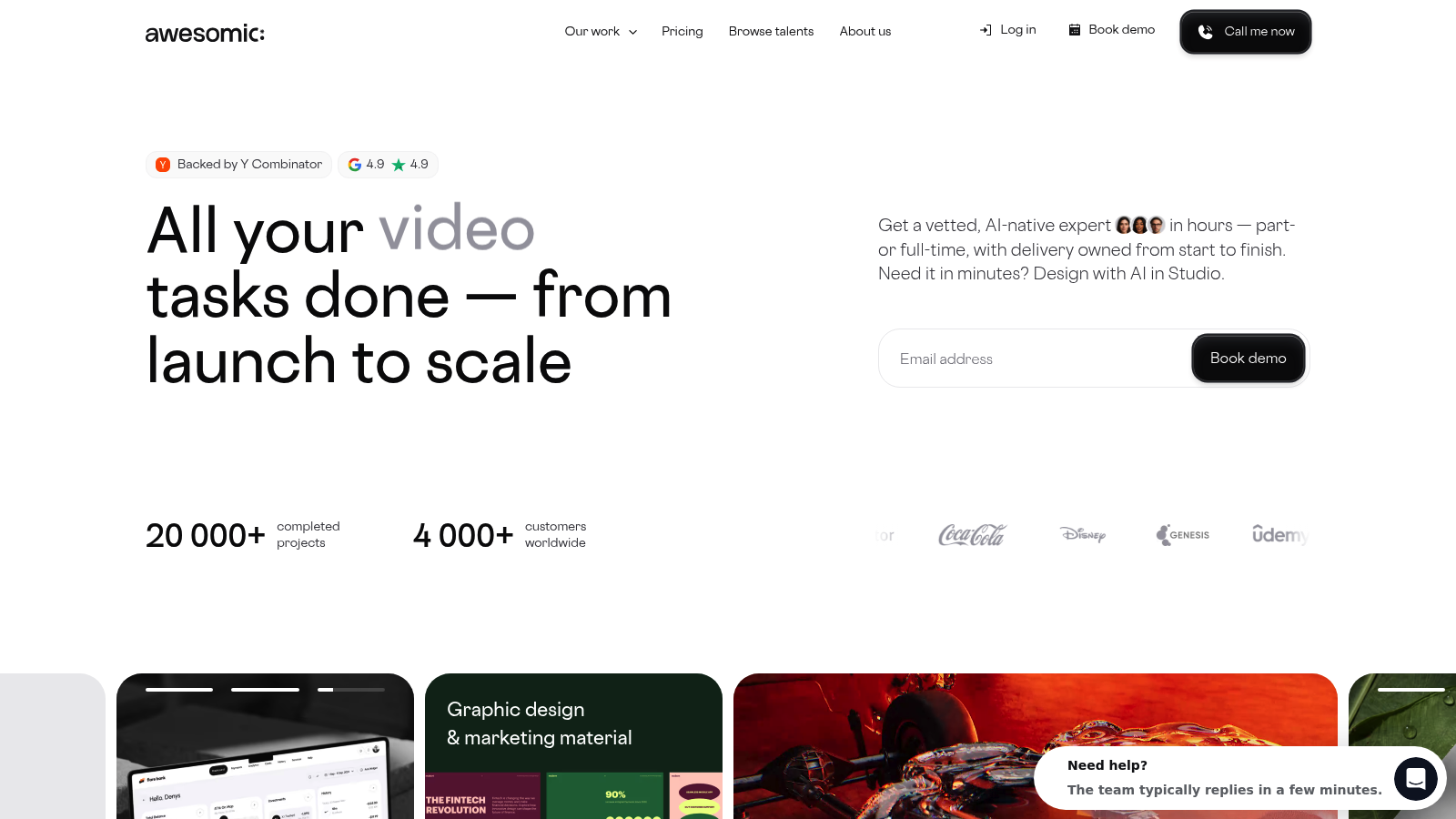
Owns: continuous video and motion output alongside the design it has to sit next to.
The problem most seed and Series A companies actually have is not that they cannot get one good video made. It is that they need a launch film in March, three ad variants in April, a demo walkthrough when the product changes in May, and a hiring clip in June, and every one of those is a fresh scoping conversation with a studio that has moved on.
Awesomic works as a monthly subscription. You post a task, a vetted specialist picks it up the same day, and revision rounds are not capped or metered. Because video shares a plan with interface, website and identity work, the launch film, the landing page it points at and the ad cuts made from it can all be one thread instead of three vendors.
Toothy.ai is the clearest example of the tempo. The dental AI company got into the YC Winter Batch and needed its entire site rebuilt, with a founder deadline recorded on our case study page as "ASAP, by Monday if possible." We matched design and development talent in under 24 hours and work was underway the following day, ending in a new visual identity, custom illustrations and a full Webflow handoff.
Our video launch gallery collects the motion side of that work, including launch pieces for YC companies such as Lemma, Grep and Fondo.
Services: launch and product films, animated explainers and demos, motion graphics, social and ad cutdowns, with interface, website, identity and illustration work available on the same plan.
Pricing: $1,490 monthly buys Graphic Pack, the design-only tier. All-in-One at $2,995 adds no-code development, copywriting and QA to that. Both fall by a fifth on a three-month term, landing at $1,190 and $2,396. Dedicated Talent, meaning one full-time specialist plus a project manager, is quoted per engagement.
Proof: upward of 20,000 finished projects, a client base past 4,000 companies, matching 4.9 scores on Google Play and Trustpilot, a roster that takes fewer than one applicant in a hundred, and Y Combinator on the cap table. Our founder Roman Sevast has said publicly that more than 500 YC startups have worked with us, making us the largest motion design provider in that community; Y Combinator itself is among the clients on our case study index.
Honest limits: if the deliverable is one flagship film with a named director, a location shoot and a six-figure budget, hire a production company from further down this list. We are built for the video a growing product generates every month, not for a single annual centerpiece.

2. Testimonial Hero

Owns: customer proof, captured at scale.
Testimonial Hero does one thing, which is why it does it well: video testimonials and written case studies for B2B companies, produced as a repeatable program rather than a one-off shoot. Its site badges 4.9 stars on G2 and now carries a StorySnap company mark, and the client wall reads like a software conference lineup, with NinjaOne, Axonius, Qlik, Intercom, HubSpot and Grammarly all shown.
The pitch is a distinction worth stealing even if you hire elsewhere: when you say it, it is marketing, and when your customer says it, it is social proof. Deliverables extend past the film itself into quote cards sized for individual social channels, which is the part most testimonial projects forget until the video is already edited.
Services: customer video testimonials, written case studies, sales and social cutdowns, branded quote graphics.
Where it fits: companies with reference customers and a sales team that keeps asking for proof, rather than companies still explaining what the product is.
3. Studio Monday

Owns: explainers and launch films on a fixed two-week clock.
Studio Monday leads with a promise most studios will not make, which is a video project delivered in 14 days, and it scopes itself explicitly to B2B SaaS and tech teams with complex products to explain. Its homepage counter claims 300 videos delivered against 300 deadlines met, and revisions are advertised as unlimited.
Speed of that kind usually means a narrower creative range, and that is the honest trade here. If your launch date is the constraint and the concept is straightforward, the clock is the feature.
Services: explainer video production, product launch films, scripting, storyboarding.
Where it fits: a dated launch, a funding announcement or a demo day where the video has to exist by a specific morning.
4. LV Productions

Owns: the full startup video stack, stage by stage.
Established in 2018 and working with Bay Area startups since, LV Productions organizes its offer around funding stage rather than format, covering seed through Series C and shipping most work in two to three weeks. The service list is unusually specific to this buyer: pitch videos, demo day videos, product launch films, hiring and culture videos, acquisition ads, series announcement videos and app walkthroughs.
Its process page makes the tempo explicit, replacing a multi-week strategy phase with a single 60-minute session and presenting one creative direction rather than three. Its own site shows a 5 out of 5 rating across 61 Google reviews.
Services: pitch and demo day video, product launch films, product demos, recruiting video, paid social ads.
Where it fits: a funding or launch moment with a fixed date, where one strong concept beats a menu of options.
5. Hey Digital

Owns: video built to be bought against, not admired.
Hey Digital presents itself first as a B2B SaaS performance marketing agency, with video as one line inside that, and the distinction matters. It reports managing more than $2.3 million in monthly ad spend for SaaS companies, and names Pitch, AppLovin, PostHog, Todoist, Hotjar, Toggl and Writesonic among its clients.
Hiring a firm that also runs the media buying means the creative gets judged on cost per acquisition rather than on the internal review call. That is a genuine advantage for paid social and YouTube, and a poor fit if what you want is a brand film nobody will A/B test.
Services: SaaS video ads, YouTube advertising, ad creative production, paid social strategy and reporting.
Where it fits: teams with budget already flowing into paid channels who want the creative and the media in one place.
6. Rocketwheel

Owns: volume animation and explainer work across regulated categories.
Rocketwheel positions itself as a video production problem solver for health, fintech and tech, and its capability list runs wide: motion graphics, animation, illustration, ads, screencast, whiteboard, live action and 3D. Its numbers block reports 245 clients and more than 730 videos.
Two caveats belong in the open. Its footer identifies the operating entity as a Canadian corporation, so this is not a US studio despite the client base. And its own homepage states its tenure twice with different figures, 14 years in the hero and 18 in the counters, which is the kind of small inconsistency worth asking about on a first call.
Services: animated explainers, product demos, motion graphics, screencast and whiteboard video, live action, 3D.
Where it fits: companies needing a steady run of animated assets, particularly where health or financial compliance shapes the script.
7. Motif Motion

Owns: animation that has to teach something.
Working from South Warnock Street in Philadelphia and operating since 2015, Motif Motion frames its whole practice around comprehension rather than persuasion, describing itself as animation services that teach across explainer video, training and eLearning. It runs a dedicated SaaS and product demo line within that.
The education heritage shows up as a real strength for products with a learning curve, where the job is to make a workflow legible rather than to make a brand feel premium. If your onboarding is where users drop off, this is the right shape of studio.
Services: animated explainers, product demo video, training and eLearning modules, motion graphics.
Where it fits: complex products where the video has to leave the viewer able to do something, not just wanting to.
8. Slow Clap Productions

Owns: live action with genuine production depth, from San Francisco.
Slow Clap covers the whole chain in-house, listing creative development, pre-production, production, editorial, animation and VFX, and finishing as separate disciplines. Its own framing is that preparation is king, with casting, locations and logistics treated as the part where projects are won or lost, and it describes crews that scale from fifty people down to a one-person shoot.
Being in San Francisco is not incidental for this buyer. It means the crew has shot software companies, and it means a director can be on your campus without a travel line in the budget.
Services: brand films, commercial production, documentary-style customer stories, editorial, animation and VFX, color and sound finishing.
Where it fits: a flagship film where real people, real locations and craft are the point.
9. Indigo Productions

Owns: New York production capacity across formats, including live events.
Founded in 1990 by Max Rosen, Indigo describes itself as a New York City video production company serving corporate, commercial and entertainment clients, and it runs virtual events and broader creative services alongside film production.
That breadth is the reason to call it and the reason to be specific. There is no software specialism on display here, so expect to bring the category knowledge yourself. What you get in exchange is a shop that has been mounting productions in New York for over three decades and can handle a launch event and its film as one job.
Services: corporate and commercial video, virtual and hybrid events, live streaming, post-production.
Where it fits: a New York launch event or conference presence where the video and the room need one owner.
10. Madoff Productions

Owns: brand film with a fashion and narrative sensibility.
Madoff Productions, founded by B. Jeffrey Madoff, is a New York film company whose reel leads with cinematic, fashion-inflected narrative work rather than product explanation. The homepage does not pitch services at all; it simply plays the work, which tells you what the company competes on.
For a tech startup this is a specific and occasionally perfect fit. If you are launching a consumer product where feeling matters more than feature clarity, a craft-led film house will beat a SaaS explainer studio. If your video needs to explain a data pipeline, it will not.
Services: brand films, commercial direction, narrative and fashion production.
Where it fits: consumer-facing launches where the film is meant to make people feel something rather than understand something.
11. VeeKast

Owns: video production paired with live audio-visual delivery.
Based in White Plains, New York, VeeKast describes itself as a full service video production company and AV provider, which is an unusual and occasionally very useful combination. The same team that shoots your film can run the room it screens in.
Its portfolio skews toward brands, nonprofits and events rather than software, so this is a capability hire rather than a category hire. Worth a call if your next quarter includes a physical event; less relevant if you only need assets for the web.
Services: corporate and brand video, event and conference AV, live streaming, post-production.
Where it fits: a summit, user conference or investor day where filming and staging are the same problem.
What startup video actually costs
Price in this category is driven less by run time than by how many people have to be in a room on the day. A ninety-second animation can be one designer for three weeks; a ninety-second live-action piece can be a fourteen-person crew for two days. Read the bands below as tiers rather than quotes.
One caveat before the numbers. The explainer band below spans the whole market, from a specialist animation shop that will quote nearer $4,000 for a templated sixty seconds to a top-tier motion studio whose floor is closer to $15,000. Where a given firm sits inside that spread depends far more on its overheads and its client list than on your brief, which is why two quotes for the same script can differ fourfold without either being wrong.
| Deliverable | Typical range | Main cost driver |
|---|---|---|
| Animated product explainer, around 90 seconds | $8,000 to $40,000 | Custom illustration, character work, script rounds |
| Screen-recorded product demo | $3,000 to $12,000 | Number of flows, voiceover, localization |
| Live-action launch or brand film | $25,000 to $150,000 | Crew size, location, talent, director |
| Customer testimonial program | $2,500 to $8,000 per story | Travel, number of subjects, turnaround |
| Paid social ad variants | $1,500 to $6,000 a month | Volume of cuts, formats, testing cadence |
| Video on a design subscription | $1,490 monthly and up | Throughput, plus the design running beside it |
Two structural costs hide inside those ranges. The first is versioning: a single film usually needs vertical, square and captioned cuts, and studios that price origination cheaply often price the derivatives dearly. The second is geography. The Bureau of Labor Statistics counted just 4,037 teleproduction and postproduction establishments nationwide in 2024, with roughly 16,000 people employed and average pay of $113,142, and California alone accounts for 1,527 of them against 476 in New York and 199 in Florida. A shop outside that cluster may well be subcontracting the finish, which is fine when disclosed and expensive when discovered late. The range of production services available at each tier tends to track that concentration closely.
Who owns the launch film, and the window nobody mentions
The contract question founders ask is whether they own the video. The question they should also ask is what that ownership is worth if somebody copies it, and the answer depends on a deadline most agencies never raise.
What copyright actually covers
Copyright Office guidance on registering motion pictures is clear that protection attaches to the expression fixed in the film, meaning the camera work, the dialogue and the sounds. It does not cover the idea or the concept behind the work. The clever premise your agency pitched is not the protected thing; the finished film is.
The same guidance notes that when a motion picture is published, everything embodied in it is published too, including the music, the script and the sounds. That matters for licensing, because a track cleared for one launch does not automatically travel to next year's campaign.
The 90-day rule worth diarizing
Registration is where the money sits. Statutory damages and attorney's fees are available only for infringement occurring after the effective date of registration, with one exception: if a published work is registered no later than 90 days after first publication, those remedies remain available for earlier infringement too. The full text is in the Copyright Office's Circular 45.
For a startup this is a calendar entry, not a legal project. Publish the launch film, register it inside three months, and keep the receipt with the source files. Skip it and your recourse against a competitor who reuses your footage is materially weaker, whatever the contract says about ownership.
Briefing a video so it ships on time
Most video overruns are decided before a camera moves, and they are decided in the same handful of places every time:
- Write the one sentence the viewer should be able to repeat afterward, and open the brief with it.
- Lock the script before storyboarding, and the storyboard before animation or shooting starts.
- Name every deliverable and aspect ratio up front, including whether it must work with the sound off.
- State the number of revision rounds included and what counts as one round.
- Confirm in writing who owns the source files, and what the music license covers by territory and duration.
- Agree the review chain, capped at two named approvers, before kickoff.
Step two is where the money is. Changing a line in the script costs an hour, changing it after animation has begun costs days, and changing it after sound design costs weeks. Step six is the one founders skip and regret, because a video reviewed by six people converges on nobody's taste. If you want to see how the sequence runs in practice, our production workflow guide walks through a real project end to end.
Choosing between them
Match the firm to the shape of the year, not to the best reel. If you have one dated, high-stakes moment and the budget to make it count, a production company like Slow Clap, Madoff or Indigo is the right call. If you have a launch with a fixed deadline and a straightforward concept, Studio Monday and LV Productions are built for exactly that clock.
If video is a channel rather than an event, the economics change completely. Paid-first teams should look at Hey Digital, proof-led teams at Testimonial Hero, and teams that need explanation at Motif Motion or Rocketwheel. Where video is one of several creative needs firing every month, a subscription usually beats a retainer, a comparison our take on video marketing services works through in more detail.
Then ask the three questions that separate finalists: who physically does the edit, what happens to the price when you need six versions instead of one, and what the turnaround is on a change requested after delivery. The last one predicts the relationship better than any reel, because it tells you whether you are a project or an account.
FAQs
How much should a tech startup budget for its first launch video?
Plan on $8,000 to $40,000 for a strong animated explainer and $25,000 upward for live action with a crew. Founders in the r/ycombinator community report figures in that range, including one who paid $10,000 for a splash video alone. If that is out of reach, buy a product demo and a set of ad cuts first; they do more commercial work per dollar than a brand film does.
Should we hire a tech-specific studio or a general production company?
Hire tech-native when the product is hard to explain and the deadline is tight, because you will not spend two weeks teaching the agency your category. Hire a generalist when the film needs real crew, locations and craft. The mistake is assuming a beautiful reel implies category fluency, or that category fluency implies production capability.
How long does a startup video take to produce?
Two to three weeks is realistic for animation or a simple live-action piece with a decisive client, and several firms here publish exactly that window. A flagship brand film with casting and location shooting runs six to ten weeks. The variable that actually predicts the timeline is how many people have to approve the script.
Do we own the video after the project ends?
Usually yes for the finished film, but read what is excluded. Source project files, stock footage, fonts and music are frequently licensed rather than transferred, and those licenses are commonly limited by duration, territory and media. Ask for the license terms in writing before the final invoice rather than when you want to re-cut the film for a new campaign.
Is a design subscription a real alternative to a video agency?
For continuous output, yes. A subscription suits teams producing several assets a month across video, web and brand, where the value is consistency and no repeated scoping. It is the wrong tool for a single flagship production with a named director and a location shoot, which is a project purchase and should be bought as one. Deck work usually lands in the same quarter as a launch film, and our roundup of presentation design agencies covers that adjacent buy.
One subscription and your hiring problems solved


FAQ


Awesomic is a revolutionary app that matches companies with vetted professionals across 30+ skill sets, from design and development to marketing and product. Based in San Francisco with a global core team, we offer a faster and more flexible alternative to traditional hiring through a subscription-based model. Awesomic delivers high-quality talent on demand, without the delays of recruiting.
We function as a subscription-based service that matches you to top-tier, vetted talent. Submit a project in just a few clicks and start receiving deliverables in as little as 24 hours. Scale your Awesomic plan up or down as your business needs change.
Every Awesomic subscription comes with unlimited revisions. You receive daily progress updates via the app, and you can provide feedback or request iterations as needed. If your project requires a different approach, you can request a talent rematch at any time, at no extra cost. You can also add teammates to collaborate and streamline feedback
A talent marketplace is a platform that utilizes data and intelligent matching algorithms to connect professionals with projects based on their skills, experience, and availability. While often used internally by large companies, Awesomic applies this model at scale, matching vetted global talent to your most critical business needs.
Hiring is time-consuming, expensive, and risky. Awesomic eliminates that problem. We rigorously vet all talent for technical ability, communication, and soft skills, ensuring only senior-level professionals work on your projects. You skip the job posts, interviews, and delays, and get straight to results.
No, Awesomic goes beyond design. While many clients utilize us for branding, UI/UX design, or motion graphics, we also provide vetted talent in no-code web development, product design, marketing, and more. Think of us as an extension of your team. A flexible, high-performing creative partner from planning to execution, whether you're building awesome products or scaling your team.
You can talk directly with your matched talent via the Awesomic app, connect via Slack, email, or schedule video calls. No matter the plan, you’ll receive daily updates in the app for every active task. You can also tag us in for any issues through our in-app customer chat.


