




12 Best Branding Agencies in USA for 2026


Key takeaways:
- Federal labor data counts 39,052 advertising agency establishments in the United States, so a shortlist is a filtering problem rather than a discovery problem.
- Awards are a weaker signal than the search volume suggests. Of eleven serious US branding firms we checked, only one publishes an awards list on its own site.
- One well-known Seattle branding agency's domain now redirects to a Polish online casino, and another firm still listed as active has no website at all, only an Instagram profile.
- Federal occupational data puts the median salary for a marketing manager running branding internally at $159,660, which is the real number an agency fee should be compared against.
Branding is the one creative purchase where the buyer usually cannot judge the product. You can tell whether a website loads and whether an ad drove signups. You cannot easily tell whether an identity system will still hold up when the company launches a second product line in three years.
That uncertainty is why this category leans so heavily on proxies: awards, client logos, directory rankings. Some of those proxies are useful. Most are less useful than they look, and we will show our work on which is which.
The durability question is the one worth holding onto, since long-term brand planning demands different decisions from designing something that photographs well at launch.
We're first on this list. We have also been direct about the engagements where a strategy-led consultancy will serve you better than a subscription, because on a genuine repositioning it often will.
When you actually need a branding agency
Three quite different jobs get filed under "branding," and they call for different suppliers.
The first is identity design: a logo, type system, color, and the rules that hold them together. It is a defined deliverable with a clear finish line, and a studio or a subscription can both do it well.
The second is brand strategy: positioning, architecture, naming, messaging. This is research and argument more than craft, and it is what large consultancies exist for. It is also where fees climb fastest.
The third is brand execution at volume: the campaign assets, decks, social, packaging and web pages that a brand generates every week once it exists. Strategy firms are badly suited to this and priced wrong for it.
Most companies believe they need the second and actually need the first and third. Naming which one you are buying, before you brief anyone, is the single most useful thing you can do. Our guide to brand identity and personality is a reasonable place to pressure-test that distinction.
What awards actually tell you, and what they hide
"Top branding agencies USA awards" is a common search, so it is worth answering honestly rather than decorating this page with unverifiable claims.
We checked the public sites of eleven established US branding firms for named awards. Only Firebelly Design publishes an actual awards list, citing Webby Awards, Fast Company Innovation by Design Awards, a Cooper Hewitt National Design Archives nomination, Communication Arts Awards, an ADC Awards shortlist and Type Directors recognition. The rest, including two global consultancies, publish none.
That is not because they have not won anything. It is because at a certain level, agencies stop merchandising awards and let client work do the arguing. So the absence of an awards page tells you almost nothing about quality, and its presence tells you mostly about marketing choices.
There is a second problem. Most design awards charge an entry fee per submission, so the results partly reflect which firms choose to enter and how many categories they enter. A small studio that submits to twenty and a large one that submits to none will produce a very misleading comparison.
Awards are worth something narrow and specific: juried design awards indicate craft, judged by peers, in a particular year. They say little about strategy, nothing about whether the agency hits deadlines, and nothing at all about whether it will still be trading next year. Use them as a tiebreaker between two finalists, never as a filter.
How we checked this list
Every candidate's real domain was resolved by search, then opened, then checked for a published street address on the firm's own pages. No directory ranking was taken on trust.
Two results are worth stating plainly, because competing roundups still list both firms as active.
Hornall Anderson, a long-established Seattle branding agency, no longer runs at its own domain. Requests to hornallanderson.com now land on a Polish-language offshore casino ranking page. We confirmed this two independent ways before writing it down.
Butchershop, which appears in a current 2026 startup-branding roundup, redirects to an Instagram profile. There is no website behind the name.
We also found a repositioning worth flagging: Column Five, long known as a visual storytelling and infographics studio, now presents itself as a B2B marketing agency for SaaS and AI companies. If you shortlisted it from memory, check what it does today.
Every firm below was live, reachable, and publishing a verifiable US location when we checked in August 2026.
The 12 best branding agencies in USA
The table below sorts by where each firm is genuinely strongest rather than by size, since a global consultancy and a ten-person studio can both be the right answer depending on the brief.
| Agency | Headquarters | Where it's strongest | Typical client | Engagement model |
|---|---|---|---|---|
| Awesomic | San Francisco, CA | Identity plus everything it generates | Startups to mid-market | Monthly subscription |
| Interbrand | New York, NY | Brand valuation and global architecture | Global enterprise | Consulting retainer |
| Siegel+Gale | New York, NY | Simplification and naming | Enterprise, financial, healthcare | Consulting project |
| Vault49 | New York, NY | Packaging and brand innovation | Consumer goods | Project |
| Gretel | Brooklyn, NY | Identity systems for media and culture | Media, entertainment, tech | Project |
| Athletics | Brooklyn, NY | Editorial-feeling brand systems | Culture, education, tech | Project |
| Firebelly Design | Chicago, IL | Purpose-driven brand and digital | Nonprofits, mission-led brands | Project |
| Tether | Seattle, WA | Brand plus industrial and packaging design | Consumer products, retail | Project |
| T3 | Austin, TX | Consumer insight ahead of expression | Large consumer brands | Retainer |
| Emotive Brand | Oakland, CA | Positioning for B2B and technology | B2B tech, enterprise | Consulting project |
| Perky Bros | Nashville, TN | Craft-led identity for smaller teams | Boutique, hospitality, professional | Project |
| SDCO Partners | Charleston, SC | Brand and physical space together | Hospitality, retail, lifestyle | Project |
Headquarters in that table come from each firm's own site. Several run additional offices, and where a firm names one location as headquarters we used that.
1. Awesomic
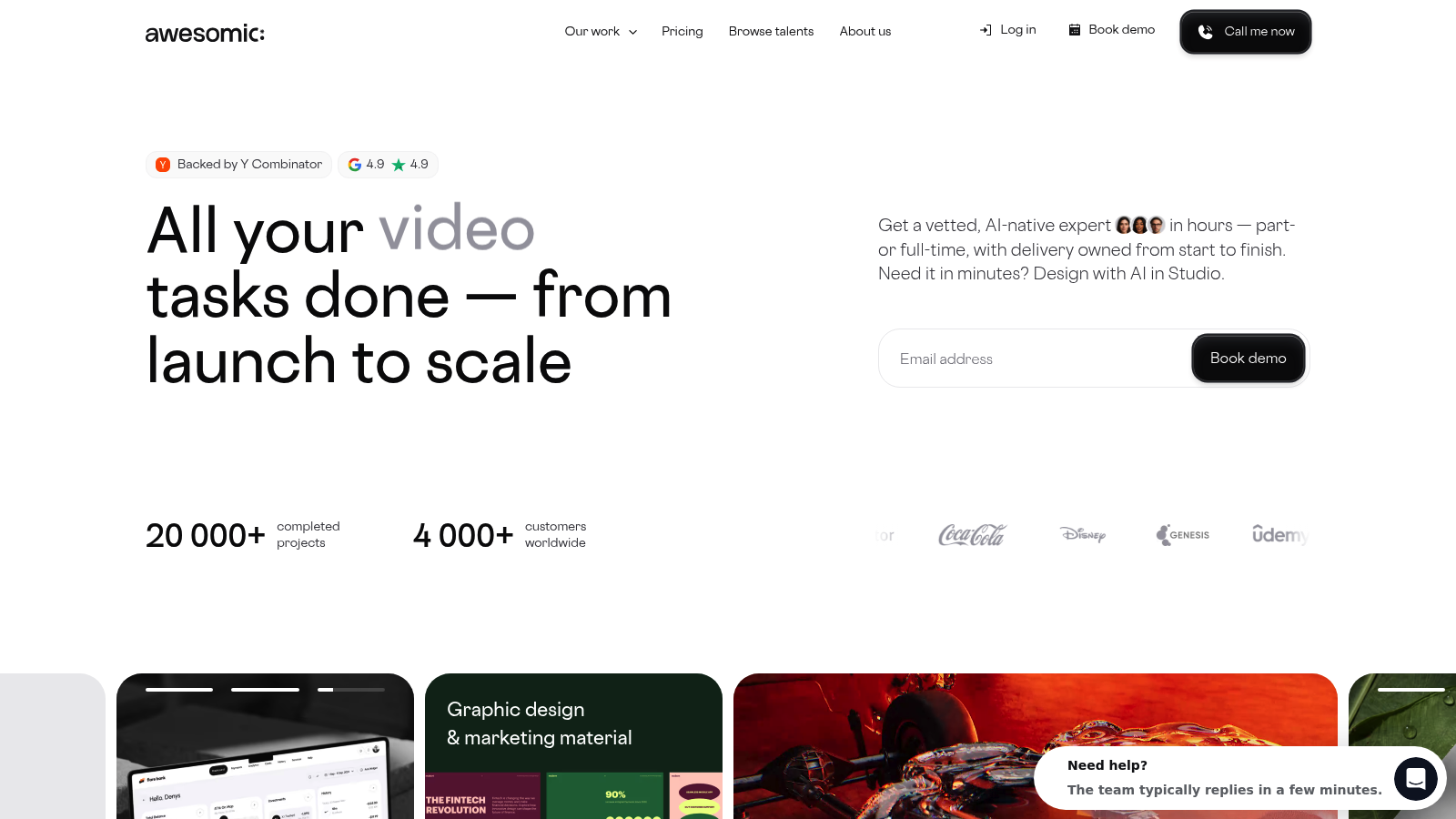
Strongest at: identity work plus the endless stream of assets it creates afterward.
Most branding engagements end at the wrong moment. You receive a logo, a type system and a PDF of guidelines, and then discover that nobody is available to apply them to the website, the deck, the ads and the email templates. The identity is finished; the brand is not.
Awesomic is built for that second half. We're a San Francisco subscription service: post the work, meet the matched specialist the same day, and keep revising until the piece is right. Brand identity, web design, no-code build, motion and copy all run through the same monthly fee, which means the rebrand and its rollout are the same engagement rather than two procurement cycles.
NGT Academy shows the shape of it. The Y Combinator-backed IT school rebuilt its entire brand, website, ads, email and decks through one subscription across roughly four months and eight tasks. The identity came first, four directions anchored on the school's existing yellow, refined through twelve iterations into a full system of color, gradients, typography, logo usage, icons and illustration. Then the site: copy rewritten page by page, every page redesigned in light and dark for desktop and mobile, plus an interactive IT Blueprint Pyramid.
One detail from that project says more about process than any award would. The typeface originally chosen turned out to be licensed for personal use only, and the problem was caught before anything shipped. Founder Terry Kim's summary afterward was that the brand finally looked like the caliber of program they run.
Services: brand identity and systems, logo and type, web design and Webflow build, motion and video, pitch decks, social and ad creative, copywriting.
Pricing: entry is Graphic Pack at $1,490 per month. All-in-One, which brings in no-code development, copywriting and QA, sits at $2,995. Billing quarterly takes twenty percent off either figure, to $1,190 and $2,396, against a three-month commitment. Dedicated Talent, a full-time designer alongside a dedicated PM, is priced on request.
Proof: over 4,000 businesses served and upwards of 20,000 projects shipped, 4.9 on Trustpilot and on Google Play, an 0.82 percent acceptance rate among applicants, backed by Y Combinator, and a Red Dot winner.
Honest limits: if you need brand valuation, portfolio architecture across a dozen business units, or category research to defend a board decision, hire a consultancy from this list instead. We do identity and execution extremely well; we are not a strategy house, and pretending otherwise would waste your time. You can judge the work directly from our case studies.

2. Interbrand

Strongest at: putting a defensible financial number on a brand.
Interbrand works from 622 3rd Avenue in New York and is best known for Best Global Brands, the annual brand valuation ranking it has published for decades. That methodology is the product as much as the design work is.
It is the firm you engage when a brand decision needs to survive a board or an investor conversation, and when the argument has to be quantitative rather than aesthetic.
Services: brand valuation, brand strategy and architecture, identity design, brand experience.
How they engage: enterprise consulting retainers, with fees to match.
Why buyers shortlist it: almost nobody else can attach a credible dollar figure to brand equity, which is a specific and occasionally decisive need.
3. Siegel+Gale

Strongest at: making complicated organizations legible.
Siegel+Gale operates from 622 Third Avenue in New York, a floor away from Interbrand in the same building, and has built its practice around simplicity as a strategic discipline. Its work concentrates in financial services, healthcare, professional services and energy, the sectors where complexity does most damage.
Naming is a genuine specialism here rather than a line item, which matters if a merger or spin-off is what triggered the project.
Services: brand strategy, naming, simplification, identity design, brand activation.
How they engage: scoped consulting projects, typically enterprise scale.
Where it fits: mergers, spin-offs and repositionings where the core problem is that customers cannot understand what you sell.
4. Vault49

Strongest at: brands that have to win on a physical shelf.
Vault49 works from Varick Street in New York and describes itself as a brand and innovation agency. Its center of gravity is consumer packaged goods, where identity, packaging structure and shelf impact are one problem rather than three.
The firm publishes design commentary and participates in industry conversation, including an AIGA Design Podcast appearance, though it does not maintain a formal awards page.
Services: brand identity, packaging design, brand innovation, campaign creative.
How they engage: project-based, often tied to a launch or range extension.
Its real strength: packaging is unforgiving in a way screen design is not, and firms that are genuinely good at it are rarer than the category suggests.
5. Gretel

Strongest at: identity systems built to flex across a lot of content.
Gretel operates from Clifton Place in Brooklyn and is known for brand systems in media, entertainment and technology. Its work tends to be built for volume from the start, which is the right instinct for any brand that ships something new every week.
Expect a systems-first conversation rather than a logo-first one.
Services: brand identity, design systems, motion and brand expression, digital design.
How they engage: defined projects with a discovery phase up front.
Why it earns a place here: a system that survives a thousand applications is a harder brief than a mark that looks good on one slide, and this is the kind of studio built for it.
6. Athletics

Strongest at: brands with something substantive to say.
Athletics is a Brooklyn brand studio on North 6th Street whose work has a distinctly editorial quality, with typography doing much of the heavy lifting. Its client base skews toward culture, education and technology organizations.
If your brand's value is in ideas rather than a product photograph, that emphasis is an asset.
Services: brand strategy and identity, typography and editorial systems, digital design, publication design.
How they engage: project-based.
Where it beats the alternatives: on brands that live through writing and thinking rather than imagery, where most identity work quietly underperforms.
7. Firebelly Design

Strongest at: mission-led organizations that need to look serious.
Firebelly is a Chicago studio working across brand, strategy and digital, with a long-standing focus on nonprofits and social-impact organizations. It is also the one firm on this list that publishes a substantive awards record: Webby Awards, Fast Company Innovation by Design Awards, a Cooper Hewitt National Design Archives nomination, Communication Arts Awards, an ADC Awards shortlist and Type Directors recognition.
That record is genuine and verifiable on the studio's own site, which is exactly the standard the rest of this category fails.
Services: brand identity, brand strategy, web design and build, campaign and print.
How they engage: project-based, with a stated interest in mission alignment.
Why buyers shortlist it: a nonprofit brief handled by a studio that takes nonprofits seriously produces a different result than one handled as a discount commercial project.
8. Tether

Strongest at: brands that exist as objects as well as logos.
Tether, Inc. works from 1st Avenue South in Seattle and combines branding with industrial and packaging design under one roof. That combination is unusual and genuinely hard to assemble from separate vendors.
If your product has a physical form, a retail presence and a digital footprint, having one team hold all three prevents the usual drift between them.
Services: brand identity, industrial design, packaging, retail environments, digital.
How they engage: project-based, often spanning several disciplines at once.
Where it fits: consumer hardware, beverage, retail and any category where the object and the identity have to agree.
9. T3

Strongest at: grounding brand decisions in consumer research.
T3 runs from Comal Street in Austin, with additional presence in Los Angeles and London, and leads with consumer insight and strategic marketing rather than pure design. Its practice sits closer to the marketing side of branding than most firms here.
That makes it a fit for large consumer brands where the brand question is really a segmentation question.
Services: consumer insight and research, brand strategy, marketing strategy, experience design.
How they engage: retainers, typically with larger organizations.
Its real strength: it will argue with your assumptions using data, which is uncomfortable and frequently the point.
10. Emotive Brand

Strongest at: B2B and technology companies that sound like everyone else.
Emotive Brand works from 2nd Street in Oakland and describes itself simply as a brand strategy and design firm, with a homepage promise to align business, brand and culture into one force. The name is the thesis: it treats how a brand makes people feel as a strategic variable rather than a decorative one.
Expect positioning and messaging work to lead, with visual identity following from it.
Services: brand positioning and strategy, messaging, identity design, employer brand.
How they engage: consulting projects with a strategy phase up front.
Why it made this list: B2B brand differentiation is genuinely difficult, and a firm that has chosen it as a specialism beats a generalist on that brief.
11. Perky Bros

Strongest at: small, high-craft identity work with senior attention.
Perky Bros is a Nashville studio on Chestnut Street producing carefully made identity work for boutique, hospitality and professional clients. It is deliberately small, which is the point: the people you meet are the people who do the work.
That is the trade a small studio offers, and it is a real one if your project is a good fit for the size.
Services: brand identity, print and packaging, art direction, web design.
How they engage: project-based, with limited concurrent capacity.
Where it beats the alternatives: on projects where senior craft matters more than scale, and where a large agency would hand you to a junior team anyway.
12. SDCO Partners

Strongest at: brands people walk into.
SDCO Partners works from Charleston and describes itself as a branding and interior design studio, an unusual pairing that makes complete sense for hospitality and retail. The brand and the room get designed by the same people.
For a restaurant group, a hotel or a physical retail concept, that removes the most common failure point, where the identity and the space feel like different companies.
Services: brand identity, interior design, environmental graphics, web and print.
How they engage: project-based, often tied to a property opening.
Why buyers shortlist it: very few firms can hold brand and physical space in one engagement, and separating them usually shows.
What branding costs in the US
Almost no branding agency publishes rates, so the ranges below reflect the tiers these firms operate in rather than quoted prices. They move with company size, scope and how much research sits in front of the design.
| Type of firm | Typical identity project | What you're paying for |
|---|---|---|
| Solo designer or small studio | $5,000 to $30,000 | Senior craft, narrow scope, limited capacity |
| Established independent studio | $30,000 to $150,000 | A full identity system and rollout guidance |
| Global brand consultancy | $250,000 upward | Research, architecture, valuation, governance |
| Subscription service | $1,490 to $2,995 a month | Identity plus continuous execution afterward |
The comparison most companies skip is the internal one. The Bureau of Labor Statistics puts 2024 median pay for advertising, promotions and marketing managers at $159,660 a year, and that is one salary, before a designer, benefits, software or recruiting time. Against that, a $60,000 identity project from an established studio is not the expensive option, it is the cheap one.
Scale is worth understanding too. Bureau of Labor Statistics data counts 39,052 advertising agency establishments operating in the United States, concentrated in California, New York, Texas and Florida but present in every state. The implication is that shortlisting is an exercise in exclusion, and the criteria you exclude on matter more than the ones you include on. We work through that filtering in more depth in our guide to finding a branding agency.
Questions that separate the finalists
By the time two or three firms remain, portfolios stop being useful because all of them look good. These questions do more work:
- Who actually does the design, and will they be in the meetings?
- What happens after delivery, and what does applying the brand to a new campaign cost?
- Can we see a project that went badly and what changed because of it?
- Who owns the files, the fonts and the source artwork when we are finished?
- What is the licensing status of every typeface in the proposal?
That last question is not pedantic. On the NGT Academy rebrand the chosen typeface turned out to be licensed for personal use only, which would have been an expensive discovery after launch rather than before it. Font licensing is one of the most common and least discussed liabilities handed to clients in this category.
The ownership question matters just as much, and the answer should be in the contract rather than in an email. Weighing an agency against other routes to the same work is covered in our comparison of creative sourcing options.
Making the decision
Match the firm to the job rather than to its reputation. A repositioning that has to persuade a board belongs with Interbrand, Siegel+Gale or Emotive Brand. A launch identity that has to be built and then used belongs with a studio or a subscription.
Be honest about the second half too. The identity is perhaps twenty percent of the work; the other eighty is applying it to everything you publish for the next three years. Firms that hand over guidelines and leave are not being negligent, that is the model, but you need a plan for what happens next. Our breakdown of subscription against freelance costs covers the arithmetic on that ongoing half.
And treat awards as the tiebreaker they are. Of the eleven firms here, one publishes an awards record, and it is a good studio, but so are the ten that publish none.
If you want identity work and the execution that follows it handled by the same team, that is what our branding service does.
FAQs
How much does a branding agency cost in the USA?
An established independent US studio typically charges $30,000 to $150,000 for a full identity system, while small studios and solo designers work in the $5,000 to $30,000 range. Global consultancies such as Interbrand or Siegel+Gale start around $250,000 and go considerably higher, because you are buying research, brand architecture and valuation rather than design alone. Subscription services price monthly instead, from $1,490, which changes the comparison once you account for the rollout work that follows any rebrand.
Do branding awards actually mean anything?
Less than the search volume implies. When we checked eleven established US branding firms, only Firebelly Design published an awards list at all, and the absence of one at the other ten says nothing about their quality. Most design awards also charge to enter, so results partly reflect which firms submit and how often. Juried design awards do indicate craft as judged by peers in a given year, which makes them a reasonable tiebreaker between two finalists but a poor filter for building a shortlist.
How do I verify a branding agency is legitimate before contacting them?
Open the firm's own site and look for a street address, then confirm the domain still belongs to the agency. Both checks matter. While researching this list we found that Hornall Anderson's domain now redirects to a Polish online casino, and that Butchershop, still listed as active in a 2026 roundup, has no website at all and only an Instagram profile. Directory listings and roundups are frequently years out of date, so treat them as a starting point rather than evidence.
Branding agency or design subscription: which should we hire?
A branding agency runs a defined project with a research or strategy phase, delivers an identity system and guidelines, and then the engagement ends. A design subscription is an ongoing monthly arrangement that covers identity work and everything the brand needs afterward, including web pages, decks, ads and social assets. Agencies are the better choice when the strategic question is genuinely hard. Subscriptions are the better choice when the volume of ongoing application is the real problem, which is the more common situation.
Who owns the logo and design files after a branding project?
It depends entirely on your contract, and the default is often not what clients assume. Under US copyright law the creator is the author unless there is a written agreement transferring rights, and logo design does not automatically qualify as work made for hire. Ask for an explicit assignment of copyright in writing before work starts. Ask separately about typefaces, since a font license is issued to a named entity for named uses and stays with whoever that license names.
One subscription and your hiring problems solved

FAQ


Awesomic is a revolutionary app that matches companies with vetted professionals across 30+ skill sets, from design and development to marketing and product. Based in San Francisco with a global core team, we offer a faster and more flexible alternative to traditional hiring through a subscription-based model. Awesomic delivers high-quality talent on demand, without the delays of recruiting.
We function as a subscription-based service that matches you to top-tier, vetted talent. Submit a project in just a few clicks and start receiving deliverables in as little as 24 hours. Scale your Awesomic plan up or down as your business needs change.
Every Awesomic subscription comes with unlimited revisions. You receive daily progress updates via the app, and you can provide feedback or request iterations as needed. If your project requires a different approach, you can request a talent rematch at any time, at no extra cost. You can also add teammates to collaborate and streamline feedback
A talent marketplace is a platform that utilizes data and intelligent matching algorithms to connect professionals with projects based on their skills, experience, and availability. While often used internally by large companies, Awesomic applies this model at scale, matching vetted global talent to your most critical business needs.
Hiring is time-consuming, expensive, and risky. Awesomic eliminates that problem. We rigorously vet all talent for technical ability, communication, and soft skills, ensuring only senior-level professionals work on your projects. You skip the job posts, interviews, and delays, and get straight to results.
No, Awesomic goes beyond design. While many clients utilize us for branding, UI/UX design, or motion graphics, we also provide vetted talent in no-code web development, product design, marketing, and more. Think of us as an extension of your team. A flexible, high-performing creative partner from planning to execution, whether you're building awesome products or scaling your team.
You can talk directly with your matched talent via the Awesomic app, connect via Slack, email, or schedule video calls. No matter the plan, you’ll receive daily updates in the app for every active task. You can also tag us in for any issues through our in-app customer chat.


