




12 Best Social Media Video Agencies for Brands in 2026

Key takeaways:
- Social video agencies split four ways: in-house studios, creator networks, paid-social creative specialists and full-service social teams. They are priced and staffed completely differently.
- The creator economy has a formal footprint. Federal labor data counts 40,861 US independent artist, writer and performer establishments, at an average annual wage of $162,062.
- If your brand video is likely to reach under-13s, COPPA applies to what you collect, and "we didn't mean to target children" is not the test the rule uses.
- Ask any agency its monthly asset count and who appears on camera. Those two answers predict cost and risk better than the showreel does.
Brands do not struggle to make one good social video. They struggle to make sixty a quarter that still look like the same company.
That is a production-systems problem rather than a creative one, and it is why the agencies in this category look so different from film production companies. The good ones are built around throughput, formats and reusable components, not around shoot days.
Below are twelve worth knowing, sorted by model. We're first, and we are explicit that if your plan depends on other people posting for you, several firms here will serve you better than we can.
The four models, and what each is actually selling
In-house studio agencies own production capacity directly: cameras, editors, sometimes a physical studio. You brief them and they shoot. Sociallyin, Fresh Content Society and Luminous Studios work this way, and the advantage is speed with no third-party dependency.
Creator and influencer networks do not make the video themselves. They match your brand to creators who do, then handle contracting, briefing, rights and measurement. Viral Nation, Whalar, Socially Powerful and Billion Dollar Boy sit here. You are buying access and operations, and the creative voice is deliberately not yours.
Paid-social creative specialists produce ad creative built for performance, usually at high variant counts, and iterate against results rather than taste. Vidsy and Shuttlerock work this way. Volume and testing discipline are the product.
Full-service social agencies own the whole channel: strategy, calendar, community, paid and content. Movers+Shakers and Trendy Grandad lean here, with strong creative on top.
Several firms straddle this line and lead with whichever half the buyer asked about, a pattern we also see among design marketing agencies. The expensive mistake is buying a creator network when you needed a studio, or vice versa. A creator program cannot produce a consistent brand library, and a studio cannot manufacture the authenticity a creator brings, because the whole value of creator content is that it does not look like the brand made it.
What COPPA means for brand video
This section is missing from every social video roundup we read, and it is a real exposure rather than a theoretical one.
The FTC's Children's Online Privacy Protection Rule, 16 CFR Part 312, defines a child as an individual under the age of 13 and requires operators of services directed to children to obtain verifiable parental consent before collecting, using or disclosing personal information from them.
Two details matter for brand social video specifically.
First, the rule recognizes a mixed audience category: a service that is directed to children under the rule's criteria but does not target children as its primary audience. Plenty of brand content lands here without anyone intending it. Animated characters, bright color, toys, games, music and child-appealing talent are among the factors that push content into that classification, regardless of who you had in mind.
Second, the analysis follows the content and the audience rather than your stated intent. A brand that is not aimed at children but produces content with obvious child appeal, on a platform used heavily by minors, is making a compliance decision whether or not it knows it.
The practical steps are unglamorous: know whether your content is likely to reach under-13s, mark it correctly with the platform's audience settings, and make sure any data collection sitting behind it, including pixels, remarketing and comment-based engagement, is handled accordingly. If you run creator campaigns, this needs to be in the creator brief rather than assumed.
Ask an agency how it handles audience classification. A firm that has run into this before will answer immediately; one that has not will treat it as your problem.
The 12 best social media video agencies for brands
The table groups by model, since that decision precedes vendor choice. Locations come from each agency's own site, which matters if you specifically need a US-based partner.
| Agency | Model | Best for | Based in | US presence |
|---|---|---|---|---|
| Awesomic | Subscription creative | Social assets plus the design around them | San Francisco, CA | Yes |
| Sociallyin | In-house studio | Social content with production built in | Atlanta, GA | Yes |
| Fresh Content Society | In-house studio | Always-on social management | Highland Park, IL | Yes |
| Luminous Studios | In-house studio | Social-first video production | New York and Los Angeles | Yes |
| Movers+Shakers | Full-service social | Culture-led campaigns and TikTok | New York, NY | Yes |
| Trendy Grandad | Full-service social | Social-first video across markets | Manhattan and London | Yes |
| Billion Dollar Boy | Creator network | Creator-led campaigns at scale | New York and London | Yes |
| Whalar | Creator network | Creator partnerships and talent | US and UK | Yes |
| Viral Nation | Creator network | Large creator programs plus technology | Toronto, Canada | Via Canada |
| Socially Powerful | Creator network | Multi-market influencer video | London, with New York office | Yes |
| Vidsy | Paid-social creative | Creator-made ads for paid channels | United Kingdom | Serves US brands |
| Shuttlerock | Paid-social creative | High-volume ad variants at speed | Global, multi-market | Serves US brands |
Where a firm operates in several countries, the final column reflects whether it publishes a US office rather than merely serving US clients.
1. Awesomic
Model: design and creative subscription.
Social video never travels alone. The campaign needs thumbnails, the landing page it points at needs building, the packaging in the shot needs designing, and the whole thing needs to look like one brand across a dozen formats.
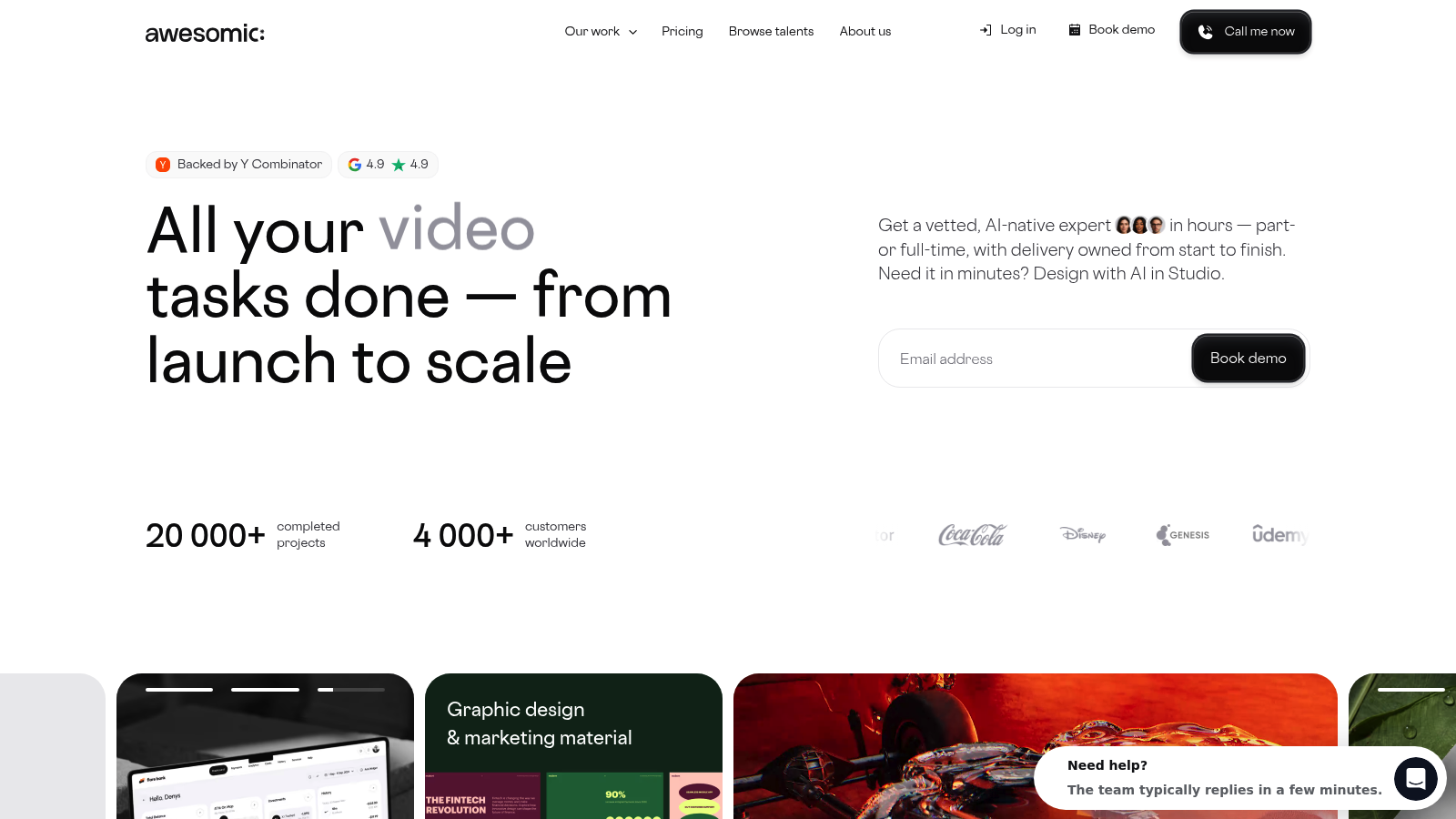
Awesomic covers that surrounding surface on a monthly subscription. Requests go into the app, a vetted specialist starts within hours, revisions are uncapped, and social creative shares a plan with web, brand, packaging and motion.
Yerbaé shows the model over a long horizon. The zero-sugar energy drink brand worked with us for more than a year, and the range is the point: packaging design for the Raspberry Sorbet and Peachy Mimosa Twist launches, landing page templates built for influencer campaigns and celebrity partnerships, a steady stream of social assets around each launch, and a Penn State collaboration on a campus Blue Razz flavor.
To be accurate about what that engagement was: it was design and brand assets rather than video production. The reason it belongs in this article is that it is the same operating problem a social video program has, which is producing consistent branded output continuously, across formats, for a consumer audience that sees all of it together.
Services: social and ad creative, motion graphics and animated cutdowns, illustration systems, packaging and label design, landing pages, brand identity, presentations.
Pricing: Graphic Pack runs $1,490 a month, All-in-One $2,995, with the latter adding no-code build, copywriting and QA. Switching to quarterly billing over a three-month term takes them to $1,190 and $2,396. There is also Dedicated Talent, pairing one full-time creative with a PM, priced on request.
Proof: more than 20,000 projects for over 4,000 companies, 4.9 on Google Play and on Trustpilot, 0.82 percent of applicants accepted, Y Combinator backed.
What we are not: creator and influencer programs sit outside what we do, as does contracting talent and buying media. If the plan depends on fifty creators posting in a fortnight, hire Whalar, Billion Dollar Boy or Viral Nation. Our graphic service covers the assets around those campaigns.

2. Sociallyin
Model: in-house studio.
Sociallyin works from Zonolite Road in Atlanta and describes itself as a social media agency with an in-house studio, which is the detail that separates it from most social shops.
Owning production means the strategist and the camera operator work for the same company, so an idea agreed on Monday can be shot on Wednesday rather than scheduled with a third party.
Services: social strategy, in-house video and photo production, community management, paid social, influencer.
Why buyers shortlist it: production capacity inside a social agency compresses the gap between idea and post.
3. Fresh Content Society
Model: in-house studio, always-on.
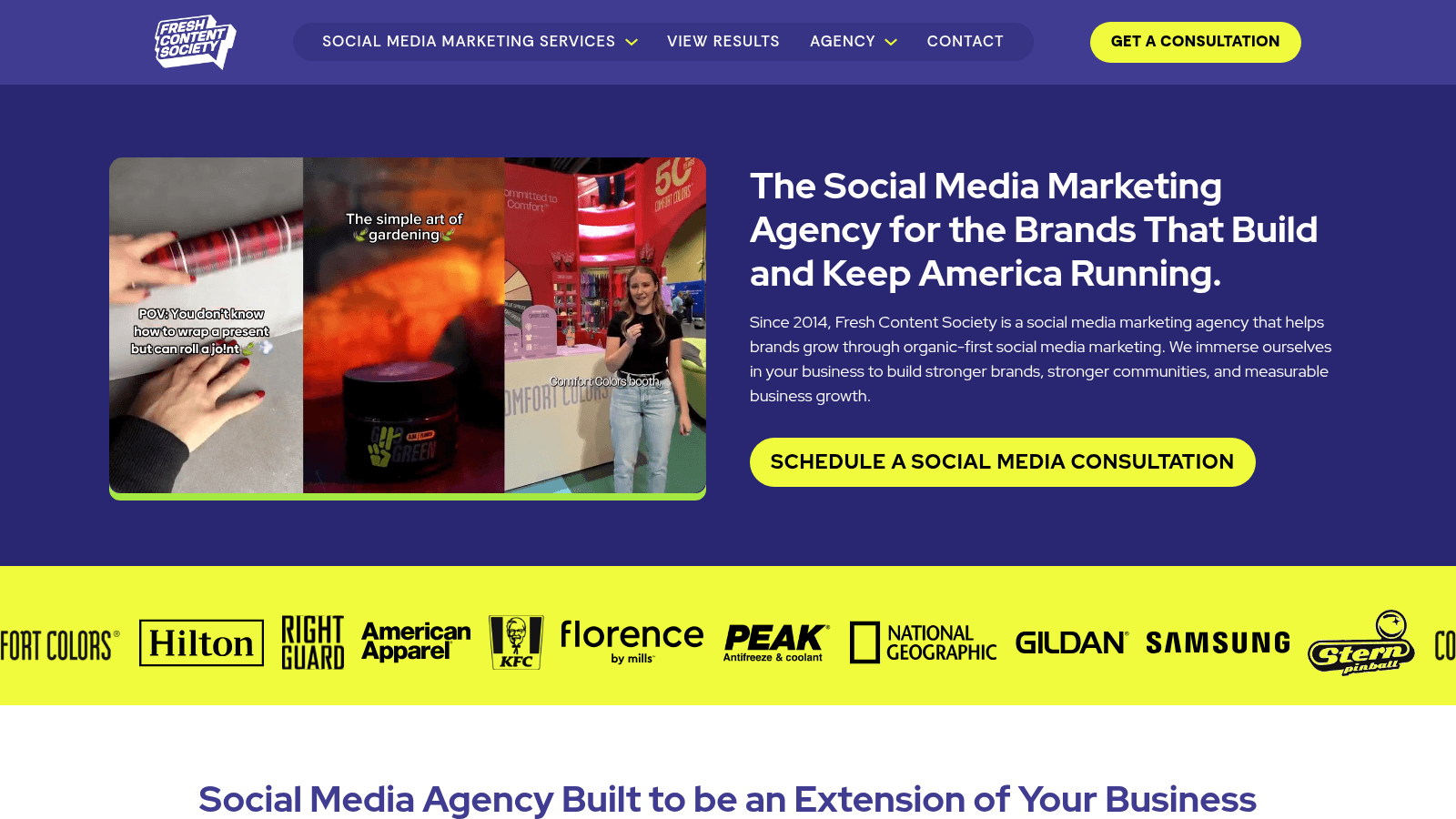
Fresh Content Society operates from Central Avenue in Highland Park, Illinois, running social as a managed function: content production, publishing, community response and paid.
It suits brands that need someone to own the channel completely rather than deliver campaigns into it.
Services: social media management, video and content production, paid social, community management.
Where it fits: companies with no internal social team that need the whole discipline run rather than only the assets made.
4. Luminous Studios
Model: in-house studio, production-led.
Luminous Studios produces social-first video with presence in New York and Los Angeles, coming at social from a production background rather than a social-management one.
That origin shows in finish quality, which matters for brands whose social output still has to look considered rather than casual.
Services: social video production, brand content, commercial production, post-production.
Its real strength: production values in a category where a lot of output is deliberately rough.
5. Movers+Shakers
Model: full-service social, culture-led.
Movers+Shakers builds campaigns around cultural moments, and is best known for TikTok work that behaves like native content rather than advertising placed on the platform.
This is campaign thinking. Hire it for a moment you want to create, not for a calendar you need filled.
Services: social campaign creative, short-form video, creator collaboration, brand strategy for social.
Where it beats the alternatives: when the goal is participation and reach rather than a steady content drumbeat.
6. Trendy Grandad
Model: full-service social, production-first.
Trendy Grandad runs a Manhattan headquarters at The Farm Soho on Broadway alongside a London base, describing itself as a social-first video production company.
The transatlantic structure is genuinely useful for brands running the same campaign in both markets without briefing two agencies.
Services: social-first video production, content strategy, campaign production, editing.
Why it earns a place here: US and UK production from one team, at a scale that still answers the phone.
7. Billion Dollar Boy
Model: creator network.
Billion Dollar Boy works from Hudson Street in New York alongside London, positioning as a social agency built on creator instinct, combining influencer strategy with in-house creative.
The hybrid matters: many creator networks only broker relationships, while this one also shapes what gets made.
Services: creator campaigns, social strategy, content production, paid amplification.
Where it fits: brands wanting creator authenticity without surrendering creative direction entirely.
8. Whalar
Model: creator network and talent.
Whalar operates across the US and UK as a creator economy group spanning campaigns, talent management and creator services.
Its breadth suits long-term creator programs rather than one-off activations, particularly where you want continuity with the same creators over time.
Services: creator campaigns, talent management, social strategy, content licensing.
Its real strength: treating creators as long-term brand assets rather than media placements.
9. Viral Nation
Model: creator network at scale, with technology.
Viral Nation is headquartered in Toronto and runs large creator and influencer programs, with proprietary technology for talent matching and brand safety alongside the services business.
Brand safety is the reason to look here specifically. At scale, vetting hundreds of creators manually stops being feasible.
Services: influencer and creator campaigns, talent management, social strategy, brand safety technology.
Why buyers shortlist it: programs large enough that operations and vetting, not creative, become the constraint.
10. Socially Powerful
Model: creator network, multi-market.
Socially Powerful is a global influencer marketing agency headquartered in London, and states that it operates a major office at 30 Wall Street in New York alongside other international locations.
Its value to US brands is coordinated activity across several territories, which is difficult to run from a single-market agency.
Services: influencer marketing, social video content, paid social, global campaign management.
Where it fits: campaigns that must run in several countries at once with local creator knowledge in each.
11. Vidsy
Model: paid-social creative specialist.
Vidsy produces creator-led video ads for paid social channels, working with a network of creators to generate ad variants built for specific placements rather than repurposed from other formats.
This is advertising production rather than brand content. If the videos exist to be paid against, that focus is the right one.
Services: creator-led video ads, paid social creative, ad variant production, creative testing.
Where it beats the alternatives: when media spend is significant and creative fatigue is the actual bottleneck.
12. Shuttlerock
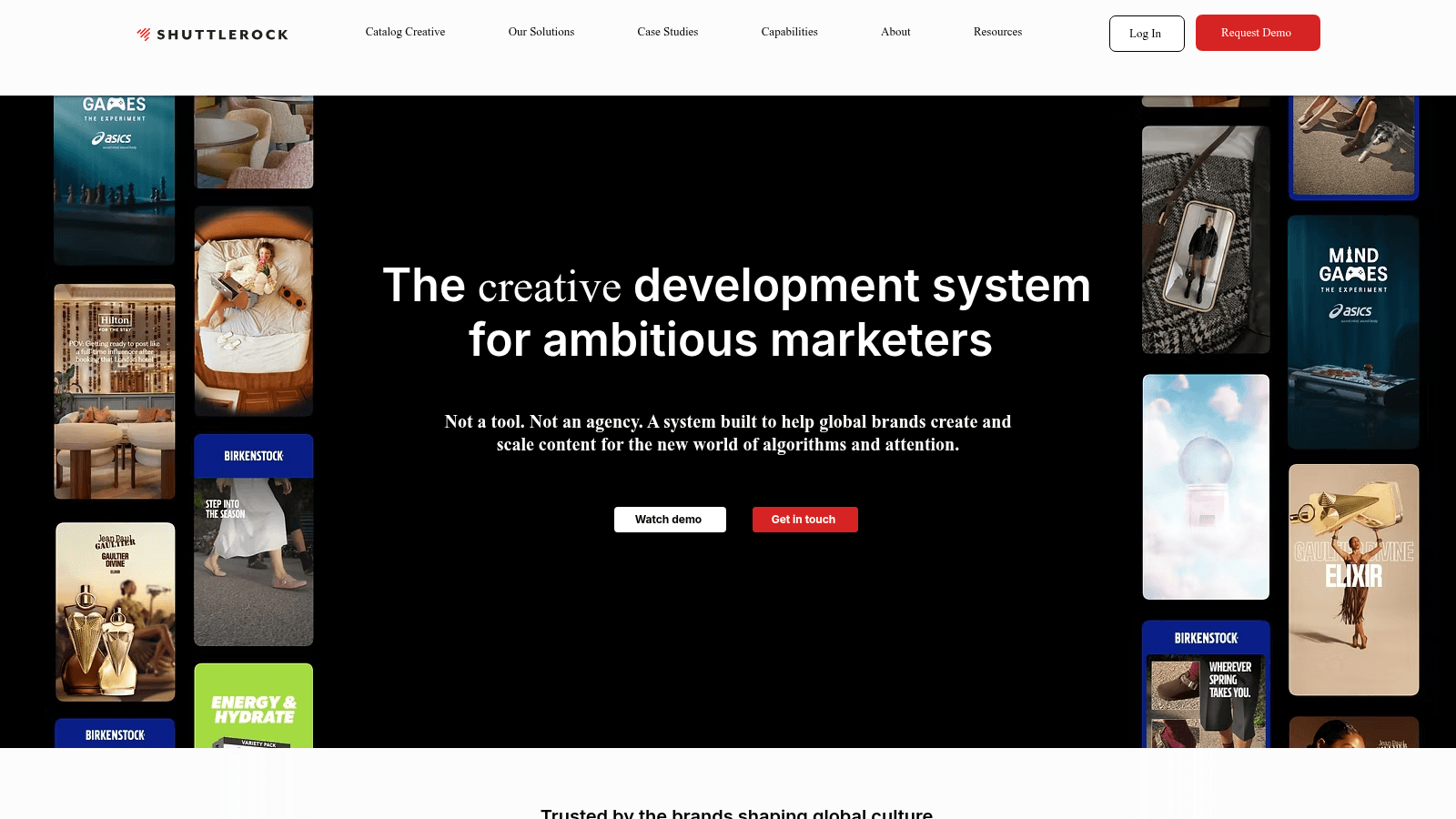
Model: paid-social creative at volume.
Shuttlerock operates as a creative development system across multiple markets, turning existing brand assets into large numbers of platform-ready video variants quickly.
Its distinguishing capability is generating many formats and sizes from material you already own, which is a different economic proposition from originating everything.
Services: video ad production at scale, creative adaptation, format and localization variants.
Why it made this list: most brands have more usable footage than they realize, and this model monetizes it.
What social video costs
Pricing in this category is unusually opaque, because "a video" ranges from a fifteen-second edit of existing footage to a shoot with talent. The ranges below reflect the tiers these firms work in.
| Option | Monthly cost | Approximate output |
|---|---|---|
| Freelance editor working from your footage | $2,000 to $6,000 | Roughly 4 to 12 edited assets |
| Design and creative subscription | From $1,490 a month | An open queue spanning formats |
| In-house studio agency retainer | $8,000 to $30,000 | Managed calendar plus shoots |
| Full-service social retainer | $15,000 to $50,000 | Strategy, content, community, paid |
| Paid-social creative specialist | $5,000 to $25,000 | High variant counts for ads |
| Creator or influencer program | $25,000 upward | Creator fees plus management |
Creator programs need reading carefully, because the agency fee and the creator fees are separate. A $25,000 program might be $15,000 to creators and $10,000 in management, and the split varies enormously between firms. Ask for it explicitly.
The market underneath this is now formal enough to measure. Federal data counts 40,861 independent artist, writer and performer establishments in the United States, employing about 61,000 people, at an average annual wage of $162,062. That is the professionalized end of the creator economy, and it explains why creator fees have stopped being negotiable in the way they were five years ago. Where volume rather than star power is the need, our monthly graphic design service covers the flat-rate alternative.
Briefing for volume without losing the brand
Social video programs fail on consistency rather than quality. These practices prevent the common failures:
- Define the formats once: aspect ratios, safe areas, caption style, logo treatment, opening frames.
- Build a component library so variants assemble from approved parts instead of starting blank.
- Set an approval SLA. A two-day review cycle destroys a channel that needs same-week response.
- Decide the sound-off experience deliberately, since most social video is watched muted.
- Put audience classification and disclosure requirements in the creator brief, not the contract appendix.
- Agree usage rights up front: how long, which channels, and whether paid amplification is included.
Point six is where money leaks. Creator content licensed for organic use only, then boosted as an ad, is one of the most common and most avoidable disputes in this category, and the fix costs nothing if it is agreed at the start. Point two is where the cost curve bends, since a library turns the fortieth asset into an assembly job rather than a new commission. Our comparison of on-demand design covers how that library gets built and maintained.
Choosing the right partner
Start with the number of assets you need each month, then the source of the creative voice.
Under roughly ten assets a month, a subscription or a freelance editor is the efficient answer, and an agency retainer will feel expensive for what arrives. Between ten and forty, an in-house studio agency earns its fee. Above forty, or across several markets, you need either a paid-social specialist geared for variants or a full-service team.
Then ask whose voice the content should carry. If it must sound like your brand, buy a studio or a subscription. If its persuasive power depends on not sounding like your brand, buy a creator network, and accept that you are trading control for credibility. Brands running both in parallel are common, and treating them as one budget line is how the creator side ends up over-directed and under-performing. The overlap with paid campaign work is covered in our roundup of advertising design agencies.
Finally, if you need a US-based partner specifically, note that four of the firms here are headquartered outside the United States even though several maintain New York offices. That distinction rarely appears in a directory listing.
For teams weighing agency retainers against flat-rate capacity, our design subscription overview sets out the arithmetic.
Agencies buying capacity to resell to their own clients work differently again, which our agency model is built around.
FAQs
How much do social media video agencies charge?
Expect $8,000 to $30,000 a month for an in-house studio retainer, $15,000 to $50,000 for full-service social, and $5,000 to $25,000 for a paid-social creative specialist depending on how many variants you need. Creator and influencer programs generally start around $25,000, though the agency fee and the creator fees are separate and the split varies widely, so ask for it explicitly. A design and creative subscription starts well below all of these, from $1,490 monthly, and covers production without channel management or media buying.
Which are the top social media video agencies in the US?
Among the firms here, Sociallyin in Atlanta, Fresh Content Society in Highland Park, Illinois, Luminous Studios in New York and Los Angeles, Movers+Shakers in New York and Trendy Grandad in Manhattan are US-headquartered. Billion Dollar Boy and Whalar operate substantial US businesses alongside UK bases. Viral Nation is Canadian, Socially Powerful is UK-headquartered with a New York office, and Vidsy and Shuttlerock serve US brands from outside the country. If a US entity matters for procurement or contracting, that distinction is worth confirming before the first call.
Do COPPA rules apply to brand videos on social media?
They can, and intent is not the test. The FTC's rule at 16 CFR Part 312 defines a child as anyone under 13 and requires verifiable parental consent before collecting personal information from children through services directed to them. The rule also recognizes a mixed audience category for content that meets the child-directed criteria without targeting children primarily, and factors such as animated characters, bright visuals, music and child-appealing talent all feed that assessment. Practically, classify your content correctly in platform audience settings and make sure pixels and remarketing behind it are handled accordingly.
Should we use a creator network or an in-house studio agency?
It depends whose voice should carry the message. An in-house studio agency makes content that sounds like your brand, with consistent quality and full creative control, which suits product education, brand storytelling and anything requiring accuracy. A creator network produces content that deliberately does not sound like your brand, which is exactly why audiences trust it, and you trade creative control for that credibility. Many brands run both, and the mistake is over-directing the creator side until it loses the quality it was hired for.
How many social videos does a brand need each month?
It depends on channel and goal rather than a universal number, but the useful planning question is how many you can approve rather than produce. Most programs bottleneck at review, not creation. Under ten assets a month, a freelancer or subscription is efficient. Between ten and forty, an agency with production capacity earns its fee. Above forty, you need a component library so variants assemble from approved parts, otherwise consistency degrades regardless of who is making them.
One subscription and your hiring problems solved


FAQ


Awesomic is a revolutionary app that matches companies with vetted professionals across 30+ skill sets, from design and development to marketing and product. Based in San Francisco with a global core team, we offer a faster and more flexible alternative to traditional hiring through a subscription-based model. Awesomic delivers high-quality talent on demand, without the delays of recruiting.
We function as a subscription-based service that matches you to top-tier, vetted talent. Submit a project in just a few clicks and start receiving deliverables in as little as 24 hours. Scale your Awesomic plan up or down as your business needs change.
Every Awesomic subscription comes with unlimited revisions. You receive daily progress updates via the app, and you can provide feedback or request iterations as needed. If your project requires a different approach, you can request a talent rematch at any time, at no extra cost. You can also add teammates to collaborate and streamline feedback
A talent marketplace is a platform that utilizes data and intelligent matching algorithms to connect professionals with projects based on their skills, experience, and availability. While often used internally by large companies, Awesomic applies this model at scale, matching vetted global talent to your most critical business needs.
Hiring is time-consuming, expensive, and risky. Awesomic eliminates that problem. We rigorously vet all talent for technical ability, communication, and soft skills, ensuring only senior-level professionals work on your projects. You skip the job posts, interviews, and delays, and get straight to results.
No, Awesomic goes beyond design. While many clients utilize us for branding, UI/UX design, or motion graphics, we also provide vetted talent in no-code web development, product design, marketing, and more. Think of us as an extension of your team. A flexible, high-performing creative partner from planning to execution, whether you're building awesome products or scaling your team.
You can talk directly with your matched talent via the Awesomic app, connect via Slack, email, or schedule video calls. No matter the plan, you’ll receive daily updates in the app for every active task. You can also tag us in for any issues through our in-app customer chat.


